Can Kin Productions’ IPO hit the right pitch in Singapore’s event tourism boom?
Its move into arts and culture reflects a broader strategic shift that began in 2024 when it established a design-and-build services unit
 Add BT as a preferred source

DeeperDive is a beta AI feature. Refer to full articles for the facts.
[SINGAPORE] Stepping into the newly opened IMBA Theatre at Gardens by the Bay, few would expect that homegrown sports event manager Kin Productions holds a 7.5 per cent stake in the venue.
The space, which hosts immersive exhibitions, currently features works by Colombian artist Fernando Botero and British artist David Hockney.
The investment aligns with Kin’s strategy of capitalising on the growth of Singapore’s event tourism sector, as it prepares for a potential listing on the Singapore Exchange (SGX) later this month.
“We have already made a conscious effort (to move) right into the space of event tourism, specifically into the arts and culture space, using retained earnings from our years of operation,” Vincent Chai, chief executive of Kin, told The Business Times. “But we are not stopping there.”
This reflects a broader strategic shift that began in 2024, when Kin moved beyond its core sports events business into the wider event tourism space and established its design-and-build (D&B) services unit.
Recognising that visitors attending its events were also contributing to the broader tourism economy, the group saw an opportunity to extend its capabilities.
Navigate Asia in
a new global order
Get the insights delivered to your inbox.
With 29 employees as at end-September, Kin’s core business is its events delivery and management segment. It acts as an end-to-end partner – overseeing projects from planning, through execution, to post-event wrap-up.
Meanwhile, its D&B segment focuses on the conceptualisation, design and construction of permanent experiences for galleries, museums and theme parks.
“We have proven ourselves adequately and strongly as an events delivery partner,” Chai said. “We want to go into experience creation (and) to own experiences.”
He added that owning experiences would allow the company greater control over its growth and enable it to export concepts across the region.
Rather than setting up permanent overseas offices, Kin intends to deploy teams into markets such as Jakarta, Malaysia and Vietnam on a project basis – an approach that he said avoids the cost inefficiencies associated with maintaining underutilised operations abroad.
Sports event business
Founded in 2017, Kin was established by Chai and his former colleagues from Cityneon, an entertainment company which was at the time listed on the Singapore Exchange (SGX).
Kin’s executive chairman Ko Chee Wah had served as Cityneon’s group managing director, during which he took the company public in 2005. Cityneon was later rebranded as Neon Global, and subsequently taken private in 2019.
Kin Productions started off with large-scale sports events. Among its earliest major projects were the OCBC Cycle and the Formula 1 Singapore Grand Prix in 2017.
The Kin team drew on their prior experience from working on the 2015 SEA Games in Singapore and the 2014 Nanjing Youth Olympic Games in delivering the projects.
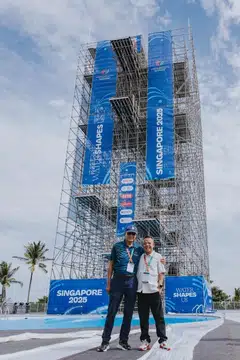
Subsequently, Kin was appointed the official contractor for the HSBC Singapore Rugby Sevens 2019. In the same year, the group was selected as the official event builder and Expo contractor for OCBC Cycle, Singapore’s largest annual cycling festival.
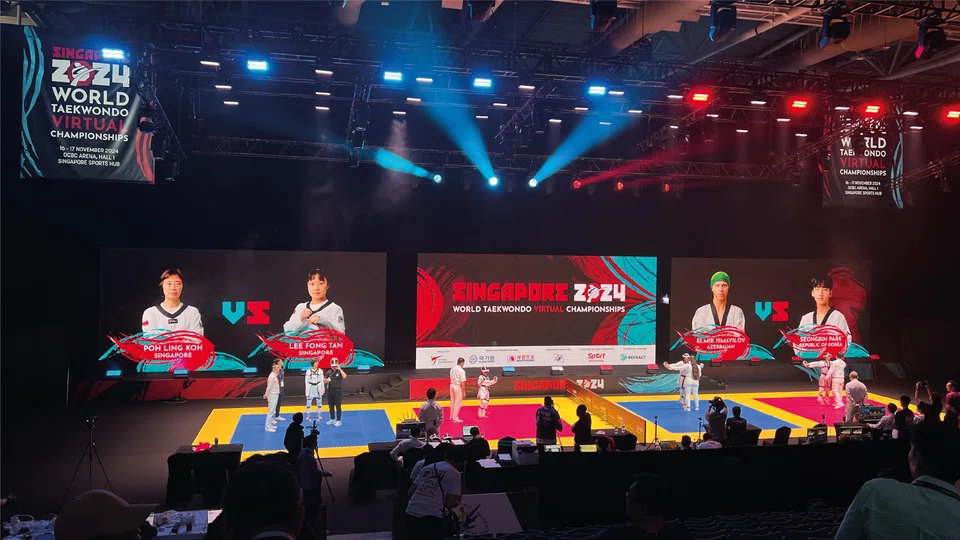
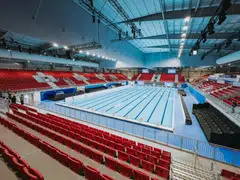
In recent years, its projects have included the World Aquatics Championships, the FIDE World Chess Championship Singapore 2024, and the Singapore 2024 World Taekwondo Virtual Championship.
In 2024, Kin held a 17.3 per cent share of Singapore’s sports events management market, according to its prospectus, citing Euromonitor data.
IPO plans
Now, the group wants to raise funds for further growth.
Kin’s executives told BT in a recent interview that the group is profitable, with revenue of S$56.5 million in the nine months ended 30 September 2025.
“We have quality management in our ranks that make sure that even if we take (on) a job at competitive prices, we are able to make a profit out of it,” said Ko.
Kin is seeking a Catalist listing as it believes this will enhance its public image locally and overseas. This will allow it to raise funds from capital markets to expand its business operations, particularly in the event tourism space.
Ko said this forms part of a broader, step-by-step growth strategy, noting that the company must first reach a certain scale before qualifying for the SGX mainboard.
“We do not want to learn to jump before we crawl – but at the rate we are growing, in two to three years’ time, we hope to be on the mainboard,” he added.
Ko also described a listing on the Singapore Exchange as akin to “winning a prize”, pointing to the stringent listing requirements.
These, he noted, include close scrutiny of a company’s financials, leadership, and governance, which together serve as a strong validation that a company has been thoroughly scrutinised by the investing community.
Looking ahead, Kin aims to strengthen its position in Singapore by delivering high-quality experiences across sports, entertainment, and arts and culture, with the broader goal of attracting more tourists to the country.
“A good event fills the stadium but it is not good enough for us… we want to do a great event (and) fill up cities,” he added.
Competition heats up
However, Kin’s foray into the event tourism space means it is entering a mature and highly competitive ecosystem. Established players in Singapore’s event tourism sector include Kingsmen Creatives, Constellar, Pico Group, Neon Group, and MP International.
In its preliminary prospectus, Kin highlights several key risks. These include the group’s ability to successfully secure new projects, competition from established and new entrants to the market, as well as the risk of decreased demand for new projects.
Chai identified four key pillars underpinning Singapore’s event tourism ecosystem: meetings, incentives, conferences and exhibitions (Mice); entertainment; arts and culture; and sports.
Attractions, cruise, events, and Mice have led to strong tourism spending here, noted Singapore Tourism Board (STB).
This momentum has translated into stronger tourism performance.
STB data indicated that tourism receipts reached S$23.9 billion in the first three quarters of 2025, a 6.5 per cent year-on-year increase, marking the highest recorded figure for the period. International visitor arrivals rose to 16.9 million over the same period, an increase of 2.3 per cent.
Looking ahead, STB expects arrivals to reach 17 million to 18 million in 2026, generating S$31 billion to S$32.5 billion in tourism receipts. The outlook, however, remains measured amid global economic uncertainty and geopolitical volatility affecting travel demand.
It is against this backdrop of sustained demand that Kin’s expansion becomes more relevant. Asked how it intends to leverage its strengths in sports event delivery to secure more projects in the wider event tourism space, Chai pointed to the transferability of its operational capabilities across segments.
He noted that while the “DNA” of sports, Mice and entertainment events may differ, their underlying objective is broadly the same: driving tourism into Singapore.
Chai noted that sports events, in particular, often involve far greater logistical complexity than other formats, given the scale of manpower coordination and operational execution required.
By contrast, he said, conferences tend to be more structured and contained, while entertainment and festival-style events sit somewhere in between.
The boundaries between these segments are increasingly blurred, said Ko. He cited the Formula 1 Singapore Grand Prix as an example of a hybrid event that combines motorsport with large-scale entertainment programming, drawing both sports fans and concert audiences.
“We are looking at sports events as a tourism driver as well,” he added.
He pointed to previous projects such as the Festival International des Sports Extremes (FISE), the world’s largest urban sports festival held at Somerset Skate Park and the newly revamped youth hub *Scape.
Ko also shared that the company is preparing to stage what could be one of Singapore’s largest pickleball tournaments this July, involving around 500 participants, including at least 150 overseas players. The event, he said, reflects the growing overlap between sports events and tourism flows.
He added that Kin has a “unique proposition (for) the market and investment community” as it is perhaps the only player in this space.
Decoding Asia newsletter: your guide to navigating Asia in a new global order. Sign up here to get Decoding Asia newsletter. Delivered to your inbox. Free.
Copyright SPH Media. All rights reserved.