SingPost H2 net profit falls 81.5% to S$41.2 million as traditional business worsens
This comes as operating environment for the logistics and letters business remains challenging
 Add BT as a preferred source

[SINGAPORE] Singapore Post ( SingPost ) on Thursday (May 14) recorded a net profit of S$41.2 million for its second half ended Mar 31, down 81.5 per cent from S$222.5 million in the year-ago period.
Shares of the national postal provider ended Thursday at S$0.355, down S$0.02 or 5.3 per cent, with some 26.2 million shares traded. This is 44.1 per cent lower than its closing price of S$0.635 a year ago.
The group’s earnings per share (EPS) for the half year stood at S$0.0183, versus an EPS of S$0.0989 in the previous corresponding period.
Revenue for the six months fell 18.2 per cent on the year to S$187.6 million, from S$229.5 million.
The postal and logistics player said the declines came “as the operating environment for the logistics and letters business, particularly in international e-commerce delivery, remained challenging”.
“While the post office network segment also showed a decline, property assets revenue remained relatively steady during the period,” it said.
Navigate Asia in
a new global order
Get the insights delivered to your inbox.
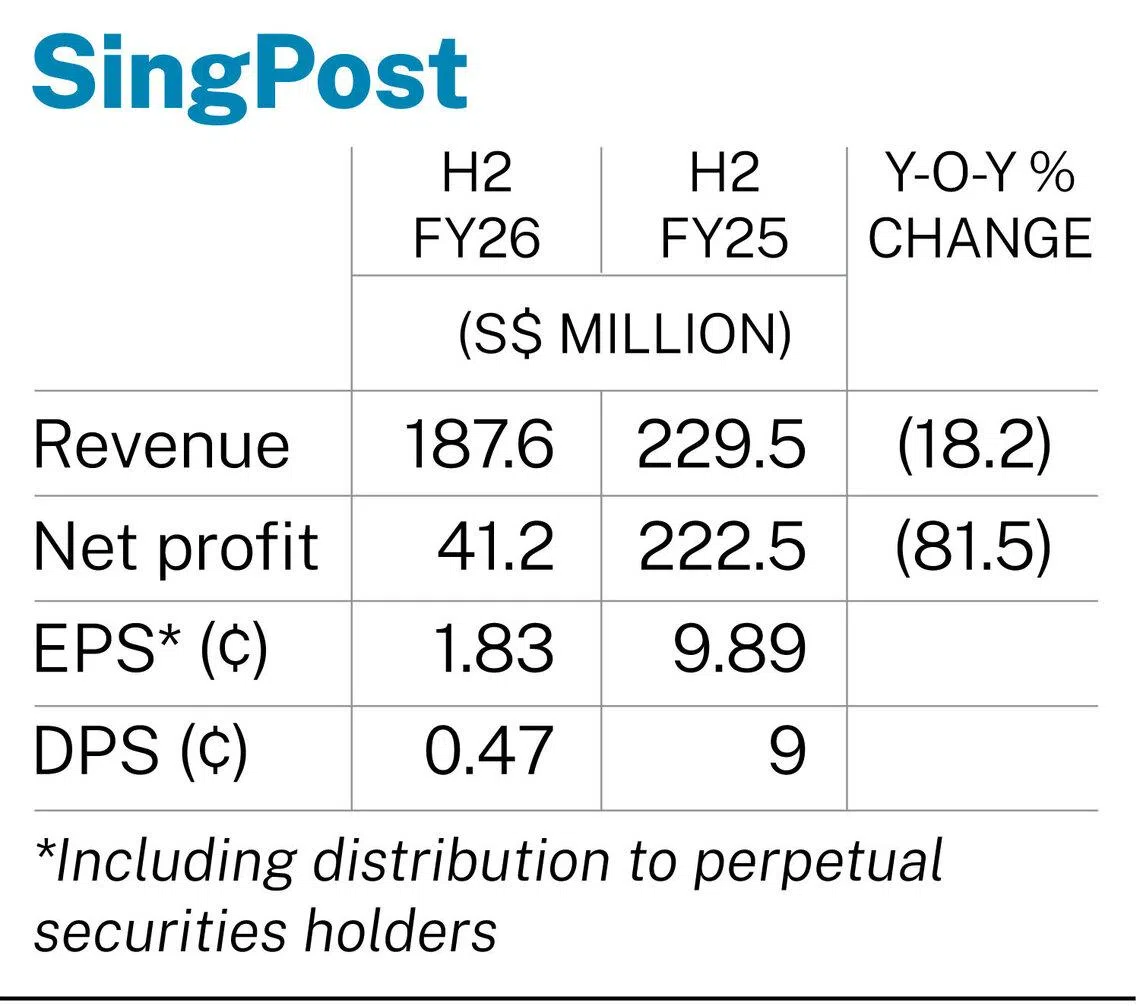
The board is recommending a final dividend of S$0.0006 per ordinary share, amounting to S$1.4 million, for the financial year ended Mar 31. Including the interim dividend of S$0.0008 per share paid out in December, total dividends amount to S$0.0014 per share.
Additionally, the board is recommending a supplemental dividend of S$0.0041 per ordinary share, amounting to S$9.3 million, for the financial year ended March.
The proposed dividends are subject to shareholder approval at its annual general meeting, which is to be convened. The payable date will be announced later.
For FY2026, SingPost’s revenue declined 23.1 per cent on the year to S$376.1 million from S$489.1 million.
The lower top line was attributed to a 55.2 per cent contraction in international revenue amid a volatile global macroeconomic environment, alongside the continued decline in letter mail volumes.
Reflecting softer international volumes, full-year operating profit fell 68.9 per cent year on year to S$11.8 million from S$37.9 million.
Net profit for FY2026 fell 75.2 per cent on the year to S$60.9 million, from S$245.1 million.
In tandem, full-year EPS stood at S$0.027, down from S$0.1089 previously.
Net asset value per share dipped to S$0.6335 as at Mar 31, from S$0.6979 in the year-ago period.
Mark Chong, CEO of SingPost, said the full-year results “reflect a consolidated baseline” from which the group will strengthen and scale its business.
“Our strategy outlines our road map to navigate evolving market dynamics and drive long-term shareholder value,” he added.
“By investing in technology and automation, focusing on asset enhancement in our property portfolio and working towards financial sustainability in our business, we are fortifying the core of SingPost while expanding purposefully into new logistics services.”
Growth strategy
SingPost outlined a three-pillar reset strategy for sustainable growth, alongside portfolio consolidation plans. The strategy’s three priorities are to strengthen core fundamentals, build scalable capabilities and capture growth priorities.
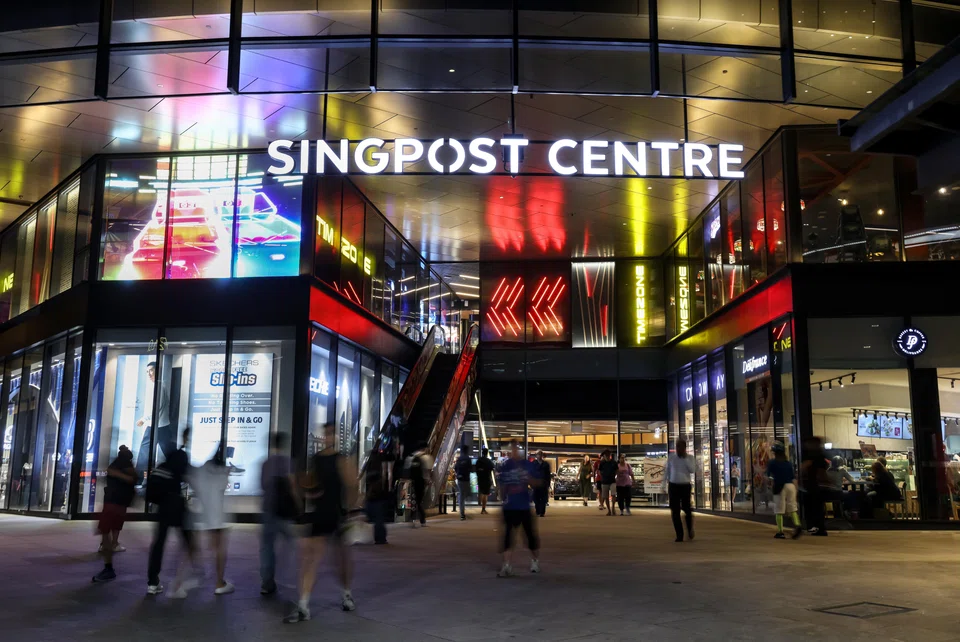
Notably, it will retain its flagship SingPost Centre as it is bullish about the upside potential of the building, which will remain a cornerstone of its property assets business.
The move marks a turnaround from the 2023/2024 decision of its former board to dispose the Paya Lebar headquarter building. Near-term plans to enhance the property for improved efficiency and yield are being weighed.
The group will leverage the government’s longer-term blueprint for the Paya Lebar region, to reap potential value-enhancing opportunities for the benefit of shareholders.
Chong said at a media briefing on Thursday that the shift in plans for SingPost Centre was made in tandem with the changing world.
“What we have seen is that with the turbulence out there in the world, it is better that we be more certain on our earnings... As we dive deeper into it, I think we have now fully realised the full potential of the Paya Lebar airport closure and plans around Paya Lebar, and we think there’s a lot more upside that we could reap.”
Isaac Mah, chief financial officer of SingPost, pointed out that it is in a “net cash” position – which means it has more cash than debt – when asked about capital outlay for the enhancement of SingPost Centre.
Although the amount required is not known, as SingPost has just started the project, Mah is confident that “we can make it work” given that its balance sheet is “a lot stronger”.
On whether there is nationalisation intention, Chong said: “No announcement, means no.”
The group is transitioning its logistics and letters business to an “improved operating model” over the next few years, to cope with shifting demand. It plans to integrate artificial intelligence and automation to cut costs by over 10 per cent, and improve processing capabilities through enhanced automation with autonomous vehicles and robotics.
SingPost aims to optimise footprint and operations for its post office network, which is “on a firm path to achieve commercial sustainability”. This is to drive value by improving rental income from post office properties and developing new revenue streams.
Decoding Asia newsletter: your guide to navigating Asia in a new global order. Sign up here to get Decoding Asia newsletter. Delivered to your inbox. Free.
Copyright SPH Media. All rights reserved.