Challenges push manufacturers to higher-value activities
Singapore
SINGAPORE'S manufacturers are grappling with an uneven recovery in external demand and falling global prices for certain goods on one hand, and domestic labour constraints on the other.
But the good news is that for two decades now, they have been moving away from resource-intensive activities towards high-margin capital-intensive ones, and Singapore's central bank expects that they will continue to do so, especially as trends such as cloud computing boost prospects for manufacturing-related services.
In its latest Macroeconomic Review, released on Tuesday, the Monetary Authority of Singapore (MAS) said that manufacturing firms have grown output volume by over six times from 1980 to 2013, thanks to steady labour productivity growth. Employment grew by less than 50 per cent over that period. Land intensity, estimated by the amount of real capital expenditure on land, buildings and structures for every unit of real total output, fell over that period too.
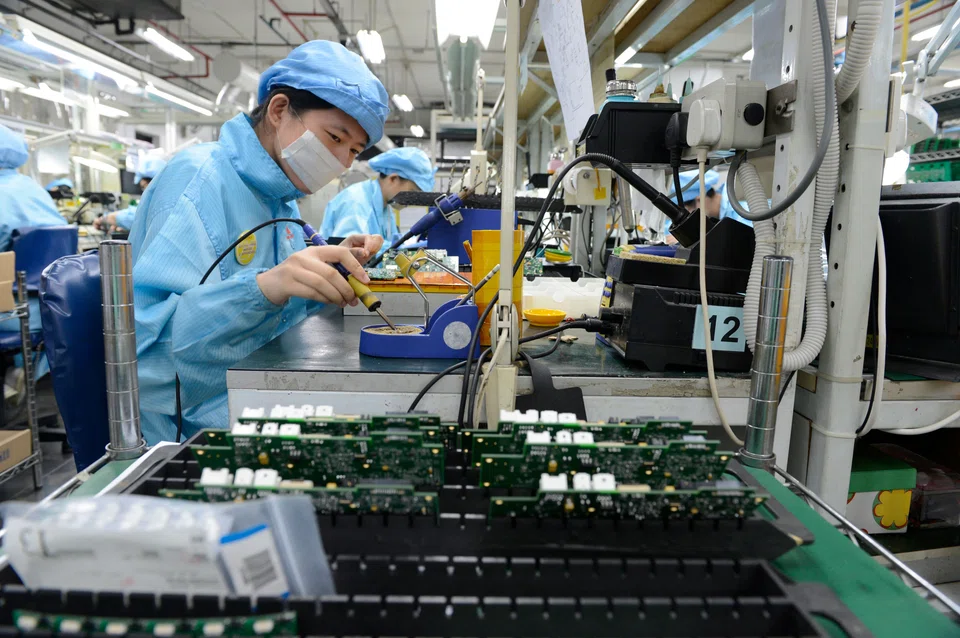
Singling the electronics sector out as a major driver of manufacturing's move towards higher value-added activities, MAS noted that the most recent phase - electronics manufacturers' shift into niche production and services - was induced by less than pleasant factors.
In recent years, the domestic IT industry has had to deal with domestic supply constraints and weak demand abroad, the review said.
At home, business costs have risen due to higher utilities, transport and operating costs, including outsourcing and R&D expenditures. Wage bills also grew due to the growing proportion of skilled labour manufacturers needed. At the same time, some local IT producers have faced falling global prices in their specific product lines. But this has prompted them to change their business models and shift towards higher value production, MAS said.
While some private-sector analysts have, in the past few years, questioned if electronics' poor domestic exports performance and a rise in export prices were signs that local exporters could be losing competitiveness, MAS' review provided a different take.
The unit value of IT goods did rise over the 2011 to 2013 period, the report said, reflecting a growing focus on products such as 300mm wafer fabrication and specialised chips used in smartphones, automotive engines and electronic passports. These could have contributed to a rise in price premiums.
And though the value of electronics domestic exports has fallen over the past three years, exports of IT-related services have risen significantly, the report added.
"The response by firms has been characterised by a leftward shift into upstream activities such as R&D, and a rightward shift into more downstream services," MAS said. And the shift to services-related activities is expected to continue. For instance, more fabless semiconductor firms based in Singapore are looking to expand their R&D and supply chain management operations here. These firms' contribution to total electronics output doubled from 11 per cent in 2010 to 23 per cent in 2010.
Then, there are favourable global trends. "Manufacturing related services, for instance, should be able to leverage on the rise of cloud technology, which has emerged as one of the fastest growing branches of the global IT industry," MAS said.
Read more: