

If you work for a listco your family controls, does pay incentivise you the way it would for an outsider?

IT'S that time of year again when we comb through the annual reports of listed companies to see how much their board members and top executives were paid for their professional efforts over the preceding financial year.
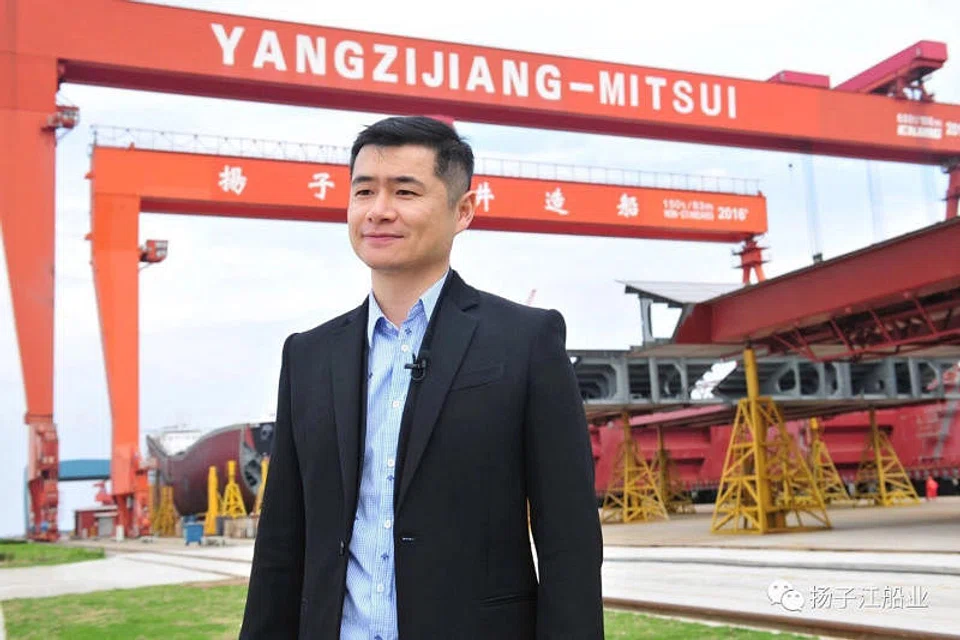
One company that stands out is Yangzijang Shipbuilding - not for how much its top brass are paid, but for how little.
Yangzijiang's executive chairman and chief executive officer, Ren Letian, received a salary of only S$80,400 for FY2021, according to the company's latest annual report. He did not receive any variable bonus, or directors' fees.
Ren Letian does not have to live on this salary alone, of course. As at end-2021, he held a deemed interest in nearly 165.8 million Yangzijiang shares. Those shares have a market value of some S$265.3 million, and will deliver S$8.3 million in dividends for FY2021.
Ren Letian has been CEO since May 2015 and took on the role of executive chairman in April 2020.
Ren Yuanlin - who is Ren Letian's father - was also seemingly lowly paid while he was executive chairman. He received a salary of just S$43,468 for FY2019, according to Yangzjiang's annual report for that year.
He is currently honorary chairman of Yangzijiang, and has a deemed interest in 852.8 million shares - or almost 21.8 per cent of the company's total outstanding shares.
Ren Letian and his father seem to set the tone for executive salaries at Yangzijiang. The total remuneration for top 6 key management personnel (including Ren Letian) for FY2021 was S$567,543.
Only one of them - chief financial officer Liu Hua - was paid more than S$250,000 for FY2021.
Some academics have hypothesised that family-controlled companies behave differently from non-family-controlled firms when it comes to incentivising top executives - and all the more so when those executives happen to be members of the family.
In the first place, there is less distance between ownership and control at these firms. Families are also sometimes said to take a longer-term perspective when it comes to making investments.
Moreover, families that have the bulk of their wealth invested in a single corporate group might assess risk differently from non-family shareholders. The failure of their business organisation would mean not just catastrophic loss of financial wealth but also the destruction of what some academics call "socioemotional" wealth.
So, are family-controlled firms less likely to incentivise their top executives to push for short-term growth? Are they naturally less impressed by high-priced managerial talent?
One study last year by scholars at Spain's University of Oviedo and Australia's Curtin University concluded that CEOs of family-controlled listed companies in Australia received lower total and variable pay. The study also found that there was less pay disparity between the CEO and other top executives at these firms.
It might be unwise to read too much into such academic exercises, though. Human beings are complex creatures, and the internal dynamics of every family with respect to their business interests are different.
The unfettered control of a public company by a single individual or family does not always lead to positive outcomes for non-family shareholders, even if it keeps a lid on top executive pay.
Still, it's interesting to survey top executive pay in the Singapore market through this lens.
Long-term performance
In particular, DBS CEO Piyush Gupta received total remuneration of nearly S$13.6 million for FY2021 - up 47.8 per cent from the nearly S$9.2 million he earned in FY2020, and 11.9 per cent ahead of the S$12.1 million he earned in FY2019.
On the other hand, UOB CEO Wee Ee Cheong's FY2021 remuneration of more than S$10.9 million was up 11.5 per cent against the S$9.8 million he earned in FY2020 and almost level with the S$10.8 million he was paid for FY2019.
Few shareholders of DBS would begrudge Gupta his pay. He runs the biggest of the local banks, and DBS has grown strongly after he took the helm in 2009.
Since the beginning of 2010, DBS has delivered a total return (with dividends reinvested) of 249.4 per cent. OCBC and UOB have returned 109.4 per cent and 151.8 per cent, respectively.
But, Gupta's strong performance is yet to make up for the tough decade DBS shareholders endured after the Asian financial crisis. Since the beginning of 2000, DBS has delivered a total return of 220.5 per cent.
UOB - where Wee has been deputy chairman since 2000 and CEO since 2007 - returned 416.7 per cent. OCBC returned 368.1 per cent.
The stronger long-term performance of OCBC and UOB was the result of consistency. From 2000 to 2009, OCBC and UOB generated annualised returns of 8.4 per cent and 7.4 per cent, respectively. DBS delivered a negative annualised return of -0.9 per cent over the same period.
Since 2010, however, DBS has seen its annualised return soar to 10.7 per cent. OCBC and UOB delivered annual returns of 6.2 per cent and 7.8 per cent, respectively.
So, family-controlled companies are better for long-term shareholders - right? Not so fast.
The performance of family-controlled companies varies widely. Within the property sector, City Developments (CDL) has delivered a total return of just 27.6 per cent since the beginning of 2000, while UOL Group and Hongkong Land generated far superior total returns of 972.4 per cent and 645.8 per cent, respectively.
The problem with family controlled-companies, however, is that management may not fundamentally change when things go wrong.
At CDL, there was turnover in non-executive and independent directors following its failed investment in Sincere Property Group. But CDL's executive chairman and CEO remain in their positions.
Give investors information
One lesson from this is perhaps that family-controlled companies should not remunerate family members on exactly the same basis as non-family members.
Boards should try to understand the socioemotional aspect of top executive positions that are given to family members. If the bulk of their family's wealth, social standing and prestige is already invested in the company, how effective would variable bonuses be as a performance incentive?
It might also be worth considering the job mobility of these family members. What risk is there of UOB's Wee crossing the street to OCBC? Would CDL's Sherman Kwek ever seriously contemplate a career at CapitaLand Investment?
This column is not suggesting that family members should be paid nothing, but that getting the best out of them might not be about big bonuses.
Instead of trying to incentivise family members to work for investors, perhaps boards of family-controlled companies should provide disclosures to enable investors to better understand the motivations of those family members.
For instance, Yangzijiang's Ren Yuanlin could provide information about when and under what circumstances his 21.8 per cent deemed interest in the company would pass to his son or other members of his family.
It might be useful for him to explain why one of Yangzijiang's co-founders Wang Dong turned over his 10.1 per cent stake in the company last year to an employee benefit trust. How will these shares be administered for the benefit of employees?
Yangzijiang should perhaps also explain why the nearly 550.8 million yuan (S$117.9 million) worth of interested party transactions involving Ren Yuanlin during FY2021 were necessary.
A better understanding of the Ren family, its internal dynamics and its peripheral business interests would promote a better understanding of Yangzijiang.
RELATED ARTICLE: Chief executives at 13 STI companies receive higher remuneration in 2021
TRENDING NOW

UOB found ‘grossly negligent’ over Stamford Land rights issue advice, to pay S$1.9 million
MAS allocates S$1.45 billion to five asset managers in third EQDP batch: Chee Hong Tat

He built the Vingroup empire. Now South-east Asia’s richest man is handing some key roles to his sons

NoMad Singapore marks brand’s arrival in Asia

