Six Dubai real estate bonds fall into distress as war rolls on
They represent about 15% of US dollar real estate bonds in the Middle East
 Add BT as a preferred source
DeeperDive is a beta AI feature. Refer to full articles for the facts.
BONDS issued by two Dubai property developers have fallen into distressed territory, with investor concern mounting over credit quality and refinancing risks as the war in the Middle East rolls on for a fourth week.
Six US dollar-denominated property bonds in the region are indicated at distressed levels, or trading with a yield spread of over 1,000 basis points above the risk-free rate, according to data compiled by Bloomberg. That represents about 15 per cent of US dollar real estate bonds in the Middle East.
The bonds, all Islamic notes, are issued by entities linked to Dubai-based Binghatti Holding and Omniyat Holdings, with a 2027 issue from Binghatti coming in as the most distressed.
Binghatti’s core business is mid-market housing, though it has also made a push into luxury projects, unveiling plans for a Mercedes-branded tower and one of the world’s tallest residential buildings. Omniyat focuses on the ultra-luxury segment.
The once-hot sector has soured quickly. At the end of February, the widest-indicated bond was trading at less than half of the threshold associated with distress. But the Middle East’s primary bond market has been effectively shut since the war broke out, leaving issuers with limited refinancing options and increasing pressure on lower-rated names.
A representative for Binghatti said that the firm’s construction sites are fully operational and on schedule despite geopolitical tensions. “Cancellation rates remain below 1 per cent, consistent with historical norms, and March sales have hit approximately AED 500 million (S$174.1 million) per week, matching pre-crisis levels.”
Navigate Asia in
a new global order
Get the insights delivered to your inbox.
Omniyat said that it was “in a strong position, fully funded, with substantial contracted revenue providing over four years of revenue visibility”. Construction is active across all of the firm’s launched sites and there have been no purchase cancellations, the statement added.
Fitch Ratings has placed both Binghatti and Omniyat on watch for possible downgrades, citing the impact of geopolitical risk on demand and the risk of higher construction costs. Still, both companies entered this period of volatility with solid balance sheets, Fitch said.
Separately, Moody’s Ratings affirmed Binghatti’s rating, saying it has good liquidity over the next 12 months to cover its February 2027 maturity.
SEE ALSO

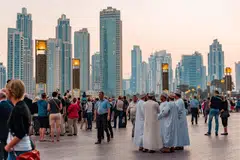
Before the war, property companies in the Middle East had been on a debt spree as they raced to secure locations for residential projects in Dubai and Abu Dhabi. That has created a growing wall of maturities, with about US$8 billion due by 2030.
“Dubai real estate names were the most affected by the situation”, with short selling by hedge funds contributing to a broad-based sell-off across the sector, said Zeina Rizk, co-head of fixed income at Amwal Capital Partners. “There are pockets of opportunities appearing, but some are waiting for better clarity on the outcome before stepping in.” BLOOMBERG
Decoding Asia newsletter: your guide to navigating Asia in a new global order. Sign up here to get Decoding Asia newsletter. Delivered to your inbox. Free.
Share with us your feedback on BT's products and services