

UBS CEO brings tech iteration to world of wealth management
That differentiating edge would allow the bank to capture a bigger share of the private-markets business, Ralph Hamers says
Singapore
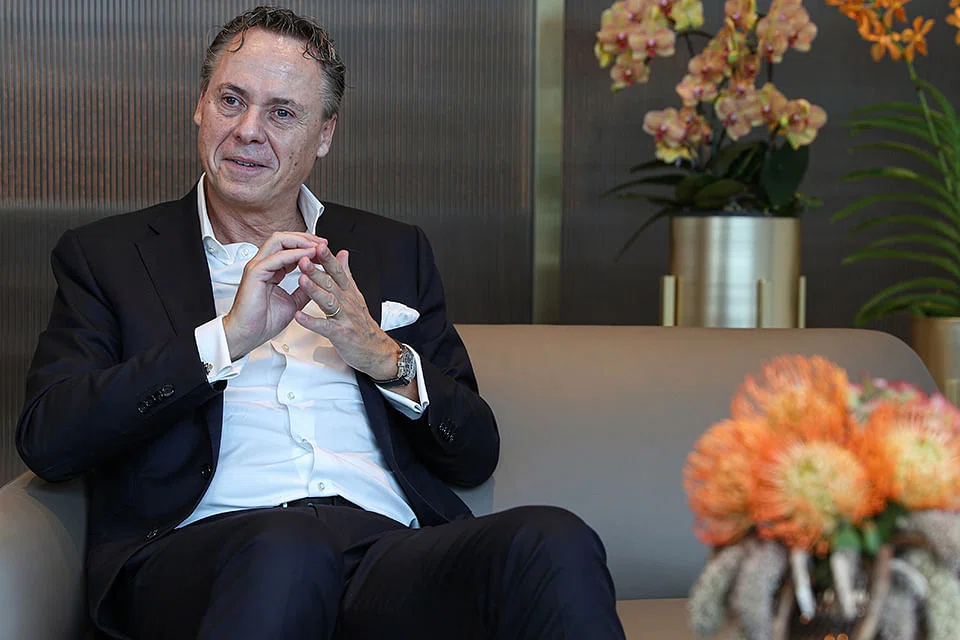
UBS group CEO Ralph Hamers is no stranger to the merits of technology - after all, he had last led Dutch bank ING Group to its fame as a top digital-led lender in Europe during his tenure as CEO.
Having moved to the world's largest wealth management bank just about a year ago, Hamers is bringing that technology expertise into a fiercely competitive - and expensive - business.
That differentiating edge would allow the bank to capture a bigger share of the private-markets business, said Hamers in an interview with The Business Times. In that space, arguably richer opportunities abound today but are harder to track and matchmake to clients than publicly traded assets.
UBS is also moving to capture a bigger share of clients who have found themselves comfortable with a hybrid model of wealth management: a service that has customers making self-directed trades, while having easy access to an adviser on demand when it suits their needs. This is particularly critical when seen in Asia, where wealth is growing much faster than anywhere else globally, he said.
"The Asia-Pacific clients are more entrepreneurial, and in general, want to be more on top of things themselves," said Hamers, speaking to BT while he was in town to officiate the opening of the bank's largest Asia-Pacific office. But these clients also want a mix of advice on wealth transfer and protection, he added.
"We also know that the big trend currently is the private markets. How are our advisers going to know about all the private market opportunities? You can't do that without digital support because there are so many of them."
Such private-market investments will include numerous funds from private equity houses. UBS has also set up its TechConnect service in Singapore, to connect clients to existing or potential tech unicorns in South-east Asia. Setting this up makes the function more "explicit" for UBS bankers to connect fellow entrepreneurs in this region.
Hamers points to the success of Silicon Valley, where an ecosystem reinvented itself to buffer against the loss of the silicon chip business, and built new ventures over the decades by feeding on the connections in that community. The TechConnect approach is similar, though by comparison, in "a more pressure cooker state", Hamers said.
Meanwhile, UBS's hybrid digital wealth management tool My Way, had amassed some US$4.2 billion in assets under management as at the end of June this year - of which US$1 billion is in Asia. The combined total grew to US$5.1 billion as at Q3 this year.
A hybrid model could find more success in the US market, which is flush with active self-directed traders. It could also find more favour among female clients, with trends showing that women are generally more keen on algo-driven models that require less constant minding, noted Hamers.
Asia's wealth prospects are well-told, and Hamers underscores that China is a big market to tackle in the asset management space.
The policy of common prosperity means opportunity in focusing particularly on the "middle level" of wealth, said Hamers. He described that the wealth build-up in the world's second largest economy is shaping up to look more like an oval, rather than an pyramid. Tackling the changing composition of China's burgeoning wealth requires scale to be successful, said Hamers, with the bank looking to work with partners to distribute products there.
The bank scores highly among clients in terms of market intelligence, and having the right product suite. Where it can improve, said Hamers, is in being more personalised and timely with matching the right calls to the right clients. Revving up the recommendation engine is about using the right data and charging it up with artificial intelligence.
With that backdrop, a large part of this tech-driven strategy comes from delayering the corporate hierarchy that has cultivated an "entitlement culture" around where tech dollars should be spent, Hamers observed.
He has streamlined some titles to break what he sees as bureaucracy - getting rid of all ranks above managing director - and said the bank will "further delayer" the organisation. To him, the leadership signal is this: rank is not the important thing here, subject matter expertise is.
"Because if you have a hierarchy, you have different layers, and you have decision-making power attached to the hierarchical level. Whereas you want to go to a world where the decision-making power is allocated to the people who know the best," he said.
"So you will have to bring the decision-making power to the subject matter experts. They may be the lowest in rank, so to speak, but they really know what they're doing."
The tech-driven strategy also had him sitting at UBS's new office at 9 Penang Road till about midnight the day prior to its official opening, as he worked through the technology budget. The technology decisions today are now run by the executive board, regardless of where the project sits geographically.
Every quarter, the board goes through tech-related projects and thoroughly reviews if they are meeting objectives and milestones from where the projects have progressed from a quarter back, and where it should be 6 months from now.
This "3 months back, 6 months forward" approach, said Hamers, will help clarify if the technology budget is efficiently allocated, stripping out the "entitlement" attached to such spending.
TRENDING NOW

Government to bring forward raising of retirement age, give employers more financial support to create flexi-load jobs
Former minister Maliki Osman, Revolut chairman join Asia Gulf Holdings advisory board

Is Manila Asia’s new dining hot spot?
Simba at risk of losing operating licence over spectrum misuse

