

23 financial institutions commit to train 80,000 Singapore staff in AI skills by 2028
IBF’s AI co-lab begins with pathways for leaders, wealth managers and operations staff

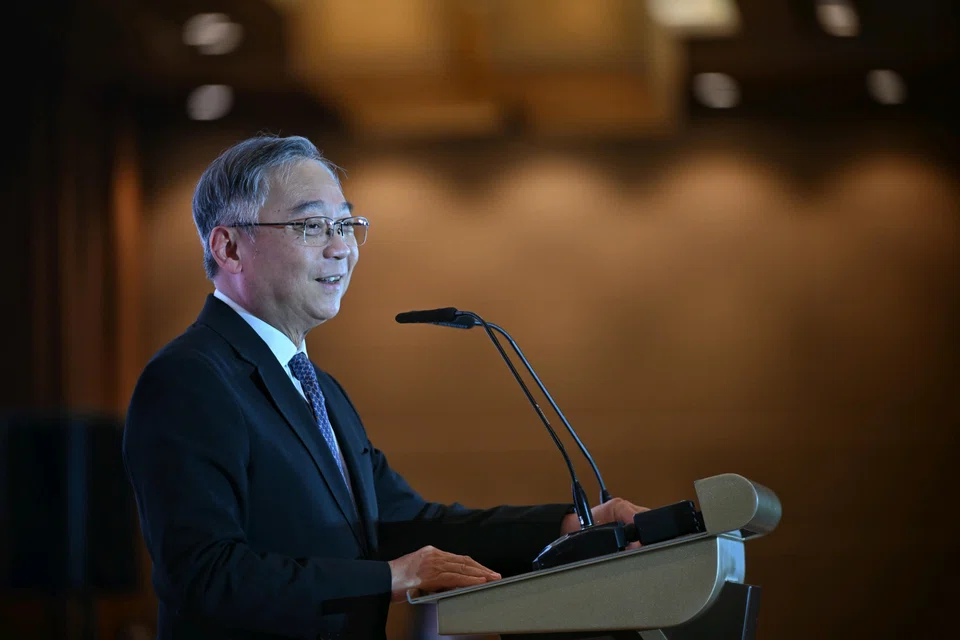
[SINGAPORE] The Institute of Banking and Finance (IBF) is launching an artificial intelligence co-lab with 23 financial institutions (FIs) to assess the impact of AI on skills and jobs, and test and develop practical approaches to training and job redesign.
Called the IBF AI Workforce Co-Lab, the initiative brings together banks, insurers and asset managers that have committed to training their entire Singapore workforce – totalling more than 80,000 employees – in critical AI skills by 2028, said Deputy Prime Minister Gan Kim Yong, at the annual IBF Distinction Evening on Thursday (Sep 24).
“We want AI to translate into better careers for Singaporeans and a more productive workforce,” said DPM Gan, who is also Minister for Trade and Industry (Trade) and chairman of the Monetary Authority of Singapore (MAS).
The 23 FIs account for around 40 per cent of the financial services workforce in Singapore, IBF noted. They include local banks DBS, OCBC and UOB, as well as Goldman Sachs, UBS, AIA, Schroders and SGX.
These FIs have committed to train their staff in critical AI skills by 2028 through IBF-recognised programmes, with more than half of their employees already trained to date, IBF said.
As a start, the co-lab will have three role-specific pathways, covering leaders, wealth managers and operations staff.
The co-lab aims to equip leaders with skills to identify valuable applications of AI, establish sound governance and lead workforce transformation.
For wealth managers, the focus will be on equipping them with stronger advisory expertise alongside the ability to use AI well. Ten private banking employers have committed to upskill their relationship managers.
Meanwhile, the operations pathway will bring together major banking and insurance employers to redesign such operational jobs and develop progression pathways.

At the event, DPM Gan also announced an enhancement of the tripartite Memorandum of Understanding (MOU) between IBF, NTUC and seven industry associations, first signed in 2024.
The initial MOU was aimed at upskilling and supporting the financial sector workforce amid emerging trends such as sustainability and generative AI.
The enhanced partnership will focus on helping the workforce adapt to AI, through wider industry outreach, and greater access to training and career support, DPM Gan noted.
He added that it will also create opportunities to develop programmes tailored to the needs of different financial sub-sectors.
NTUC assistant secretary-general Patrick Tay said: “This means equipping workers with foundational AI skills, supporting them to upskill and reskill as jobs are redesigned and AI is integrated into their roles, and building a strong pipeline of young talent.”
Beyond training, the collaboration will also aggregate and anonymise workforce-related insights, which will help identify emerging workforce needs early, he added.
DPM Gan noted that Singapore’s strategy to support the financial sector workforce comprises three “Ups”: to uplift the workforce with the critical AI skills needed to work effectively and responsibly alongside AI; to upskill finance professionals for specific AI-enabled roles; and to upbuild a stronger pipeline of AI and job-ready young talent.
IBF is also launching the Job Redesign Playbook for Financial Services, in partnership with the Skills and Workforce Development Agency and the Institute for Human Resource Professionals.
This will support finance professionals to make a substantial career change, DPM Gan noted.
Separately, IBF is working with Ngee Ann Polytechnic’s Centre for Shaping Human-First Transformation on a pilot that combines skills mapping, coaching and change management tools.
This is to help finance professionals and their managers take on new responsibilities with confidence, as AI changes how they work.
Chia Der Jiun, chairman of IBF and managing director of MAS, said that new technologies will continue to reshape financial services while creating new opportunities for the sector.
“We will need to continue strengthening capabilities, supporting people as roles evolve and building a strong talent pipeline,” he said. “This requires a continued and collective effort across the sector.”
Decoding Asia newsletter: your guide to navigating Asia in a new global order. Sign up here to get Decoding Asia newsletter. Delivered to your inbox. Free.
Copyright SPH Media. All rights reserved.
TRENDING NOW

US dollar falters after Iran’s offer to reopen Hormuz sends oil lower

He built the Vingroup empire. Now South-east Asia’s richest man is handing some key roles to his sons

Prudential announces regional leadership changes, including for Singapore, Indonesia
Indonesia court cuts Gojek founder Nadiem Makarim’s jail term to nine years

