

AI boom masks mounting risks from Middle East energy shock: MAS chief
The financial regulator is working with private banks to shorten the time needed to open an account
 Add BT as a preferred source
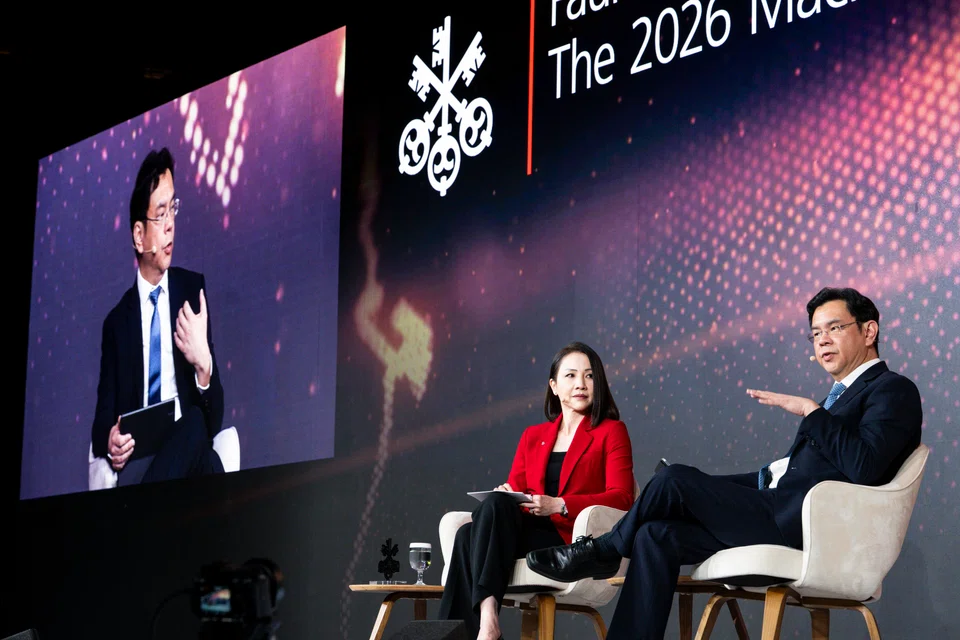
[SINGAPORE] Artificial intelligence investments have helped keep global markets buoyant despite a major Middle East energy shock, with AI-related investment contributing to as much as half of US gross domestic product growth, said Chia Der Jiun, managing director of the Monetary Authority of Singapore (MAS).
But he warned that while AI investments have boosted economic performance in parts of Asia, the concentration and sustainability of AI-driven growth could mask deeper risks.
He was speaking to almost 1,500 attendees at the UBS Asian Investment Conference Singapore Wealth Edition 2026 held at the Shangri-La Singapore hotel on Monday (May 25).
“There is a medium-term concern if global growth is narrowly driven by AI, with a small group of companies and a narrow set of sectors (gaining) if productivity gains are not widely distributed globally,” he noted.
He added that the boom is sustained by a race to scale and a race to self-improving models supported by relatively easy financing and large hyperscaler cash flows.
This has resulted in competition for scarce chips and rising unit cost to compute, which could eventually wind down if the race is “won”, or if the market increases the cost of financing.
At the same time, Chia flagged that a prolonged or intermittent closure of the Strait of Hormuz has left economists concerned about the stagflationary impact of the energy shock on global growth in the longer term.
Despite this, markets have remained resilient as AI-linked stocks continued to power the majority of US investment growth and half of its GDP expansion.
Sharpening wealth hub edge
Against this backdrop of geopolitical uncertainty and shifting global capital flows, Chia said that MAS is taking steps to further bolster Singapore’s standing as a wealth hub.


The financial regulator is working with private banks to shorten the time needed to open an account from a current median of about six weeks to within a month, using a “risk proportionate” approach, a circular released on Monday showed.
Chia said that the move will allow financial institutions to “avoid unnecessary and excessive steps in the process and be more targeted”.
“More efficient account opening will improve the competitiveness of the wealth management industry while maintaining high standards,” he added.
During the fireside chat moderated by Young Jin Yee, co-head of UBS global wealth management for the Asia-Pacific and UBS country head for Singapore, Chia also highlighted the growing potential – and risks – of agentic AI, which he described as a significant step change in AI capabilities.
“Agentic AI sets goals, reasons, breaks down a problem, sets up a sequence of steps, makes adjustments to achieve that goal,” he said. “There is great potential, but also significant risk that I think regulators and industry have to manage together well.”
On applying AI in the wealth management space, Chia pointed out that financial institutions can deploy the technology to improve their own productivity.
“We have heard of one financial institution that deployed agentic AI to work on the source of wealth and KYC (know your customer) processes; these processes involve multiple steps and this was able to achieve substantial productivity gains,” he noted.
Chia said that AI agents could also be used to serve customers better through hyper-personalisation, enabling them to effect payments, moving accounts and investments across different markets and firms. This makes differentiation increasingly key for wealth managers and advisers.
The implementation of AI in the wealth management space, however, does bring some concerns for regulators like MAS, he noted.
While autonomy for AI agents is a promising technology, it must come with effective governance. Cyberdefensive capabilities should also be stepped up given that agentic AI could probe vulnerabilities.
Chia added that as AI agents look to optimise similar goals for trading or deposit flows, a concentration of underlying models could prove destabilising, potentially leading to correlated market movements as agents pursue similar goals.
Capital market reform efforts
Chia also touched on broader efforts to strengthen Singapore’s capital markets ecosystem.
He noted that its growth capital initiative builds on Singapore’s ongoing equities market reforms, and actively draws on private-sector expertise and knowledge of market conditions.
“This is quite natural, because a strong growth capital ecosystem will provide a pipeline of companies into the public markets,” he said. “With a thriving public market, it will provide the exit needed for a healthy growth capital ecosystem, and also for them to reinvest their capital and recycle that capital after exit.”
He added: “We see this as a virtuous cycle that we need to develop, and we are consulting widely on this again to try to find feasible solutions in this area, and we will look to strengthen across all key segments from venture capital to private equity.”
The Growth Capital Workgroup, announced in February 2026, aims to strengthen Singapore’s ecosystem for venture capital, private equity and private credit.
Chia said that going forward, MAS will look to work closely with the financial sector, beyond account opening processes, to upskill the workforce, adopt a “risk proportionate” regulatory approach, promote innovation and partner with the industry.
Decoding Asia newsletter: your guide to navigating Asia in a new global order. Sign up here to get Decoding Asia newsletter. Delivered to your inbox. Free.
Copyright SPH Media. All rights reserved.
TRENDING NOW
Xi Jinping has just rewritten the rules of US-China rivalry

High Court raps UOB over inconsistent legal positions on late mortgage payment charges

‘Whole deck of cards just toppled’: FoodXervices’ Nichol Ng on how a 92-year-old family business unravelled – and what’s next
China’s Huawei reveals chip design breakthrough amid US sanctions

