Asian stocks rally as Kospi jumps 17%; yen falls as BOJ stands pat
Investors renew bets on AI trade as South Korean equities post record intraday gains
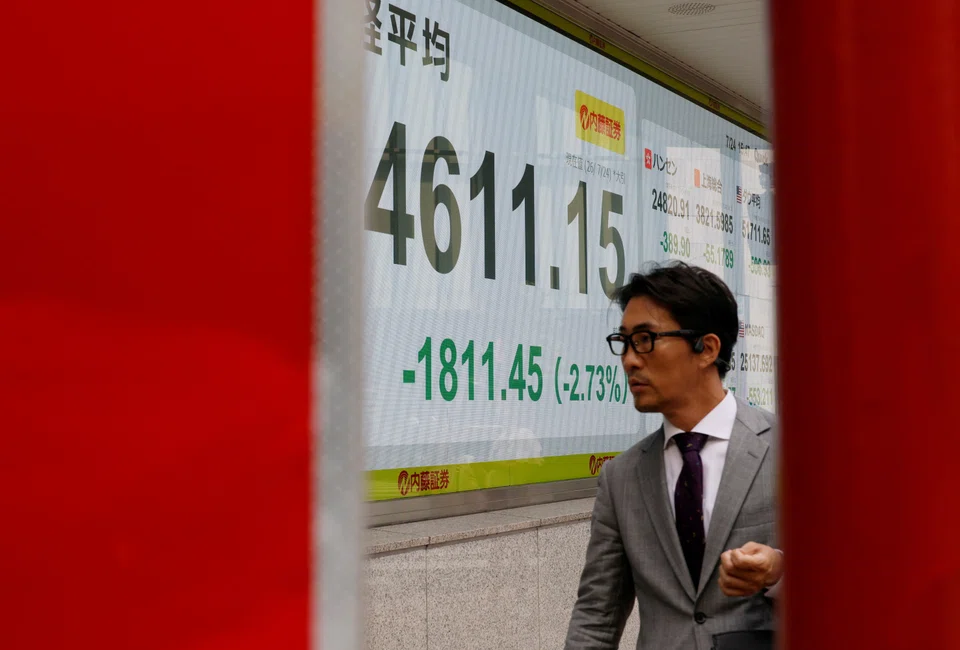
ASIAN stocks rallied on Friday (Jul 31) after South Korean equities posted a record intraday gain, as investors renewed bets on the artificial intelligence trade following this week’s rout.
The yen weakened, giving back some of Thursday’s intervention-driven gains.
The Kospi Index – a bellwether for AI investments – surged as much as 17 per cent, the biggest intraday advance on record, rebounding from a three-day sell-off.
Chipmakers SK Hynix and Samsung Electronics both jumped about 20 per cent. Japan’s Nikkei 225 Stock Average gained more than 4 per cent, lifting the MSCI Asia-Pacific Index 3.6 per cent, while the emerging markets benchmark climbed the most since April.
Among the main market moves, the S&P 500 futures rose 0.2 per cent as at 12.15 pm Tokyo time. Japan’s Topix rose 1.5 per cent, Australia’s S&P/ASX 200 rose 0.4 per cent, Hong Kong’s Hang Seng fell 0.3 per cent and the Shanghai Composite rose 0.5 per cent.
In Japan, the yen held its losses as the Bank of Japan (BOJ) kept its policy rate unchanged.
The currency had posted its biggest gain against the US dollar in more than two years on Thursday, following another round of intervention by authorities.
The currency weakened 0.7 per cent to 160.72 per US dollar, after surging more than 3 per cent to 157.98 on Thursday.
Meanwhile, the advances in Asian stocks came after an index of chip stocks on Wall Street posted its biggest gain in more than a year.
SEE ALSO




Amazon.com rose 9.5 per cent after cloud computing revenue accelerated for a fifth straight quarter, while Microsoft surged 16 per cent after earnings.
Apple, however, dropped more than 6 per cent in extended trading as supply shortages hurt its sales forecast.
“Markets are seeing strong buying after stocks had been pushed lower by leveraged bets, away from fundamentals,” said Hiroki Takei, a strategist at Resona Holdings.
“Robust earnings from Microsoft and Amazon have also given investors greater confidence that the massive investments in AI can ultimately be recouped.”
The rebound in technology stocks offered investors a reprieve after this week’s sell-off, driven by concern that the billions of dollars being poured into AI may not generate commensurate returns.
With the US Federal Reserve standing pat and bond yields climbing, traders are assessing the strength of the US economy and whether a 23 per cent jump in oil prices in July will weigh on inflation.
In the US, large gains occurred in shares that, as of the first quarter, had been top holdings of Situational Awareness – the hedge fund led by former OpenAI researcher Leopold Aschenbrenner that earlier sold a big chunk of its holdings to Citadel after liquidating equities caught up in the AI rout.
The Nasdaq 100 Index climbed over 3 per cent, snapping a six-day losing streak. Futures contracts for the tech-heavy gauge added 0.6 per cent.
“The hardest job for investors now is figuring out whether this is a sustained recovery, or just a ‘dead cat bounce,”’ said Vey-Sern Ling, managing director at Union Bancaire Privee.
Garfield Reynolds, markets live team leader at Bloomberg, said: “The rally across Asian tech sectors on Friday is so extreme it offers a burning ray of hope at the end of a very rough July for sentiment across the region.”
“The rallies will feed the narrative that a clear-out of leveraged positions sets up a cleaner floor for a sustained, and possibly steadier rally going forward,” said Reynolds.
Elsewhere, a Bloomberg gauge of the US dollar rose, snapping a five-day run of losses.
Treasuries were a touch stronger after long-term yields touched multi-year highs earlier this week, extending the surge unleashed by the Fed decision to hold rates steady despite still-elevated inflation.
The yield on the Treasury 30-year bond slipped two basis points to 5.19 per cent.
Gold traded around US$4,100 an ounce. Oil fell, with Brent crude dropping 1 per cent. The global benchmark is still up by about a fifth in July.
That said, early attention in Asia was on the BOJ.
All 52 economists surveyed by Bloomberg forecast the BOJ will hold its benchmark rate steady at the end of a two-day gathering as it assesses the impact of June’s increase to 1 per cent, the highest in 31 years.
Spotlight now shifts to Governor Kazuo Ueda’s press conference in the afternoon and any comments on the currency. BLOOMBERG
Decoding Asia newsletter: your guide to navigating Asia in a new global order. Sign up here to get Decoding Asia newsletter. Delivered to your inbox. Free.
Share with us your feedback on BT's products and services