South Korea’s Kospi jumps 6% as Asian stocks rise after bond rally
MSCI’s Asia Pacific index rises 1.7%, snapping a two-day losing streak
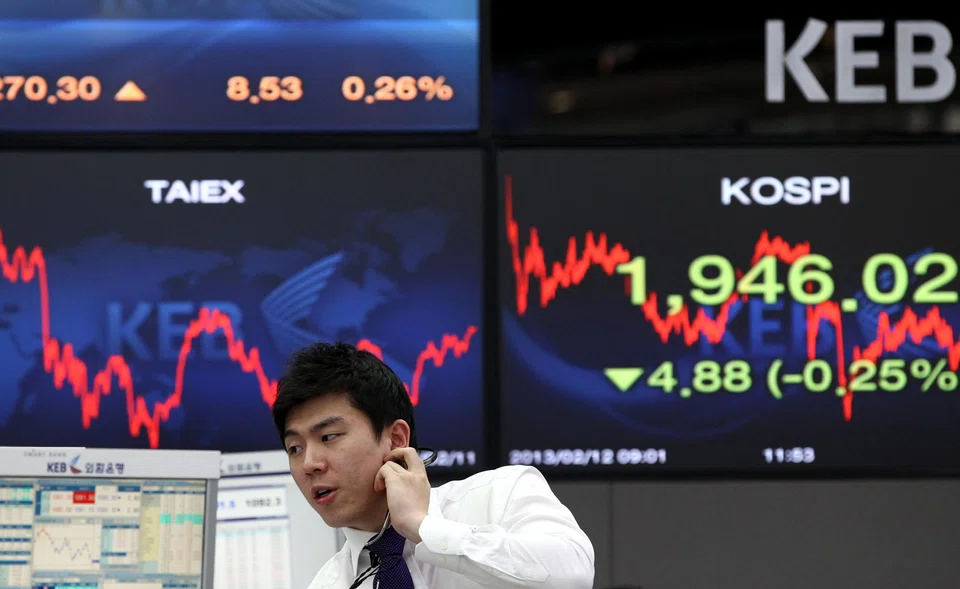
ASIAN stocks and bonds rose on Thursday (Aug 20) as treasuries extended gains, fuelled by US plans to buy back longer-maturity debt, while the US dollar steadied after sliding to a three-month low.
The US 30-year yield fell one basis point to 5.18 per cent after sliding nine basis points on Wednesday.
The benchmark 10-year yield dropped by a similar amount to 4.63 per cent, extending its six-basis-point decline in the previous session.
A Bloomberg index of Treasuries due in 20 years and above had jumped 1.7 per cent on Wednesday, its biggest one-day gain since February 2025.
Bonds in Japan, Australia and New Zealand also rose after the US Treasury said it would at least double the size of its bond buybacks, which would curb yields on long-term bonds that had climbed to multi-decade highs.
The buoyant sentiment saw MSCI’s Asia Pacific equities gauge rise 1.7 per cent, snapping a two-day losing streak.
Among the main market moves, the S&P 500 futures rose 0.2 per cent as at 1.20 pm Tokyo time.
The Nikkei 225 futures (OSE) rose 1 per cent, Japan’s Topix rose 0.9 per cent, Australia’s S&P/ASX 200 rose 0.1 per cent, Hong Kong’s Hang Seng rose 1.1 per cent and the Shanghai Composite rose 0.3 per cent.
US equity-index futures also gained, though European shares were set to drop at the open.
Advances in Asia were led by a 6 per cent jump in South Korea’s Kospi Index, with SK Hynix surging 13 per cent on a share buyback plan. Samsung Electronics rose more than 5 per cent.
Global bonds had been jolted in recent days as investors demanded greater compensation for inflation risks and rising government debt levels, while tensions in the Middle East added to price pressures.
The sell-off, which also weighed on stocks, was exacerbated by a wave of corporate borrowing to finance the artificial intelligence boom.
“The buyback suggests to me that the US Treasury is highly concerned about the long-term borrowing costs,” said Gerald Gan, chief investment officer at Reed Capital.
“Just like what he did for the Japanese yen, the effect will be temporary and the buybacks cannot be sustained for too long.”
In other corners of the market, gold slipped 0.4 per cent to about US$4,500 an ounce after climbing to its highest level since early June.
Bitcoin rose to above US$69,000 after US President Donald Trump pressed Congress to pass a key crypto bill as the White House hosted industry executives.
As sentiment improved, US equity-index futures advanced in Asian trading after the S&P 500 Index posted a modest gain on Tuesday, even as chipmakers declined. Contracts for the Nasdaq 100 Index rose 0.4 per cent.
Bloomberg’s gauge of the US dollar was little changed in Asia, after sliding 0.8 per cent on Wednesday to the lowest level since May as Treasury yields declined.
“While buybacks alone are unlikely to alter longer-term fundamentals, they do signal willingness by policymakers to lean against further yield increases,” Lloyd Chan, a foreign exchange strategist at MUFG Bank in Singapore, wrote in a note.
“This suggests the relative-rate story that has supported the dollar is fading.”
“The US dollar is shaping up as the weak link for investors weighing Treasury buybacks against the US’s widening fiscal deficit. That gives Asian currencies room to run,” said Mark Cranfield, Bloomberg markets live strategist.
Meanwhile, Brent crude advanced 0.4 per cent to about US$92 a barrel.
That was after Trump said there would be an unprecedented economic warfare operation against Iran, after faulting the country for failing to take its chance to make a deal with him.
Long-maturity government bond yields surged globally this week, with the US 30-year yield reaching its highest level since 2007.
A 10-year Treasury auction last week drew the highest financing cost for that maturity since 2007, while a 30-year sale a day later cleared at the highest yield since 2001.
While the Treasury did not indicate how the operations would be paid for, it typically relies on issuance of bills for its fluctuating funding needs.
If officials are in effect replacing longer-dated debt with short-term securities, the manoeuver amounts to a version of the US Federal Reserve’s “Operation Twist”.
“This administration needs a win, and maybe that comes in the form of artificially trying to keep long Treasury rates contained,” said Jack McIntyre, a portfolio manager at Brandywine Global Investment Management.
“They have to try something. Sentiment around the long-end globally is about as bearish as I have seen in a very long time.” BLOOMBERG
Decoding Asia newsletter: your guide to navigating Asia in a new global order. Sign up here to get Decoding Asia newsletter. Delivered to your inbox. Free.
Share with us your feedback on BT's products and services