

US stocks: S&P 500, Nasdaq end lower as crude prices jump, chip stocks weigh
Chips drop after FT report that OpenAI overstated revenues
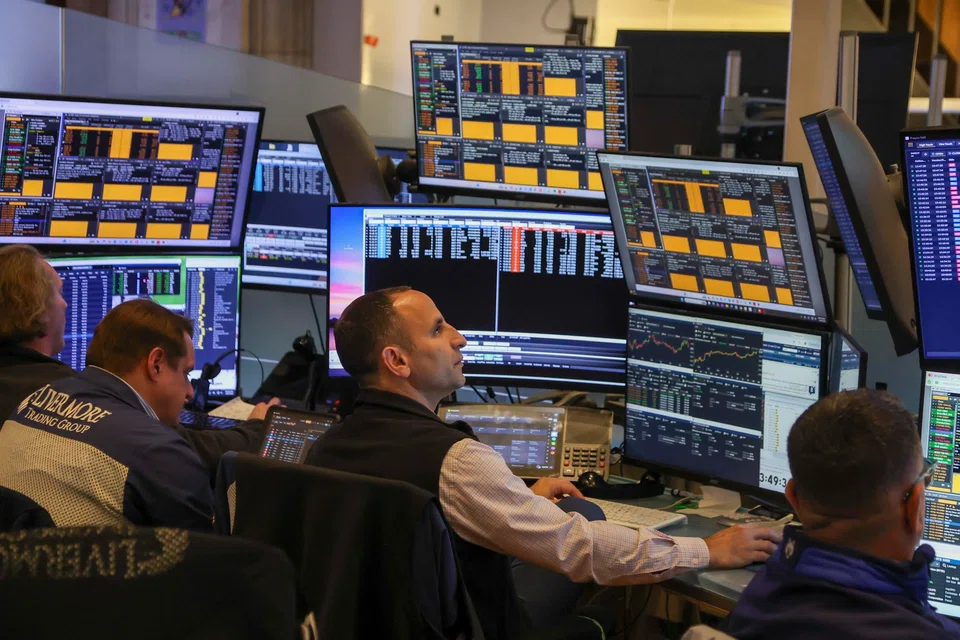
[NEW YORK] US stocks dipped on Thursday (Oct 8) as crude prices surged on a spike in Middle East tensions and a cut in US output that stoked inflation and rate-hike fears, while semiconductor stocks slumped.
Of the major US stock indexes, the Nasdaq closed with the steepest percentage loss, two days after the tech-heavy index reached a record closing high. The S&P 500‘s loss was more modest, while the blue-chip Dow eked out a nominal gain.
Chipmakers, which have soared over 80 per cent so far in 2026, were clear underperformers on the day, falling 3.4 per cent in the wake of a report from the Financial Times that OpenAI’s annualised revenues were US$20 billion less than the company previously signalled.
“The market’s going sideways in anticipation of third-quarter earnings season, which begins next week, and then there’s the ongoing conflict in Iran that’s pushing oil prices higher,” said Terry Sandven, chief equity strategist at US Bank Wealth Management in Minneapolis, Minnesota. “What’s equally telling is that year-to-date, the path of least resistance for equities has been up.”
Oil prices jumped on supply concerns after a spate of attacks on shipping in the Strait of Hormuz, combined with a cut in US output due to hurricane activity.
Front-month WTI and Brent settled up 3.6 per cent and 4.1 per cent, respectively.
Tight global crude supplies during the Iran war have sent US crude soaring more than 60 per cent so far in 2026, stoking inflation pressures. In response to those pressures, the US Federal Reserve hiked interest rates in September for the first time since July 2023.
Financial markets currently expect the US central bank to leave rates unchanged in October, while the probability of a December hike is 69.2 per cent, according to CME’s FedWatch tool.
That mirrors the expected rate hike path of the European Central Bank, and was affirmed by US Fed governor Christopher Waller, who said additional rate hikes will probably be necessary, but the timing of those hikes is “flexible.”
SEE ALSO




The Dow Jones Industrial Average rose 51.77 points, or 0.1 per cent, to 51,231.64, the S&P 500 lost 36.41 points, or 0.47 per cent, to 7,765.36 and the Nasdaq Composite lost 345.35 points, or 1.25 per cent, to 27,193.34.
Among the 11 major sectors in the S&P 500, energy stocks led the percentage gainers, while technology, weighed by chips, suffered the steepest loss.
Memory-chip giant Samsung Electronics’ record quarterly profit forecast failed to lift sentiment, with its shares closing lower in South Korea. Rival Micron Technology dropped 4.8 per cent.
On Wednesday, the Wall Street Journal reported that Broadcom is lining up US$50 billion in financing for OpenAI, with Oracle also seeking an unspecified sum, spurring fears that massive debt issuance by technology companies could intensify the competition for capital.
Broadcom and Oracle fell 4.4 per cent and 5.5 per cent, respectively.
PepsiCo shares gained 3.7 per cent after the beverage company said it would pursue additional spending cuts while lowering its annual core profit forecast.
Starbucks dipped 0.4 per cent following reports that the coffee chain was exploring a purchase of Chipotle Mexican Grill , whose shares jumped 6.2 per cent.
Palantir climbed 2.4 per cent after Goldman Sachs upgraded its rating on the data analytics software provider to “buy” from “neutral.”
Advancing issues outnumbered decliners by a 1.28-to-1 ratio on the NYSE. There were 110 new highs and 416 new lows on the NYSE.
On the Nasdaq, 2,050 stocks rose and 2,734 fell as declining issues outnumbered advancers by a 1.33-to-1 ratio.
The S&P 500 posted four new 52-week highs and 12 new lows while the Nasdaq Composite recorded 33 new highs and 319 new lows.
Volume on US exchanges was 18.81 billion shares, compared with the 17.74 billion average for the full session over the last 20 trading days. REUTERS
Decoding Asia newsletter: your guide to navigating Asia in a new global order. Sign up here to get Decoding Asia newsletter. Delivered to your inbox. Free.
Share with us your feedback on BT's products and services
TRENDING NOW
Prima to move out of historic Keppel Road flour mill building in 2028

Grab CEO’s wife Chloe Tong on life with Anthony Tan and finding her purpose

OCBC sheds S$8 billion in value as shares close nearly 6% down; analysts cautious on banks

As Asia’s food delivery giants rejig the pie, who will win the market?

