DBS, OCBC or UOB? Investors urged to be selective as Q3 reveals widening performance gap
Singapore banking trio face a growing earnings divide as funding costs cloud their 2027 outlook

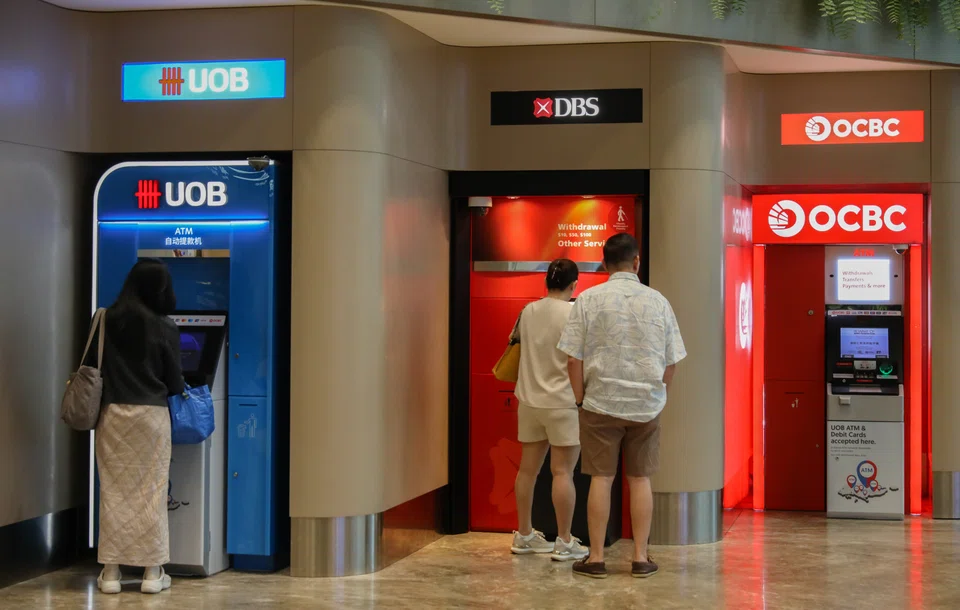
[SINGAPORE] Investors should be more selective when investing in the Singapore banks, given the widening performance gap between DBS , OCBC and UOB in the third quarter of 2026, analysts said.
Higher funding costs weighed on the local banks’ Q3 earnings, even as analysts expect margin recovery and the impact of asset repricing to be uneven across the trio.
Jefferies analyst Joanna Cheah pointed out: “(The widening performance gap) highlights how differences in funding franchise strength, balance sheet management and business mix are increasingly differentiating earnings, rather than the interest rate environment alone.”
The divergence comes as a recent share price correction has made the Singapore banks more attractive to investors, although analysts cautioned that the trio may not benefit equally from the same macroeconomic conditions.
DBS’ Q3 net profit fell 5 per cent year on year to S$2.81 billion on lower market trading income, while OCBC’s earnings rose 3 per cent to S$2.22 billion as lower contributions from insurance arm Great Eastern offset strong wealth and wholesale banking performance.
UOB’s net profit jumped 182.2 per cent to S$1.25 billion off a low base, but missed market expectations.
“The latest results suggest that investors can no longer treat all three banks as essentially the same investment,” said Saxo chief investment strategist Charu Chanana.
DBS is still delivering stronger profitability, while OCBC’s underlying business looks better than its headline results. UOB, meanwhile, has more work to do to restore earnings momentum, she noted.
Uneven funding pressures
Glenn Thum, research manager at Phillip Securities Research, pointed out that rising rates had “very different effects” on the three banks.
DBS’ net interest margin (NIM) was steady at 1.87 per cent, as hedging and deposit growth offset lower Singapore benchmark rates.
OCBC’s NIM fell 18 basis points (bps) year on year to 1.66 per cent, although it has likely bottomed out.
UOB’s fell 14 bps to 1.68 per cent, as competition for deposits pushed up funding costs faster than loan yields.
With rising funding costs outweighing the “modest” tailwind for NIMs, Citi analyst Tan Yong Hong expects markets will likely revisit the thesis that Singapore banks are direct beneficiaries of higher global rates.
Among the three, DBS is best insulated against funding cost pressures in 2027 as it has the lowest loan-to-deposit ratio and largest deposit base among peers, said Rena Kwok, senior credit analyst at Bloomberg Intelligence.
The bank had kept deposit rates higher while peers cut theirs in order to gain deposit share before market tightening, she pointed out.
Its growth in low-cost institutional deposits also came from new transaction-banking mandates and cash-management relationships rather than promotional pricing, she added.
In comparison, OCBC faces greater near-term funding pressure with the least low-cost deposit ratio in Q3, although its strong deposit growth and upward asset repricing should result in stable NIMs in 2027.
Meanwhile, Kwok expects UOB is the most exposed structurally to funding pressures, as its fixed and wholesale funding outpaces low-cost deposit growth.
Phillip’s Thum also noted that UOB and OCBC, which compete harder for fixed deposits or rely on US dollar funding, will feel the effects of higher funding costs more, given that they reprice faster than many loans.
DBS is best placed to gain from its large pool of current and savings accounts, where rates on such accounts “barely move” when the Singapore Overnight Rate Average (Sora) rises, he said.
Still, CGS International analyst Tay Wee Kuang will watch out for the pace of Sora increases, as rising rates could dampen loan demand or potentially be a leading indicator for a higher credit cost cycle moving forward.
What’s next
Looking ahead to 2027, Jefferies’ Cheah sees the biggest earnings opportunities in the recovery of net interest income, supported by balance sheet growth and a more favourable rate environment.
Jayden Vantarakis, head of Asean equity research at Macquarie Capital, also expects higher rates to be a tailwind from the fourth quarter onwards, noting that the banks had expressed confidence that their NIMs had bottomed out in Q3.
While analysts generally expect the banks to continue to see growth in wealth management, CGSI’s Tay warned that a tapering of growth for non-interest income and normalisation of credit costs could cause analysts and investors to reassess the overall outlook, given that the three banks have performed “relatively well” in both areas.
Despite these risks, Chanana expects Singapore’s banks to remain fundamentally strong and continue to offer attractive dividend income. Still, investors should look beyond headline dividend yields and be more selective, she urged. This is particularly relevant for Singapore investors who own bank shares directly and also invest in Straits Times Index exchange-traded funds, where financial stocks make up a significant portion of the index.
“After a strong run in Singapore bank shares, the opportunity may no longer be simply about owning the banks,” explained Chanana. “It is about owning them at the right valuations, while ensuring the rest of the portfolio has room to grow beyond financials.”
DBS closed 0.9 per cent or S$0.65 higher at S$70.37 on Tuesday; OCBC was up 3.1 per cent or S$0.87 at S$28.60, and UOB gained 1.4 per cent or S$0.50 to S$37.38.