Global asset managers warn geopolitical and AI concentration risk need a new approach to investing
They say uncertainty in macroeconomic environment is reshaping traditional view of a diversified portfolio

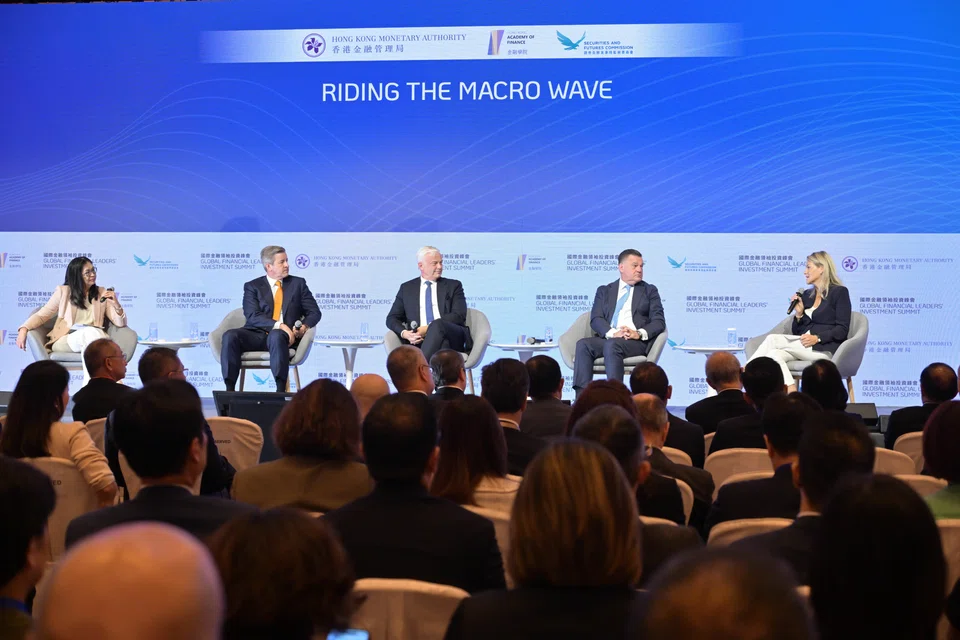
[HONG KONG] Navigating the new reality of geopolitical tensions and diversification away from artificial intelligence trades is leading some asset managers to take a fresh view of investing.
The world is moving into a different geopolitical regime, said Chris Hogbin, CEO of Lazard Asset Management at the Global Financial Leaders’ Investment Summit in Hong Kong on Wednesday (Nov 4).
The added uncertainty has meant that deals already attract a risk premium at the start.
In the past, risk applied a discount at the end of a trade, but now it has to be done at the start.
“Geopolitics is disseminating into so much of what individual companies are able to do, what their competitive sets are, and what their opportunities and risks are,” he said.
To adapt to this new reality, Lazard has changed the make-up of the talent it recruits, hiring former military professionals, former politicians and political analysts to help think through the issues and price in the risk, said Hogbin.

The current macroeconomic environment is also upending the traditional view of a diversified portfolio, noted Richard Oldfield, CEO at Schroders.
Geopolitics is driving up oil prices, which fuels inflation and causes governments to spend more, raising sovereign debt. This follows on to equities and destroys some diversification in portfolios, he added.
Markets have been resilient, although this has been mainly due to the concentration of trade in AI stocks in the first seven months of 2026.

“There wasn’t really a differentiation in what people invested in,” said Oldfield.
While AI has dominated trade and headlines, Oldfield noted that earnings for the US corporate sector outside of AI remained robust. But the equity price appreciation has not come through due to AI’s gravitational pull on capital.
“We need to be selective about where value sits and not get carried away with the market trend,” he said.
Still, the market is likely to remain resilient into 2027, said Karin van Baardwijk, CEO of asset manager Robeco. But the resilience is likely to be uneven, with much of it related to technology and the US economy.
“I wouldn’t look at the current situation as structural. I think it’s definitely conditional, as the margin for error is narrowing,” she said.
There is still good momentum for equity, but it is concentrated in the group of large AI stocks, she added.
Cracks in the market will appear when the overleveraged companies borrow, widening credit spread, said Tobias Pross, CEO of Allianz Global Investors.
There are challenges with funding AI infrastructure which are more vulnerable, and investors should watch out for low growth, high-debt countries as capex ramps up.
“There are a couple of things we need to overcome, because central banks are very much focused on inflation and rates,” said Pross.
Decoding Asia newsletter: your guide to navigating Asia in a new global order. Sign up here to get Decoding Asia newsletter. Delivered to your inbox. Free.
Copyright SPH Media. All rights reserved.