

Huawei accelerates launch of new AI chip to take on Nvidia
Firm is spearheading Beijing’s drive for self-sufficiency in critical technologies
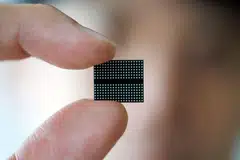
HUAWEI Technologies is accelerating the debut of its next-generation artificial intelligence chip in 2027 by several months as it aims to replace Nvidia in China and compete on the global stage.
The company’s flagship Ascend 960DT chip, originally slated for commercial availability in late 2027, will now be launched in the first quarter, Huawei’s rotating chairman Wang Tao said at the company’s annual summit in Shanghai on Thursday (Sep 17).
Another variant of the new series, dubbed 960PR, will be delivered in the third quarter of 2027, Wang added.
Huawei’s sped-up roadmap suggests the Chinese networking and chip leader is gaining confidence in advancing an ambitious three-year strategy for developing semiconductors to eventually replace Nvidia.
The company – one of several considered key to Beijing’s push to match the US in AI – has since 2025 become increasingly public about outlining its attempts to develop more powerful versions of hardware essential to building data centres and enabling the frontier Chinese labs like DeepSeek and Moonshot AI.
Wang also highlighted Huawei’s aspiration to offer its AI chips as an alternative to US-origin semiconductors.
“Computing power is key to Huawei’s overall AI strategy,” Wang said. “We will help boost the fundamental of China’s computing power and offer the world a new option with our cluster-based SuperPod technology.”
The SuperPod connectivity tech will soon allow as many as 100,000 Ascend chips in a cluster, enabling faster data transmission via Huawei’s UnifiedBus networking protocol.
The Shenzhen-based company says its adaptations and networking can make up for shortcomings in single-chip performance relative to the likes of Nvidia.
SEE ALSO

Already, Huawei has been making inroads at home and beyond.
DeepSeek is planning to deploy at least 160,000 Huawei Ascend 950DT chips at a data centre it is building in Inner Mongolia to operate its models.
The company is also exploring foreign markets including Malaysia and Egypt, Bloomberg News has reported.
The Chinese telecom-to-smartphone firm is spearheading Beijing’s drive for self-sufficiency in critical technologies in the face of years-long US restrictions aimed at crippling China’s chipmaking ambition.
It is also leading a Beijing-backed campaign to export the Chinese technology stack abroad at a time when the world’s two superpowers are vying for geopolitical dominance everywhere.
Ascend 960 series will succeed Huawei’s current Ascend 950 family of AI accelerators, of which the 950DT favored by DeepSeek is equipped with faster, higher-capacity memory for demanding AI inference workloads.
Another upgraded iteration, Ascend 970, is already planned for 2028, the company previously announced.
On Thursday, Wang said Huawei will launch Ascend 980 in 2029. Each new generation of chips will roughly double the amount of computing power of its predecessor.
Trailing Nvidia, production constraints
Wang also touted Huawei’s nascent optics technology, which enables faster data transmission between AI chips and servers.
The company is set to ship its first near-packaged optics (NPO) modules in the coming quarters, he said. NPO speeds up data transmission compared to existing pluggable optic modules and they also help ensure data integrity.
But Huawei’s AI chips are trailing Nvidia’s top-notch offerings.
Frontier Chinese AI labs like DeepSeek are still largely relying on the US company’s chips for training their models, which they then operate using more domestic semiconductors, underscoring the challenge Beijing faces to wean itself completely off of western technology.
At the same time, Nvidia’s most sophisticated silicon is still finding its way into China via smuggling, albeit in modest quantities.
A constraint in production capacity is also preventing Huawei from satisfying explosive demand for computing power in a market that Morgan Stanley estimates could reach 646 billion yuan (US$96 billion) by 2030.
Nvidia’s most advanced Blackwell processors are not directly available in China. Huawei recently raised pricing for the Ascend 950DT chip by 60 per cent, citing tight component supply in communications with customers.
On Thursday, Wang did not address key issues ahead for Huawei, including how it will navigate manufacturing bottlenecks and ramp up production to meet demand.
He also did not spend much time discussing the capabilities of Huawei’s new chips marketed for training, the most computationally intensive aspect of AI development.
Still, to overcome its disadvantages, Huawei has been trying to come up with innovative ways, including the recently announced LogicFolding technique, to improve its chip technology without the best gear.
“System-level competitiveness matters more than ever,” said Morgan Stanley analyst Charlie Chan in a recent research note.
“The effective gap is narrowing through multi-die design, advanced packaging, rack-scale system architecture, optical networking, and software-hardware co-optimisation,” Chan wrote.
Huawei is also making some progress on other fronts. Ascend 950 chips are the first Huawei AI accelerators powered by memory chips it designs in-house, though the company has provided little production details.
The Shenzhen electronics giant and other Chinese AI chipmakers have been cut off from the latest AI memory products from South Korea’s SK Hynix and Samsung Electronics as well as US-based Micron Technology as part of US export controls. BLOOMBERG
Decoding Asia newsletter: your guide to navigating Asia in a new global order. Sign up here to get Decoding Asia newsletter. Delivered to your inbox. Free.
Share with us your feedback on BT's products and services
TRENDING NOW

He built the Vingroup empire. Now South-east Asia’s richest man is handing some key roles to his sons
Quarter of Singtel special discounted shares sold ahead of CPF Board transfer

Why Tan Aik Keong of digital solutions specialist Agmo wants to make himself less indispensable

Asia needs new energy security architecture

