

Keppel CEO on telco merger: S$34 million StarHub dividend beats M1’s S$3 million contribution
Loh Chin Hua notes that the proposed deal will also remove M1’s debt from group accounts

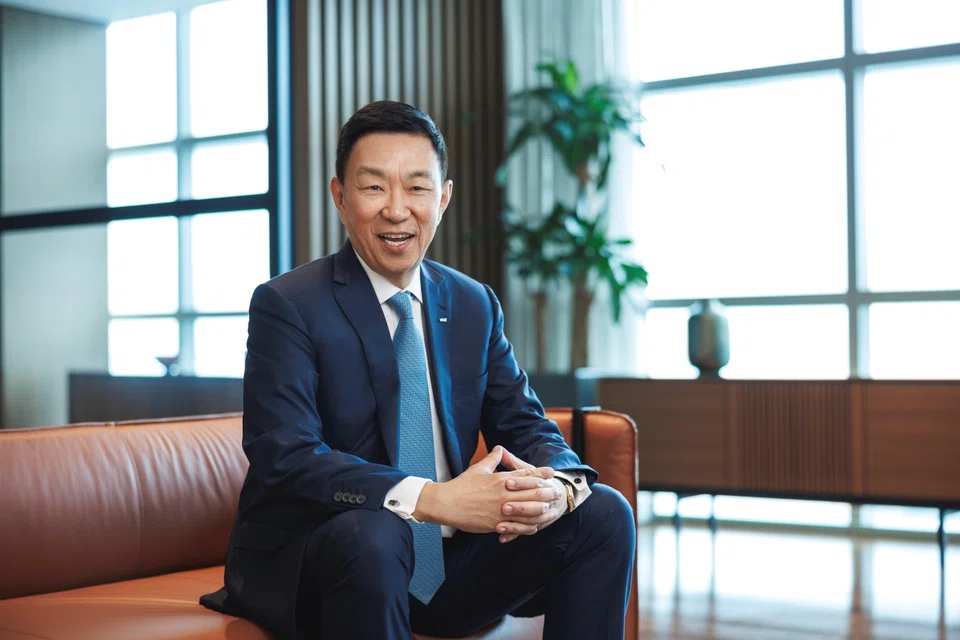
[SINGAPORE] Keppel’s potential annual dividends from its StarHub stake following the latter’s proposed merger with M1 would be more than 10 times what M1 currently contributes to group profit.
Responding to investors’ questions on the proposed StarHub-M1 merger, Keppel chief executive Loh Chin Hua said its resulting StarHub interest would generate annual dividends of S$34 million cash, compared with M1’s S$3 million profit contribution now.
On Tuesday (Nov 24), Keppel announced the proposed merger in which StarHub will issue about 651.7 million new shares to M1’s shareholders as consideration, giving Keppel a 23 per cent stake in StarHub with its 83.9 per cent ownership of M1.
Loh said the deal would also see S$324 million in debt relief that would feed into its special dividend pool. With M1 an 83.9 per cent owned subsidiary, that debt is currently consolidated into Keppel’s group accounts.
Keppel expects the enlarged StarHub to grow and benefit from the integration with M1.
When the deal was announced, StarHub was trading at S$1.01. On Thursday, the counter closed at S$1.11.

By way of illustration, Loh said a S$0.10 rise in StarHub’s share price over a year would add about S$55 million to the value of Keppel’s stake.
“Together, this would result in about S$88 million in value appreciation and dividends for the year.
“The benefits of deconsolidating M1 and the longer-term potential of our stake in the combined entity make this a very good trade for Keppel,” Loh said.


Giving further rationale for the deal, Loh said if Keppel were to continue owning M1, “we would have to fund investments in its technology stack and improve cyber resilience, as well as network and spectrum costs”.
He added: “We would also continue to consolidate its results, including losses such as those we saw in the first half of 2026.”
He said that after the proposed sale of M1 to Simba was terminated, StarHub was the only realistic merger partner.
Simba was supposed to buy M1 in for S$1.4 billion cash before the deal was scuppered after it was found to have breached spectrum usage. In comparison, StarHub’s all-share deal is a sticking point for some analysts and investors who have been selling down Keppel shares.
“The all-share deal makes sense for both sides – It allows the combined entity to conserve cash for integration and growth. For Keppel, it allows us to participate in the upside as the market consolidates, competitive conditions improve and the combined entity realises it synergies.”
Loh said the deal aligns with Keppel’s strategy to be asset-light and to monetise its non-core assets by 2030.
After a 12-month lock-in from the deal completion date, Keppel will be allowed to divest its StarHub shares.
Loh said this could be done by dripping out the shares, selling to a strategic or fund investor or distribute the shares in species or a combination of all three approaches.
Decoding Asia newsletter: your guide to navigating Asia in a new global order. Sign up here to get Decoding Asia newsletter. Delivered to your inbox. Free.
Copyright SPH Media. All rights reserved.
TRENDING NOW

From everyday payments to cross-border connectivity: How DBS is shaping the next wave of digital payments with PayLah!
Nvidia halts chip shipments to 4 countries in South-east Asia, including Singapore: FT

MAS green-lights retail investor access to wider range of complex funds, but excludes private-market funds
Yangzijiang Maritime eyes 2027-2028 profit surge on newbuild deliveries

