

Korea’s world-beating stocks are now trading cheaper than ever
 Add BT as a preferred source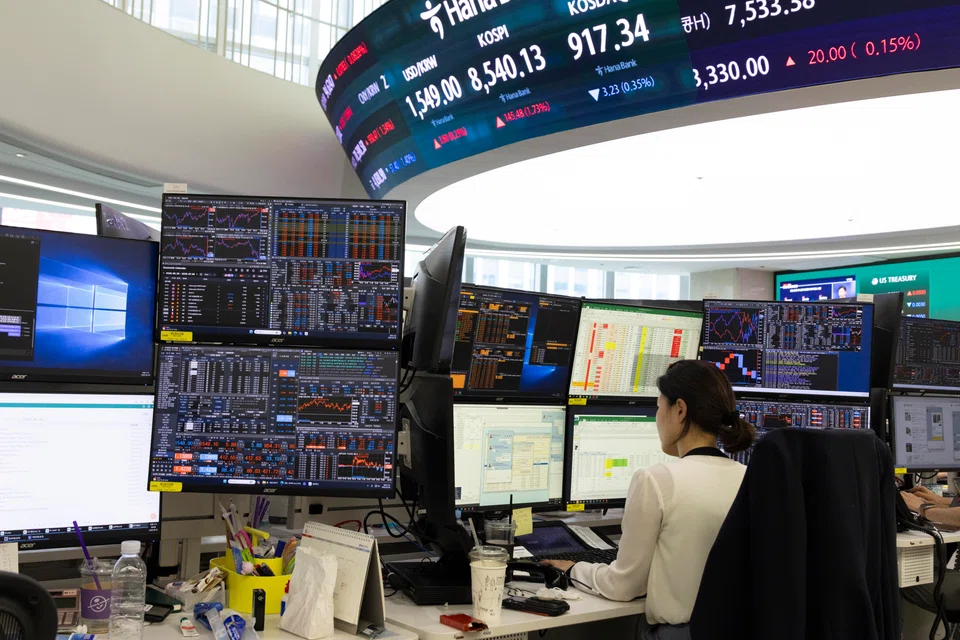
[SEOUL] South Korea’s blistering stock rally has left investors facing an unlikely backdrop: equities trading at record-low valuations.
The Kospi has climbed around 80 per cent this year to a series of record highs, yet analyst earnings upgrades have been even faster. Surging profits at memory chip giants Samsung Electronics and SK Hynix have driven the benchmark to just 6.4 times forward earnings, below even the levels seen during the 2008 global financial crisis.
The sharp sell-off in recent days, sparked by fresh doubts over the artificial intelligence trade, compressed valuations further. For investors, the question is whether record cheapness signals an opportunity or reflects a market pricing in the eventual end of the memory boom.
“Good buy or not really depends on individuals’ portfolios: If one is not exposed much to these names, it is a great time to get in to provide the growth component for the portfolio tied into the AI theme,” said Francis Tan, Asia chief strategist at Indosuez Wealth in Singapore. “Earnings are robust and still forecast to be strong.”
Unlike most bull markets, Korea’s rally has been fuelled less by investors paying higher multiples than by corporate earnings rising far more than expected. Consensus estimates for Kospi companies have risen for 17 straight months – the longest streak of upgrades in more than nine years – driven by soaring memory-chip prices as global technology firms race to build AI infrastructure.
While the index has outperformed global peers, it remains at a deep discount to other chip-heavy gauges. The Kospi’s price-to-earnings ratio is one-third the current multiple for Taiwan’s Taiex.
Cyclical earnings
The US$4.3 trillion market has long been known for its depressed value – dubbed the “Korea Discount” – due to a mix of corporate governance issues and the historically cyclical earnings of Samsung and SK Hynix, which together account for more than half of the Kospi.
Some market pundits argue that AI is creating a new demand paradigm beyond memory’s typical boom-and-bust profit pattern, but the Kospi’s low price-to-earnings ratio shows many remain unconvinced.
“Korea needs proof that the memory super-cycle still has legs,” said Charu Chanana, chief investment strategist at Saxo Markets, adding that cheapness alone is not a reason to buy. “I’m worried this quarter a lot of hyperscalers will still spend big but start talking about how they are optimising costs, and that’s bad news for memory because it means high prices are killing demand.”
The near-term outlook continues to improve. Forward earnings per share estimates for Kospi are up around 170 per cent this year, the largest annual increase in data back to 2006.
The Korean market “has never before experienced such an unprecedented, explosive surge in earnings momentum”, said Jason Minsang Kam, head of active equity management at Kyobo Life Insurance in Seoul.
Still, Kam is wary of the market’s “extreme volatility”, and recommends avoiding Korean chipmakers for now, noting the high cyclicity of their earnings.
The surge in memory prices driving chipmaker profits is seen lasting another year or so. Capacity additions by Samsung and SK Hynix to address the supply crunch raise concerns however that margins will suffer when demand slackens, as in typical cycles.
Valuation metrics
Traders may see reasons other than profits to buy stocks, including a US listing for SK Hynix that’s expected to help it close the valuation gap with rival Micron Technology. On the other hand, potential risk factors include the mounting competitive threat from Chinese firms such as ChangXin Memory Technologies, and the volatility of chip stocks that’s making the trade increasingly precarious.
Given the complexities of gauging memory earnings, some investors argue that metrics other than the price-to-earnings ratio are more useful. The cheapness argument breaks down here, with Kospi’s price-to-book ratio having climbed above two times for the first time this year.
Keith Bortoluzzi, managing director at Singapore-based Impactfull Partners, says Samsung and SK Hynix are “not screaming cheap anymore” based on PEG ratios, which measure price-to-earnings against earnings growth. “Share prices might hold steady for another six months, but they are unlikely to climb much higher,” he added. BLOOMBERG
Decoding Asia newsletter: your guide to navigating Asia in a new global order. Sign up here to get Decoding Asia newsletter. Delivered to your inbox. Free.
Share with us your feedback on BT's products and services
TRENDING NOW

Employers want AI-fluent employees. Hiring them is the challenge

The billion-dollar question Singapore Airlines shareholders should ask at its AGM

With AI, it’s not about coding better; workers need to think better: Koh Boon Hwee

JustCo takes over master tenancy at OG Orchard Point building with push into co-living market

