MAS moves to spur infrastructure investments by easing capital requirements for insurers
In addition, a S$30 million grant will defray costs of building up teams and skills, engaging professional services

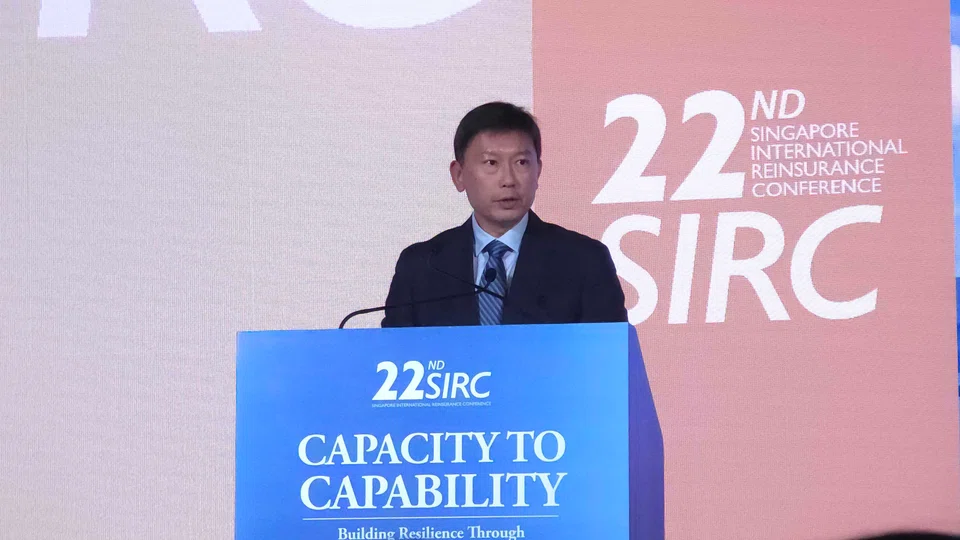
[SINGAPORE] Singapore is proposing to ease capital requirements for insurers investing in certain infrastructure and securitised assets, to boost the local infrastructure financing ecosystem and mobilise private capital for Asia’s infrastructure needs.
The Monetary Authority of Singapore (MAS) will also set aside S$30 million under the Financial Sector Development Fund, to support insurers to build infrastructure investment capabilities in the Republic, Minister for National Development Chee Hong Tat said on Monday (Nov 2).
“As risks become larger, more interconnected and more complex, the next phase of the insurance industry’s development must be about translating its scale into even deeper capacity and stronger capabilities,” said Chee, who is also MAS’ deputy chairman, at the Singapore International Reinsurance Conference (SIRC) 2026.
The measures come as Singapore seeks to boost its growth capital ecosystem, following a series of initiatives to boost equity markets, grow its asset management industry and support wealth management capabilities.
Under the latest proposals, MAS intends to lower capital charges for rated infrastructure debt investments that meet specified credit quality and other qualifying requirements.
Currently, only unrated qualifying infrastructure debt has a lower capital charge than unrated corporate debt.

MAS will recognise more external credit assessment institutions with “relevant expertise in infrastructure and securitisation”, to give insurers access to a wider pool of qualifying debt instruments.
The regulator is also working with the industry to develop standardised disclosure templates, clearer assessment guidance and fund-manager declarations, to help insurers assess whether infrastructure investments qualify for lower capital charges.
In addition, the authority intends to reduce capital charges for qualifying infrastructure equity and debt investments with additional risk-mitigating features.

These features include revenues supported by long-term contractual arrangements, limited exposure to demand risk, and support from counterparties with strong credit quality.
MAS also intends to lower capital charges for senior investment-grade securitisation tranches that meet relevant criteria on simplicity, transparency and comparability, or specified conditions such as portfolio diversification and liquidity safeguards.
A consultation on the proposed changes to the insurance capital framework will close on Dec 18, 2026.
Speaking about MAS’ role as a regulator, Chee said it is important to have the mindset of being a gatekeeper rather than goalkeeper.
The goalkeeper’s objective is to block incoming shots, while the gatekeeper exercises discretion on who can enter, he noted.
“So the regulator should see our role as a gatekeeper because we’re not trying to block everything, we’re trying to manage the risk,” he said.
“We do want to keep out the bad actors, but we got to be prepared to take some risk together with the industry, open up the opportunities, and allow good ideas to come.”
Chee noted that MAS had already taken steps to grow Singapore’s capital and financing ecosystem.
In October 2025, MAS announced differentiated capital treatment for qualifying infrastructure investments under the Risk-Based Capital 2 Framework, which took effect on Mar 31, 2026.
At 2025’s SIRC, MAS also announced a pilot to provide differentiated capital treatment for sustainable infrastructure investments that may not meet all the qualifying criteria under the main framework.
Since then, it has received applications from eight fund managers for 10 funds. Three of these funds will likely be approved by end-2026, while five already qualify under the base framework.
Building investment capabilities
The S$30 million grant will help defray the costs of building dedicated investment teams, strengthening the skills of existing staff, and engaging the professional services needed to establish and expand infrastructure investment activities.
“The intention is to anchor the people, expertise and decision-making capabilities needed to originate, assess and manage these investments from Singapore,” Chee said.
He expects this to reinforce Singapore’s broader infrastructure-financing ecosystem by connecting insurers with asset managers, banks, project sponsors, advisers and other sources of investment expertise.
Citing findings from Singapore’s Growth Capital Workgroup, he noted three points:
- Capital requirements should appropriately reflect the underlying risks of infrastructure and securitisation assets;
- Investors need more consistent information and assessment frameworks to evaluate these assets efficiently; and
- Insurers early in the journey will need some time to build up their expertise and experience.
Chee noted that while insurers in the Asia-Pacific hold more than US$10 trillion in investable assets, their allocation to infrastructure remains modest, at around 1 to 2 per cent of their assets.
As investments in data centres in the region grow, he expects significant opportunities for Singapore’s insurance industry to anchor more risk capacity and develop specialised expertise.
He noted that some industry players – including MSIG, Gallagher Re, Scor, Samsung Re and the Cybersecurity Association Singapore – are collaborating to develop a dedicated data centre insurance facility anchored in Singapore.
The facility is set to cover construction, operational, supply-chain, design and cyber risks, with US$200 million in initial capacity seeded, before being scaled up over time.
“They will bring together underwriting capacity and specialised capabilities to serve the region’s data centre risk needs,” Chee said.
“In essence, building the capacity and capabilities in Singapore, for the region,” he added, noting that a memorandum of understanding will be signed this week.
Singapore is well-placed to bring insurers, project developers and financiers together earlier in the project life cycle, so that insurance expertise can help shape the risk instead of just pricing it, he said.
The Republic’s position as an insurance and reinsurance hub gives it access to underwriting capacity, specialist expertise and global risk pools, while its broader financial ecosystem allows insurers to work alongside banks, asset managers, investors and professional service providers to develop more comprehensive solutions.
“Managing these increasingly complex and interconnected risks requires a more proactive approach to risk assessment and mitigation,” Chee said.
Decoding Asia newsletter: your guide to navigating Asia in a new global order. Sign up here to get Decoding Asia newsletter. Delivered to your inbox. Free.
Copyright SPH Media. All rights reserved.