
MAS, SGX pave way for forward-looking disclosures, but investors urged to tread with caution
Proposed rules may narrow information gaps for investors, though experts warn that projections and guidance carry risks

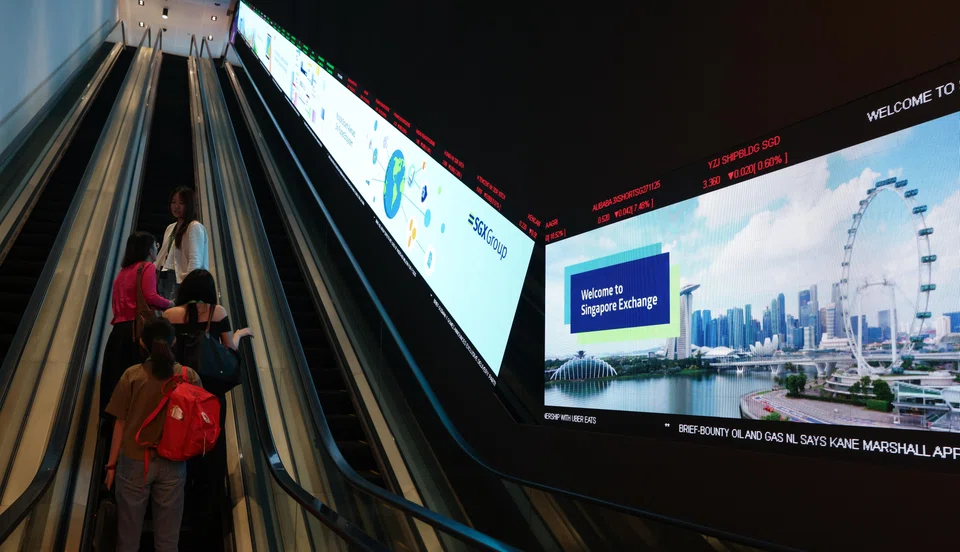
[SINGAPORE] The door may soon open for forward-looking disclosures by listed companies, with market observers saying the shift could improve transparency and narrow information gaps, even as they caution that such statements carry inherent risks and require careful interpretation by investors.
This comes as the Monetary Authority of Singapore (MAS) is seeking feedback on proposed amendments to the Securities and Futures Act, alongside draft regulations to facilitate dual listings on the Global Listing Board.
The proposals include safe-harbour provisions, in line with US market practice, to provide greater certainty around the publication of forward-looking statements.
The move follows feedback gathered by Singapore Exchange Regulation (SGX RegCo) that forward-looking statements – commonly referred to as earnings or forward guidance – rank high on investors’ wish lists.
“The key,” said SGX RegCo CEO Tan Boon Gin and head of listing compliance Michael Tang, “lies in ensuring that the forward guidance is carefully prepared, based on credible methodologies and assumptions, and is realistic and defensible, in line with the principles set out in the Listing Rules.”
Internal models, historical performance and external market data should underpin these projections, they added in a Regulator’s Column published earlier in January.
Navigate Asia in
a new global order
Get the insights delivered to your inbox.
Tan and Tang also noted that all material information, including forward guidance, must be disclosed publicly via the bourse’s electronic platform, SGXNet, to ensure a level playing field.
“Not a licence to speculate”
Observers told The Business Times that projections and guidance can improve market understanding, but they are no substitute for investor due diligence.
David Gerald, founder and CEO of the Securities Investors Association (Singapore), or Sias, noted that some listed companies on SGX already provide such guidance, so the concept is not entirely new.
“Issuers need a mindset change as forward-looking statements are not simply an extension of historical disclosure,” he told BT.
In this context, “safe harbour” is defined as a legal defence to civil liability, provided that forward-looking statements are clearly identified as such and accompanied by meaningful cautionary language, among other conditions.
Michael Kwan, director at Resource Law, described the move as a “watershed moment” for Singapore’s capital markets, shifting from a regime where “silence was golden” to one that encourages managed disclosure.
“The business community should welcome this change, but they must also recognise that the safe harbour is not a licence to speculate; it comes with clear conditions and guard rails,” he added.
Stefanie Yuen-Thio, joint managing partner at TSMP Law, said the change could prove challenging for less sophisticated issuers.
“Many smaller listed companies do the bare minimum in disclosure without realising that they are missing out on a larger potential investor pool,” she said.
Investors want insight into a company’s future plans and likely financial trajectory, she added. This ranges from high-level qualitative statements, such as expectations of stable revenue in the next financial year, to more targeted disclosures that provide indicative ranges.
Paul Chew, head of research at Phillip Securities Research, noted that forward-looking statements are already encouraged by SGX RegCo.
“(Corporates will) remain cautious in issuing such forward-looking statements unless it becomes an industry norm, or (they) recognise the material benefits of such statements,” he noted.
Investor protection
Kwan, recognising that a more permissive disclosure regime must be paired with enhanced investor recourse, noted that MAS has also proposed measures to strengthen investor protection, as set out in a companion consultation paper.
This includes a grant scheme and collective action mechanisms, designed to provide additional avenues for investor redress.
“This is where MAS has demonstrated considerable foresight,” said Kwan, noting that the regulator provides issuers with greater flexibility in disclosure and “sharper teeth” for investors.
Still, market observers caution that disclosure alone does not protect investors. Chew pointed out that operating conditions can change in ways that are outside a company’s control or expectations.
Still, Sias’ Gerald sees regulatory guard rails and enforcement as necessary, given that capital markets operate on a caveat emptor – or buyer beware – basis.
“Investor self-protection through education and discipline remains essential,” he said. “No amount of disclosure or legal protection can compensate for the absence of investor diligence.”
At the same time, market observers stressed that safe-harbour provisions here make US-style litigation unlikely.
Chew pointed out that while the rules protect companies from civil suits, they do not extend to criminal liability.
Gerald added that although litigation risk could increase in theory, Singapore’s legal, procedural and cost structures create high barriers to private enforcement.
Kwan pointed to the prohibition on contingency fees for designated representatives as the “clearest signal that Singapore is not importing the American litigation culture wholesale – just the accountability that comes with enhanced disclosure”.
Taken together with MAS’ proposed investor recourse measures, he believes the reforms should not be viewed as favouring issuers.
When the safe-harbour provisions are considered alongside enhanced recourse avenues, the changes amount to a “recalibration rather than a tilt”, giving both issuers and investors new tools, he added.
Lack of understanding
Market observers have also raised concerns about how forward-looking statements are understood.
Gerald noted that such statements are “typically accompanied by extensive disclaimers that few retail investors read or fully understand”.
This, Kwan said, could mean that “retail investors may not fully appreciate the distinction between historical facts and forward-looking projections”.
“Investors must now become more sophisticated consumers of disclosure, particularly when reading projections and estimates,” he added.
Echoing this concern, Chew noted that investors need to carefully evaluate the underlying assumptions, the company’s track record and the nature of the industry.
TSMP’s Yuen-Thio similarly highlighted the risks of overly optimistic or pessimistic guidance. “Investors who have relied on the announcements and sold, bought or held on to shares may cry foul,” she said.
She suggested that companies should ensure their guidance is well-founded and “couched in terms which are not too specific”, with qualitative guidance being probably less of a risk.
Market observers are invited to submit feedback on the proposed regulations facilitating forward-looking statements, as set out in the consultation paper, by Feb 8.
Decoding Asia newsletter: your guide to navigating Asia in a new global order. Sign up here to get Decoding Asia newsletter. Delivered to your inbox. Free.
Copyright SPH Media. All rights reserved.

