Singapore, Hong Kong banks to benefit most as Asia capital markets deepen in H2: Morgan Stanley
In Asean, select Malaysian and Thai banks can benefit too, say its analysts


[SINGAPORE] A recent report from Morgan Stanley noted that Singapore and Hong Kong banks stand to be key beneficiaries as Asia’s capital markets continue to deepen in the second half of this year.
This comes as the region generates substantial household wealth through rising incomes, urbanisation and an expanding middle class.
Nick Lord and Selvie Jusman, equity analysts from Morgan Stanley, said: “As wealth accumulates, savings gradually shift away from deposits and property, towards financial assets such as equities, bonds, mutual funds and alternative investments.”
Under such a process of “financialisation”, in which markets and institutions begin to heavily influence how businesses operate and how regular people live, financial systems will evolve from being mainly bank lending-driven to being more market-based.
Demand for wealth management and private banking is set to grow as regional economies mature, and Singapore and Hong Kong can expect to remain key beneficiaries of this trend as Asia’s leading financial centres.
The equity analysts said: “Singapore continues to strengthen its position as a regional hub for wealth management, private banking, family offices and cross-border capital flows … (while) Hong Kong (has) renewed momentum in equity capital markets, supported by initial public offering activity improving, cross-border investment flows and ongoing initiatives to deepen renminbi and fixed-income market development.”
Both markets benefit from strong regulatory frameworks, deep institutional investor bases and their ability to intermediate capital across Asia, they added.
As capital markets expand in the region, banks operating within these ecosystems gain access to faster-growing and more capital-efficient revenue streams.
How Asia’s banks stack up
The banks best positioned to benefit are those with integrated corporate, transaction banking, wealth management and capital markets platforms, across regional networks.


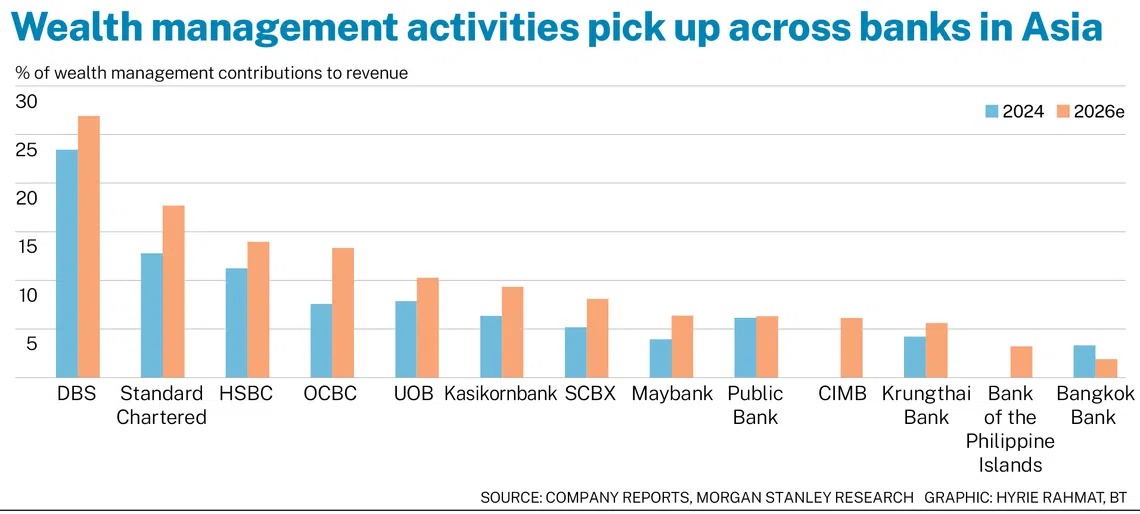
The report said that as corporates become “increasingly sophisticated” in their financing needs, their regional expansion will require syndicated loans, bond issuance, equity capital raising, foreign exchange solutions and risk-management product access.
Hence, capital market activity is becoming more intertwined with traditional corporate banking relationships.
DBS, OCBC and UOB have increasingly built these capabilities across Asean, allowing them to monetise client relationships beyond lending, said the Morgan Stanley analysts.
HSBC and Standard Chartered similarly benefit from facilitating international capital flows, trade finance and wealth management in multiple regions.
“Bank of China (Hong Kong) also stands out as a beneficiary of increasing RMB internationalisation and China-related capital market activity,” the analysts added.
However, many domestic Asean banks stay dependent on traditional lending, and are less exposed to structural growth opportunities. They may screen attractively on valuations, but the analysts stay selective due to “unfavourable macro (conditions and an) overhang on domestic policies”.
That said, in Thailand, banks seek to grow their loan book after a few years of de-risking, although most of such lending will be concentrated in secured retail and corporate lending.
“This suggests that the banking cycle may be transitioning from a period of balance sheet stagnation towards one characterised by renewed credit expansion,” noted the report.
The analysts flagged Bangkok Bank as “well-placed” among its Asean counterparts, given its longstanding focus on corporate banking and regional connectivity, with Kasikornbank as a thematic beneficiary.
Other select Malaysian banks such as CIMB and Maybank could benefit from Asia’s deepening capital markets, too.
But Indonesian and Philippine banks have had more earnings downgrades – with the more domestically-focused ones generally underperforming, as growth expectations soften amid a weaker lending momentum.
“Capital market growth is likely to become an increasingly important differentiator between banks over the coming decade,” said Jusman and Lord.
A multiplier effect
The Morgan Stanley analysts noted that balance sheet growth will be a key earnings driver over the next few years as well.
This comes as policy rates decline in South-east Asia and margin tailwinds fade, with loan growth likely to become a more important driver of earnings.
Many corporates are now entering a new investment cycle where they expand capacity and raise infrastructure spending. They are no longer focusing on repairing balance sheets or preserving liquidity as they were doing right after Covid-19.
“This should support stronger demand for corporate loans, working capital facilities, trade finance and transaction banking services,” the analysts said.
Geopolitical tensions, supply-chain resilience considerations and diversification away from a single manufacturing hub – are just some macro-economic conditions encouraging multi-national companies to expand their presence across South-east Asia.
“Countries such as Vietnam, Indonesia, Thailand and Malaysia continue to attract foreign direct investment, particularly in electronics, automotive, renewable energy and digital infrastructure,” the report indicated.
“As corporations build new production facilities, logistics networks and regional headquarters, banks become important financing partners through project financing, supply chain financing, trade services and foreign exchange solutions.”
The analysts expect these macro conditions to create “a powerful multiplier effect” with a single corporate relationship now able to generate lending, deposits, transaction banking and capital market revenues.
Decoding Asia newsletter: your guide to navigating Asia in a new global order. Sign up here to get Decoding Asia newsletter. Delivered to your inbox. Free.
Copyright SPH Media. All rights reserved.