Singapore shares close higher on Tuesday; STI up 0.5%
Across the broader market, losers outnumber gainers 291 to 280
 Add BT as a preferred source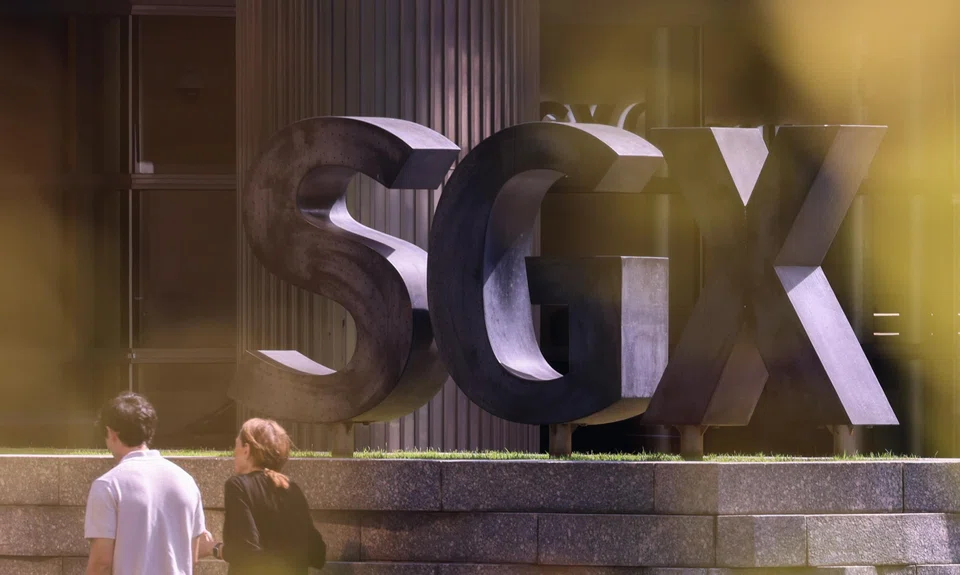
[SINGAPORE] Singapore stocks ended higher on Tuesday (Jul 14).
The benchmark Straits Times Index (STI) gained 0.5 per cent or 25.27 points to finish at 5,495.61.
DBS led the gainers on the blue-chip index, rising 1.8 per cent or S$1.24 to S$72.03.
The other local banks ended higher, too. OCBC rose 1.5 per cent or S$0.40 to S$27.88, and UOB was up 0.9 per cent or S$0.40 at S$44.38.
The worst performer among STI constituents was Singapore Exchange , which fell 2.9 per cent or S$0.71 to S$23.71.
Within the iEdge Singapore Next 50 Index, PC Partner was the top gainer, rising 6.1 per cent or S$0.15 to S$2.62.
Hong Leong Asia was the index’s biggest decliner, falling 6.5 per cent or S$0.17 to S$2.46.
Across the broader market, losers outnumbered gainers 291 to 280, after 1.3 billion securities worth S$2.2 billion changed hands.
Key regional indices were positive. Hong Kong’s Hang Seng Index gained 0.5 per cent, Japan’s Nikkei 225 rose 0.7 per cent, South Korea’s Kospi was up 0.7 per cent and the FTSE Bursa Malaysia KLCI advanced 1.3 per cent.

Analysts from BlackRock Investment Institute said that, at this juncture, they prefer Japanese equities over government bonds.
“We continue to see a more constructive backdrop for Japanese equities as the economy emerges from decades of deflation and the Bank of Japan gradually normalises policy,” they said.
Globally, senior analyst at Swissquote Ipek Ozkardeskaya said that markets are now in the “stress zone”. This comes especially with oil gaining as much as 20 per cent since its Jul 2 dip below the US$70-per-barrel level, after the resurgence of tensions between US and Iran.
Brent crude oil futures broke past US$80 per barrel, and were up around 0.6 per cent at US$81.46 as at Tuesday evening in Asia.
Ozkardeskaya pointed out that spot prices of oil are also rising faster than futures – a sign of “growing concerns” about near-term supply.
“Rising oil prices are fuelling global inflation expectations once again,” she said. “Higher inflation expectations are pushing yields higher, and higher yields (will weigh) on equity appetite.”
This article has been written with the assistance of AI and reviewed by a reporter
Decoding Asia newsletter: your guide to navigating Asia in a new global order. Sign up here to get Decoding Asia newsletter. Delivered to your inbox. Free.
Share with us your feedback on BT's products and services