

Singapore shares end lower; STI down 0.4%
DFI Retail Group leads gainers on the blue-chip index, rising 4.2% or US$0.15 to end at US$3.68
 Add BT as a preferred source
[SINGAPORE] Singapore stocks ended lower on Friday (Jun 19).
The benchmark Straits Times Index (STI) lost 0.4 per cent or 20.14 points to finish at 5,192.70.
DFI Retail Group led the gainers on Singapore’s blue-chip index, rising 4.2 per cent or US$0.15 to US$3.68.
The worst performer among STI constituents was ST Engineering , which fell 2.9 per cent or S$0.32 to close at S$10.83.
The local banks all ended lower. DBS lost 0.1 per cent or S$0.04 to S$65.96, OCBC fell 1.8 per cent or S$0.45 to S$24.63, and UOB was down 1.1 per cent or S$0.45 at S$39.25.
Within the iEdge Singapore Next 50 Index, PropNex was the top gainer, rising 7.2 per cent or S$0.13 to S$1.93. Centurion Accommodation Reit was the index’s biggest decliner, falling 3.7 per cent or S$0.04 to S$1.03.
Across the broader market, losers outnumbered gainers 241 to 173, after 1.4 billion securities worth S$2.9 billion changed hands.
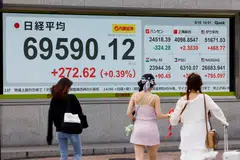
Key regional indices were mixed. Japan’s Nikkei 225 gained 0.3 per cent and the FTSE Bursa Malaysia KLCI was up 0.04 per cent. South Korea’s Kospi, meanwhile, fell 0.1 per cent.
RHB chief economist and head of market research Barnabas Gan said the bank’s risk sentiment index has improved over the last two weeks, as US and Iran are in the middle of a final peace deal.
“Assuming a US-Iran ceasefire evolves into a more durable peace agreement, we advocate a shift in asset allocation towards overweight US and Asean equities, market-weight fixed income, and an underweight position in cash,” he said.
Gan added that the recent market pricing in rates appears overly reactive to US Federal Reserve chair Kevin Warsh’s hawkish remarks.
“The uptick in Treasury yields seen early on Friday likely overstates the policy implications, particularly against a backdrop of improving geopolitical conditions,” he said. “We observe Warsh’s assertion that inflation cannot be tolerated remains consistent with established Fed rhetoric.”
This article has been written with the assistance of AI and reviewed by a reporter
Decoding Asia newsletter: your guide to navigating Asia in a new global order. Sign up here to get Decoding Asia newsletter. Delivered to your inbox. Free.
Share with us your feedback on BT's products and services
TRENDING NOW

MedPark’s assistant CEO runs a hospital where patients, physicians precede profits

E-commerce is killing ‘real’ commerce, says China’s beverage king Zhong Shanshan

Laos-China Railway picks up steam, but S-E Asian country struggles to capture gains
NDR 2026: Singapore to create new Western island to support 'new generation of industries'

