Singapore unveils national AI missions for finance amid US chip restrictions
They focus on financial crime prevention, improving access to financing and safe agentic transactions

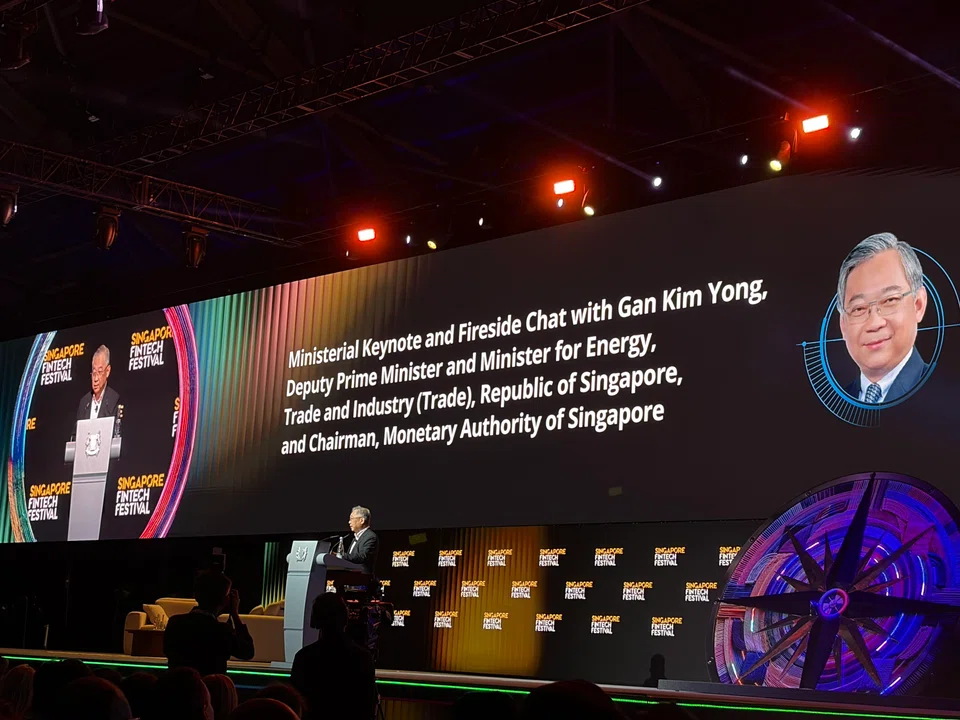
[SINGAPORE] Singapore is pressing ahead with three national artificial intelligence missions for financial services, even as new US chip export restrictions raise uncertainty over access to the computing capacity needed to support its AI ambitions.
Deputy Prime Minister Gan Kim Yong, who is also chairman of the Monetary Authority of Singapore (MAS), said on Wednesday (Nov 18) that the AI missions – first announced during Budget 2026 – will focus on three core areas: strengthening financial crime prevention, improving access to financing and enabling safe agentic transactions.
“We will bring together financial institutions, technology companies, researchers and public agencies to build shared capabilities and achieve more than any institution could alone,” he said, speaking at the Singapore Fintech Festival 2026.
“We will test promising solutions against global best practices and standards, and take those that work towards wider deployment.”
At Budget 2026, the government established the National AI Council, chaired by Prime Minister Lawrence Wong, to drive AI transformation in key sectors, including financial services.
Gan’s remarks followed new US Department of Commerce rules requiring licences to export, re-export or provide remote access to advanced semiconductors for five countries, including Singapore.

He said that authorities are working with affected companies to assess business impact and engaging US officials to facilitate access.
Stressing Singapore’s international reputation, he added that the country does not condone companies using their association with the Republic to bypass foreign laws. “We will act against those who flout our laws,” warned Gan.
Financial crime prevention
Against this backdrop, Gan detailed how Singapore plans to harness AI to address key challenges.

The first mission is to strengthen Singapore’s ability to detect and disrupt financial crime, he said.
Given that scams are not confined within the boundary of one bank, a victim’s money can pass through several institutions within minutes.
“We will not be able to mitigate the risk if each institution sees only its part of the transaction chain,” he said.
“We must connect information across the financial system while strengthening detection within each institution, so that we can identify suspicious activity earlier, intervene faster and stop more money from being lost.”
A proof-of-value is already underway with five banks, he said. Their transaction data is pooled securely, allowing AI models to pick up patterns that no single bank can see on its own.
This, he said, will shape an industry-wide Scam Detection Utility.
MAS will begin a design study early next year to develop the blueprint, including its governance and operating model.
This work will initially focus on accounts and data in Singapore, and over time there may be opportunities for cross-border cooperation.
Improving access to SME financing
Another mission is to help businesses, especially small and medium-sized enterprises (SMEs), gain better access to financing.
“Many lenders assess businesses largely on past performance and repayment history, and secure loans against personal guarantees and collateral,” he said.
These traditional approaches may not fully capture the creditworthiness and future prospects of SMEs, or that of newer startups with limited track records or assets.
Data from bank accounts, invoices, business profiles, payments and government records, Gan said, can be fragmented and difficult to access or not systematically captured. This makes it harder for lenders to bring together relevant data for proper credit assessment.
By analysing a broader range of data, AI can help lenders make faster and better-informed decisions, potentially reducing borrowing costs for SMEs.
If successful, AI can eventually identify when a viable business may need financing, allowing lenders to proactively inform SMEs of suitable financing options that they may not be aware of.
Gan said that Singapore will invite AI technology companies to develop and test solutions using realistic synthetic data, with financial institutions and public agencies contributing data and domain expertise, and seek feedback from SMEs to assess whether the solutions address their financing needs.
Enabling safe agentic transactions
The third mission will explore how AI agents can safely carry out transactions on behalf of individuals and businesses.
Such agents can help them manage cash more efficiently, make payments across institutions faster and more reliably, and enable new forms of machine-led commerce.
However, greater autonomy must come with clear responsibility and accountability, Gan cautioned.
“Agents must operate within defined authority and limits and institutions and enterprises remain accountable for actions taken on their behalf, with safeguards built in from the start,” he said.
One area being explored is how AI agents can interact with purpose-bound money to carry out transactions within defined authority and limits.
For instance, agents can automatically fulfil contractual payments once agreed terms have been verified, or complete purchases on behalf of users.
These trials will help examine the value agents can create and the safeguards needed for wider use, including common approaches to identity, authority, accountability and interoperability, he added.
The Future of Finance Institute will support the three missions by bringing together industry participants, researchers and public agencies to develop common standards, AI risk management resources and solutions for wider adoption.
Enhancing digital payments
Separately, Gan announced the release of the Phase 2 report for PayNow Generation 2, setting out how to make payments simpler, safer and more accessible.
This includes a new SGQR+ switch, which will enable Singapore residents and tourists to pay with any SGQR+ label with their preferred QR app, as well as other enhancements, he added.
Gan emphasised that trust will be central to how quickly Singapore can innovate, and financial institutions must remain accountable, with strong human oversight and effective safeguards.
The country will also invest in its workforce so they can work effectively and responsibly alongside AI, and benefit from new opportunities.
“Our focus is on trusted partnerships within a trusted ecosystem,” he said.
“By bringing financial institutions, technology companies, researchers and public agencies together around clear standards and shared responsibilities, we can test new ideas with confidence and bring useful solutions into wider use.”
Decoding Asia newsletter: your guide to navigating Asia in a new global order. Sign up here to get Decoding Asia newsletter. Delivered to your inbox. Free.
Copyright SPH Media. All rights reserved.