Singapore’s deep-tech startups tap China for scale, set sights on the US for higher margins
The challenge now lies in navigating the complex geopolitical landscape and staying true to their value proposition
[SUZHOU/SHENZHEN] Singapore’s deep-tech startups are tapping China’s robust robotics and renewable energy ecosystems to scale their businesses, while setting their sights on the US to capture higher profit margins.
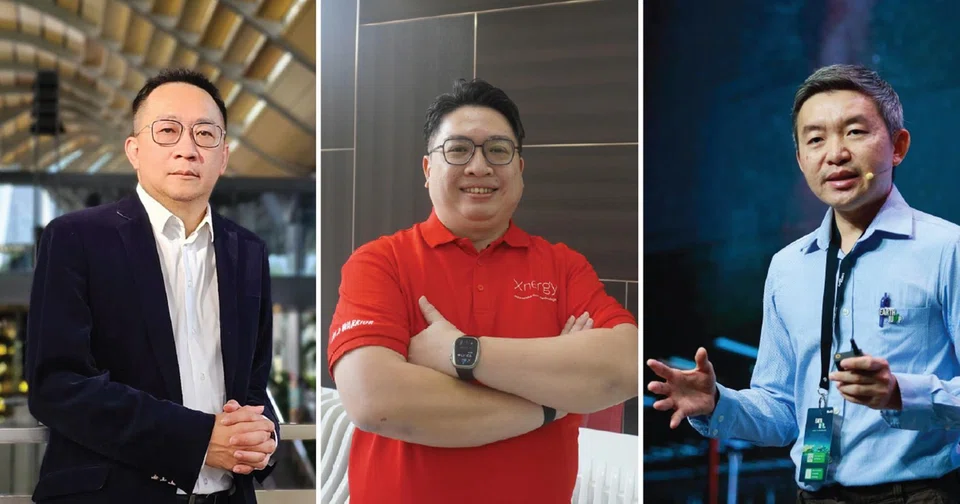
“We chose China... the most competitive market you can find in the world. And if we survive (there), we will survive anywhere,” said Tong Chin Fong, co-founder and CEO of Singapore startup Xnergy, which develops wireless charging infrastructure for robots.
To navigate the competition, Singapore companies need to identify their value proposition and determine whether it aligns with available business opportunities, said Kow Juan Tiang, Enterprise Singapore’s executive director for China.
Tech and innovation, as well as the green economy, are among the growing areas which align with China’s economic priorities.
“Even though there’s competition over there, at least the pie is growing and we need to focus on (those areas),” Kow told reporters in September as part of a media trip organised by Enterprise Singapore.
For Singapore startups such as Xnergy, Quikbot and Quantified Energy, China’s manufacturing capabilities, supply chains and customer base offer them opportunities to grow their business, and also serve as a springboard into other markets.
Tapping China’s strengths
When Xnergy started out in 2018, China’s robotics industry was relatively small, with just 100,000 mobile units produced annually, said Dr Tong.
In contrast, a single client has produced the same volume just within the first seven months of this year, he noted.
In 2025, robot installations in China grew by 20 per cent year on year and the country accounted for 59 per cent of the world’s industrial robot deployments, data from the International Federation of Robotics showed.
Xnergy brought technology first developed at the Nanyang Technological University to Suzhou in 2021, with the aim of scaling up production and positioning itself near automotive manufacturing giants such as SAIC Motor and Cherry Automobile, noted Dr Tong.
The company collaborated with local robotics companies and manufacturers to bring its chargers to production within three years. It has since sold 7,000 units worldwide.
Another Singapore startup that was drawn to China’s thriving robotics scene is Quikbot.
Quikbot was founded in 2021 and offers a software subscription platform, QuikSync, that connects robots to existing facility management systems, allowing them to navigate indoor spaces and take elevators.
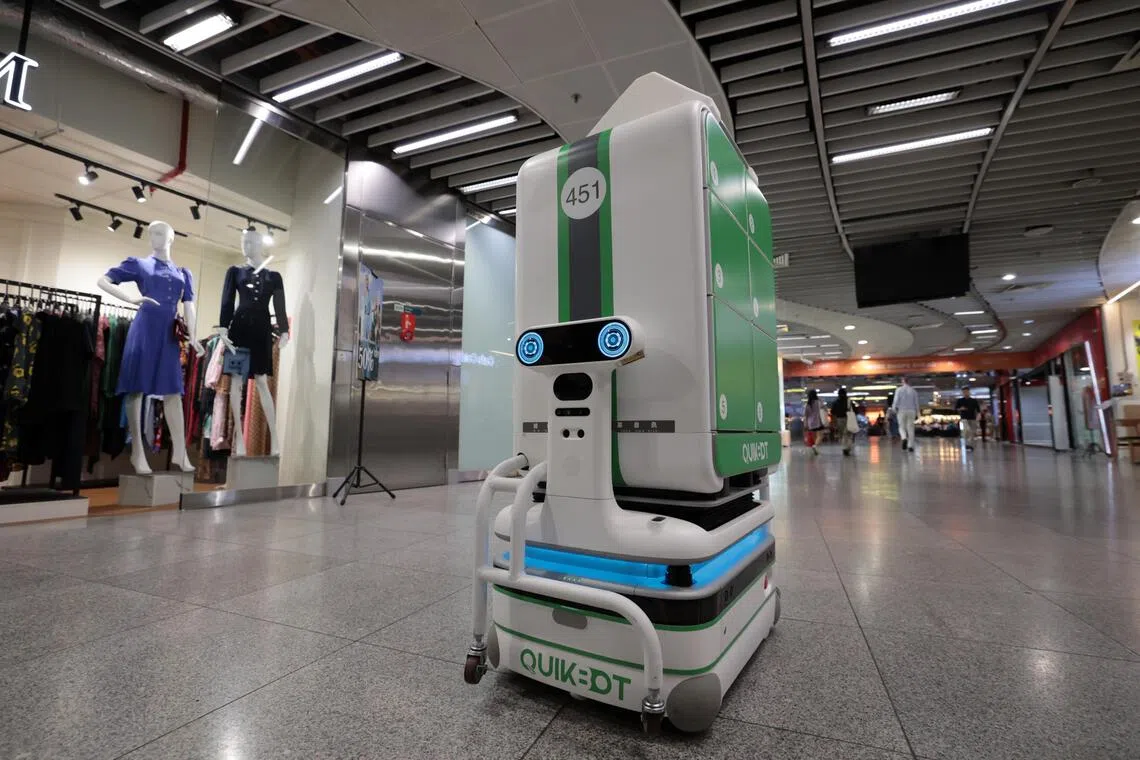
The QuikSync platform accounts for around 65 per cent of Quikbot’s revenue. Meanwhile, the company also offers autonomous last-mile delivery and logistics services across hospitals, hotels, malls and city networks in Singapore, while it expands into the United Arab Emirates and Japan.
Rather than engaging in direct rivalry with autonomous delivery solution providers in China, Quikbot set up an office in Shenzhen in 2023 primarily for research and development, and manufacturing.
CEO Alan Ng cited Shenzhen’s “immense talent pool, the most innovative robotics supply chain and a dense ecosystem of technology startups” as some of the reasons why the city was chosen.
The company’s presence in Shenzhen allows it to test and integrate new models directly with manufacturers, moving from development to deployment significantly faster, he added.
Beyond the robotics industry, another Singapore startup that is growing in China is Quantified Energy, a solar panel inspection company founded in 2021 by a team from the Solar Energy Research Institute of Singapore at the National University of Singapore.
The company, which entered the Chinese market in 2023, uses autonomous drones, artificial intelligence and electroluminescence imaging to detect defects in solar panels.
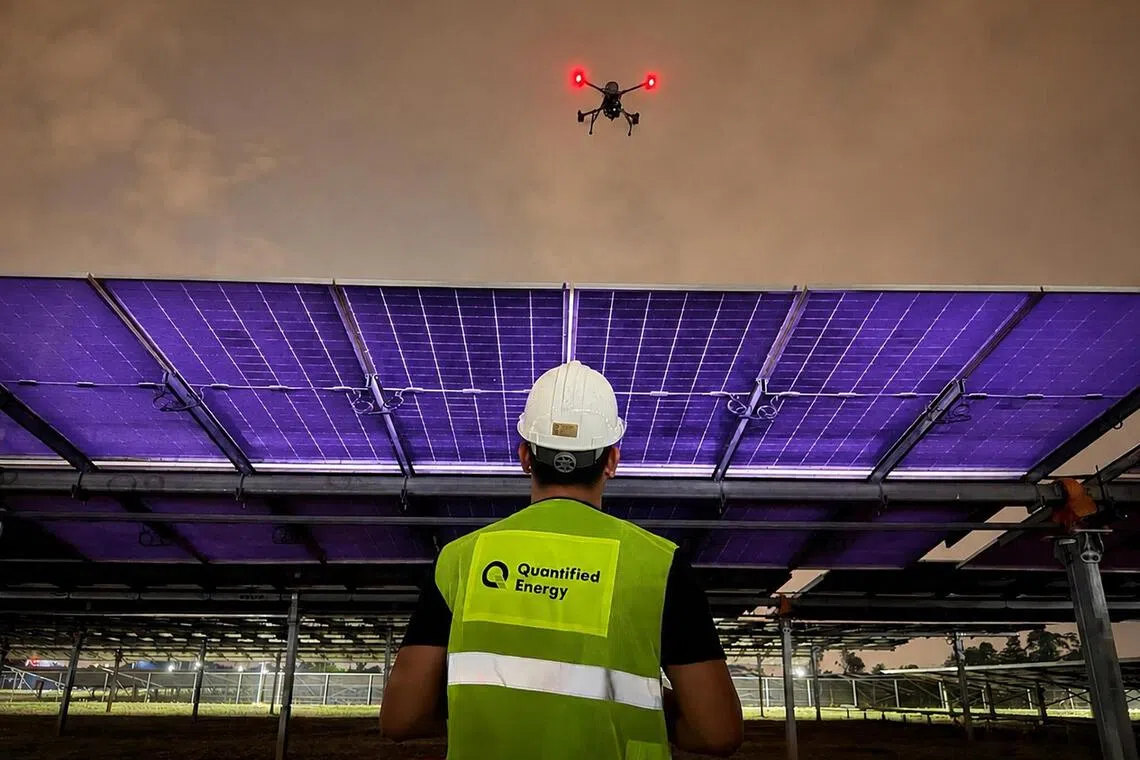
Co-founder and chief operating officer Khoo Yong Sheng told reporters the company went to China because of the country’s vast renewable energy market. In July, solar panels surpassed coal as China’s top source of power capacity, which presents a “major opportunity” for solar panel inspection services, said Dr Khoo.
Moreover, China’s installed solar capacity is expected to reach about 1.5 terawatts in 2026, roughly equivalent to three billion solar panels.
“Our technology allows us to complete inspection faster, more accurately and with less manpower than our competitors,” said Dr Khoo. He added that the company’s inspection solutions are 20 times faster and 10 times cheaper than market alternatives.
Seeking growth margins
Xnergy’s Tong noted that the large order volumes from customers in China have enabled the team to ensure that its product can be delivered reliably at scale.
Yet, while China offers room to scale and a robust supply chain, all three deep-tech startups are hoping to diversify their revenue streams and capture stronger margins in the US.
This comes as the Chinese market is experiencing the phenomenon of “involution”, which is characterised by fierce competition that erodes business profitability.
For Quantified Energy, the US has already surpassed China to become its top market.
Because solar installation costs are “much higher” in the US than in other regions, developers find the company’s inspection fees “more acceptable” and are increasingly considering electroluminescence inspection as a standard requirement for solar plants, said Dr Khoo.
Quikbot is also laying the groundwork for a US market entry over the next few years, given the country’s large stock of commercial buildings.
“QuikSync should earn stronger margins there, since pricing reflects local labour costs while our integration costs stay similar,” Ng said, noting the company is already in early pilot discussions with a US city agency.
Xnergy’s Dr Tong noted that while order volumes from the US for its wireless chargers are around one-third of those from China, margins in the US are more than double.
But pivoting to the US also presents hurdles.
Setting up US operations has been “very challenging,” said Dr Tong. He expects Xnergy’s US supply chain to take at least a year to launch as domestic manufacturing grows.
“Even if (manufacturers) have capacity now, it all goes to the data centre products,” he said. “For them, (robotics) is still the future, it is still not here yet... they serve the data centre customers where they need it immediately. So for us, we are secondary,” he added.
There is also an added layer of geopolitics to be navigated for Singaporean startups that want to operate in both the US and China.
As data privacy regulations tighten, companies must physically and digitally silo their operations. Quantified Energy currently serves its US clients directly from Singapore, but maintains a distinct local entity in China.
“All the data captured in China needs to remain in China, so the Singapore entity does not look at that data,” Dr Khoo said.
Moreover, given that bigger sources of startup funding usually come from the US or China, this puts growth-stage deep-tech startups like Xnergy in a “difficult position” as they balance their sources of funding, said Dr Tong.
“If we take (funding from) either one, they might say we have too much presence in China (or the US),” he added.
As a result, the company has relied more on investments from South Korea, Japan, Malaysia and Singapore in recent funding rounds.
For these Singapore startups, the challenge now is to navigate the complex geopolitical landscape – doing so will enable them to successfully make the leap from China’s demanding market to higher margin growth in the US.