T Rowe seeks to ring-fence US$165 billion emerging-market portfolio from El Nino fallout
The firm is among a growing number of asset managers adjusting how they invest amid climate change
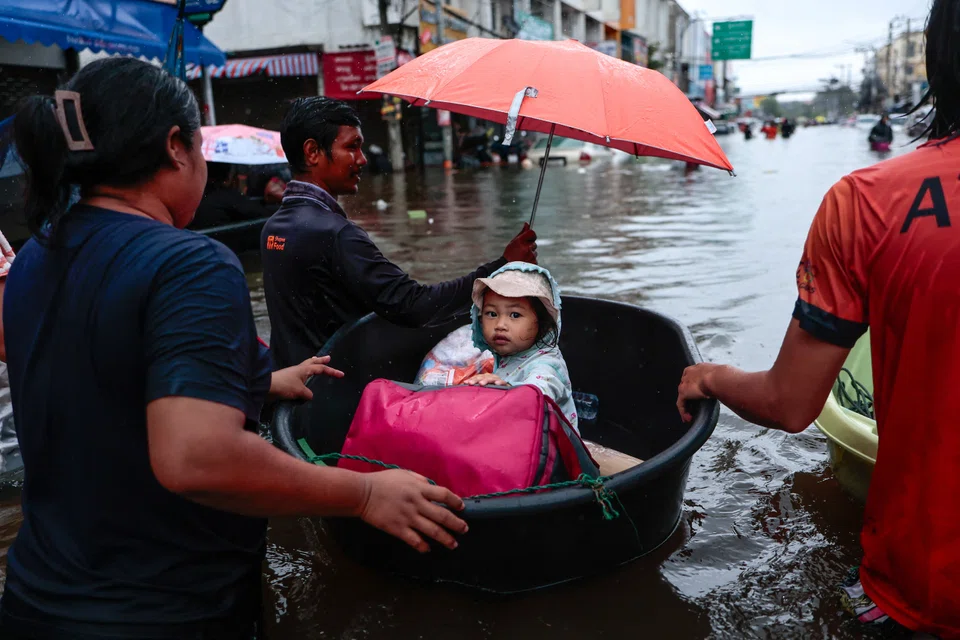
T ROWE Price has started relying on custom-made models to protect its US$165 billion portfolio of emerging-market debt and equities from what promises to be an unusually destructive El Nino.
Aaron Gifford, associate director of research for global sovereigns at the global investment manager, said planning began when the last El Nino was forming.
Two years ago, researchers at his alma mater, Johns Hopkins University (JHU), started developing the suite of climate and weather analytics that T Rowe now uses alongside its own econometric analyses.
Everything was set in motion “the minute I saw news come up of another El Nino”, Baltimore-based Gifford said. “We started realising we could really benefit from much more rigour on the academic side.”
The climate phenomenon associated with warming across the equatorial Pacific Ocean is already upending weather patterns across the globe.
Since it started forming in May, El Nino has hit maize and bean crops in Honduras and El Salvador, while in Asia, uneven rainfall is hurting rice and palm-oil production.
Analysts at Goldman Sachs Group are among those warning of the broader implications for global food prices.
In response, investors including Man Group, the world’s largest publicly traded hedge fund firm, are trying to map out possible contagion effects. But investing around El Nino also requires insight into how policymakers are likely to react.
A case in point is T Rowe’s strategy on Colombian sovereign bonds. Gifford noted that the country is “highly impacted by El Nino drought conditions” because of its reliance on hydroelectricity and agricultural output, all of which affects inflation.
SEE ALSO





For now, though, the central bank in Bogota has “stopped short of the amount of interest-rate hikes that we anticipated, or at least our analysts anticipated”, he said. “And now we get to ask: Are they making a policy mistake?”
“The size of the positions that we’re taking is more moderate, just because of this super El Nino that we’re expecting later in the year,” he added.
Studying the implications
T Rowe, which oversees a total of US$1.9 trillion, is among a growing number of asset managers actively adjusting how they invest as they try to make money – and avoid losses – by analysing all the implications of El Nino.
In London’s Mayfair district, a former Balyasny Asset Management trader who started his own hedge fund, Zulfiqar Ali, said he is preparing for an “unusually alpha-rich environment” in Europe’s power markets thanks to El Nino.
And Bloomberg reported in June that Moreton Capital Partners, based in Wilmington, Delaware, is targeting US$500 million to bet on all the ways in which El Nino will upend food prices.
Asset managers are also increasingly aware that producing forecasts that take El Nino and climate change into account requires a new kind of approach.
“The single biggest gap in all the models is that they measure the exposure, the hazards and how companies are exposed, but not how companies are managing, reducing and mitigating those risks,” said Lucian Peppelenbos, climate and biodiversity strategist at Robeco.
By the end of 2026, Robeco plans to roll out adaptation scores internally for MSCI All Country World Index members that rate companies versus their industry peers on identifying and adapting to physical climate risks.
The aim is to arm equity analysts with more data before making investment decisions.
In highly exposed emerging markets, meanwhile, investors are particularly attuned to signs that El Nino will have an impact on government deficits, energy supplies and agricultural prices.
“Any time you have a country that has an existing fiscal or external vulnerability intersecting with underpriced market risk for tail events – underpriced tail risk – that’s an intersection on the Venn diagram that we’re trying to be very attuned to,” said Samy Muaddi, head of emerging markets in T Rowe’s fixed-income division.
Getting it right
The base model developed for T Rowe by JHU uses a global vector auto-regressive (GVAR) approach, which is a macroeconomic methodology that helps figure out how a shock in one part of the world ripples through into other regions.
By combining GVAR models with more standard analyses of metrics such as sea surface temperatures, researchers can piece together the scenarios that then inform T Rowe’s investment decisions. T Rowe also engages with JHU’s country-focused research analysts.
Getting it right comes with significant upside.
“El Nino is the largest driver of inter-annual climate variability on Earth,” said Ben Zaitchik, a professor of Earth and planetary sciences at JHU. He works with Takeru Igusa, a civil and systems engineering professor, on the tools that they are continuing to develop.
The research provides estimates of El Nino’s impact on temperature, precipitation, hydrology and agriculture in 12 emerging markets spanning Latin America and Africa, as well as South and South-east Asia.
It is part of a suite of four climate analytics tools that also incorporate foundation models from Nasa and econometric studies. Both bond analysts and stock pickers at T Rowe have access to the tools.
The money manager also plans to use the models to guide climate resilience-related clauses when lending to small island nations on deals that allow them to freeze debt payments in the event of a natural disaster.
“We’re going to be well-positioned to be ahead of the market in understanding the option value embedded in climate-resilient debt clauses by having this type of partnership and research,” said Muaddi. BLOOMBERG
Decoding Asia newsletter: your guide to navigating Asia in a new global order. Sign up here to get Decoding Asia newsletter. Delivered to your inbox. Free.
Share with us your feedback on BT's products and services