Katoen Natie to test driverless trucks on Jurong Island
Singapore
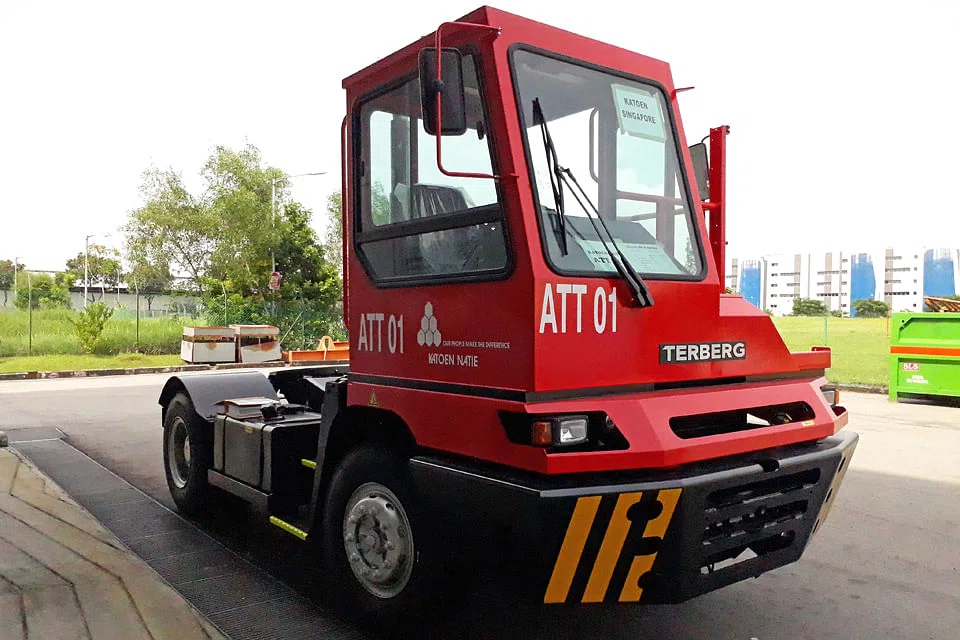
LOGISTICS service provider Katoen Natie is planning to test self-driving trucks in Singapore from September this year, in a bid to overcome difficulties in hiring truck drivers here.
The Belgium firm will first put on trial an autonomous truck in Jurong Island for a few months. If successful, 11 more of its trucks will be equipped with self-driving technology, said the firm.
"We are trying to see how we can introduce technologies that can enhance our operations at large," its senior commercial manager Wallace Tay told The Business Times.
The project involves three phases, with each using progressively more advanced technology and a wider area.
In the first phase, Katoen Natie will program the trucks to run between two fixed points in one of the largest chemical plants on Jurong Island; each round trip is 6-8 kilometres long. Transponders, or radio transmitter-receivers using radio-frequency identification (RFID) technology, will be installed on the route to signal the trucks' positions to the control centre.
In phase two, the transponder system will be replaced by a GPS system, and the test area expanded to a larger area within the plant. This will take place by either the end of next year or 2019.
Finally, the company will start using the trucks on public roads in the third phase, potentially carrying containers between various chemical plants on Jurong Island or even to Tuas Port.
This will occur in 2020 when the first autonomous buses are also expected to start running on public roads; the timeline is planned in such a way to ensure that local legislation can catch up with technology that is already available, said Mr Tay.
The group is expecting to spend about S$3.5 million on the project which is also subsidised by the government.
Katoen Natie started on this project as it was a challenge hiring truck drivers for its round-the-clock operations, said Mr Tay. With autonomous trucks, Katoen Natie can cut the number of drivers required from the current 30 to four, and redeploy them to other higher-skilled roles.
There will also be other benefits such as slower wear and tear of the vehicles as they will run on a constant speed, he added.
Katoen Natie is working with VDL Groep, a Dutch industrial and manufacturing company which has successfully implemented similar projects in Europe, for its autonomous vehicle technology.
The Economic Development Board (EDB) said it is excited for Katoen Natie to be pioneering the first-of-its- kind self-driving trucks on Jurong Island. "If successful, it can pave the way for further productivity improvements in the logistics activities on Jurong Island, and enhance the competitiveness of our chemicals sector," said energy and chemicals executive director Damian Chan.
Katoen Natie's project is one of several trials involving autonomous vehicle technology in Singapore.
French carmaker Peugeot is partnering US startup nuTonomy to test self-driving cars in the city-state. Two Peugeot 3008 autonomous cars will be on the streets in one-north - an area designated for testing autonomous vehicles by the government - by September, while a dozen more will be in operation by the beginning of next year.
nuTonomy has been conducting public self-driving taxi trials in one-north since August last year.
Next year, port operator PSA Corporation will start road trials of a truck platooning system in which a human-drive truck leads a convoy of driverless trucks using wireless communication.
The Land Transport Authority has also inked a deal with ST Kinetics to build driverless buses, with the aim of putting them into service by late 2020; a driverless shuttle bus is already plying the roads of Nanyang Technological University since March, and two full-sized driverless buses will start operations there next year.