

SIA Engineering, Rolls-Royce JV SAESL to offer 30 work-study places from 2027
It will also retrain its existing staff to keep up with changes in AI and other digital technologies

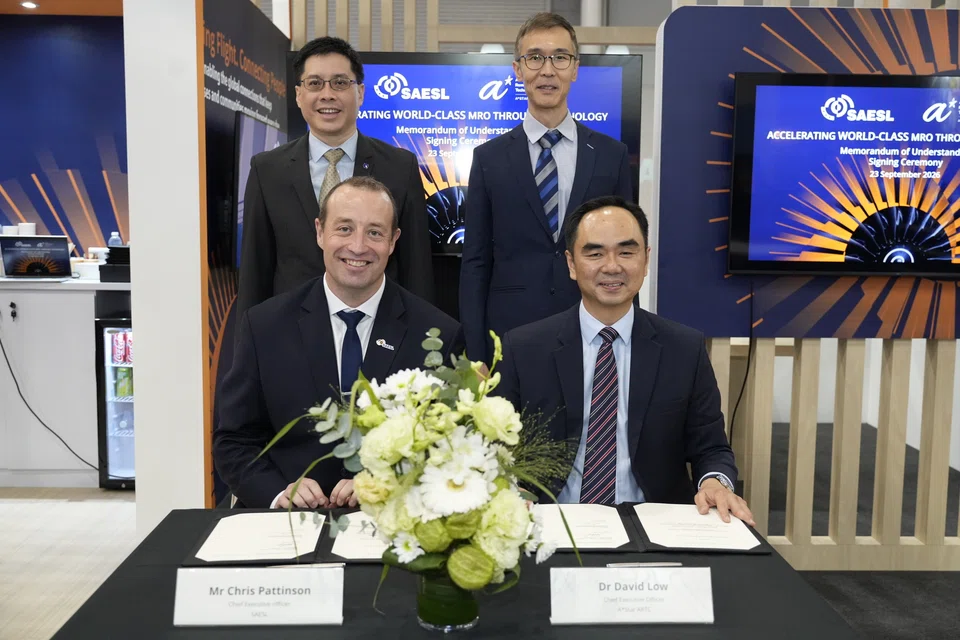
[SINGAPORE] Singapore Aero Engine Services (SAESL) is ramping up its talent pipeline by offering 30 work-study diplomas to Institute of Technical Education (ITE) students starting in 2027 while retraining its entire existing staff to keep up with digital transformation in the workplace.
The aircraft maintenance, repair and overhaul (MRO) provider’s move is part of its broader plan, announced in February, to hire more than 1,000 new technicians over the next five years. This will support a S$242 million facility expansion that will boost the SIA Engineering-Rolls-Royce joint venture’s MRO capacity by 40 per cent by 2029.
“Singapore’s aerospace industry will continue to depend on a strong pipeline of skilled local talent and continued development of advanced technologies,” said SAESL chief executive Chris Pattinson on why the company is aggressively expanding its talent pool.
Pattinson was speaking to The Business Times on Wednesday (Sep 23) at MRO Asia-Pacific 2026, a conference and exhibition for the commercial aviation aftermarket. SAESL signed four strategic memorandums of understanding (MOUs) with the ITE, Republic Polytechnic, Temasek Polytechnic and A*Star’s Advanced Remanufacturing and Technology Centre (ARTC).
The educational partnerships are expected to generate up to 200 trainee technicians annually.
Apart from building up its incoming talent pipeline, the company is also retraining its staff to keep up with rapid changes in AI. Pattinson said that as SAESL transitions away from highly manual processes, it is augmenting – not replacing – human capital.
“Every single employee today is undergoing a transformation,” Pattinson said of the company’s 2,000-strong workforce. Existing workers are being equipped with new digital skill sets to ensure they can operate alongside emerging technologies. The training will extend to new hires, with the company targeting a headcount of more than 2,500 over the next five years.
This AI-led transformation will be heavily supported by a five-year pact with A*Star ARTC, focusing on the joint development of AI-native technologies rather than relying purely on off-the-shelf software.
Off-the-shelf solutions provide the standard industry hardware and software, whereas AI-native technologies feature highly customised, co-developed applications that adapt that AI specifically to the rigorous, proprietary demands of an aerospace assembly line.
SEE ALSO
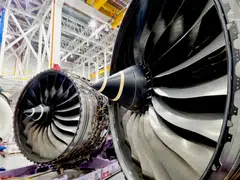

Future shop floors will feature virtual replicas of the entire assembly line to help coordinate MRO work, and SAESL said it will also conduct visual inspections assisted with technology to improve the overall quality and standard of maintenance.
SAESL’s technological transformation also leans heavily into additive manufacturing, the process of creating an object by building it one layer at a time. Pattinson said this can partially relieve the pressure the MRO sector is facing due to severe supply chain bottlenecks.
For example, by generating a highly detailed three-dimension digital model of a worn engine component and comparing it against its original condition, SAESL can create automated digital paths to execute “material-on” repairs.
This restoration method, which involves adding new repair compounds directly onto a prepared damaged base layer to restore structural integrity or surface finish, allows the MRO provider to repair parts locally. This reduces time spent waiting for physical replacements, significantly speeding up engine turnaround times for airlines.
Decoding Asia newsletter: your guide to navigating Asia in a new global order. Sign up here to get Decoding Asia newsletter. Delivered to your inbox. Free.
Copyright SPH Media. All rights reserved.
TRENDING NOW

Grab CEO’s wife Chloe Tong on life with Anthony Tan and finding her purpose

HDB reviewing ‘jumbo’ flat scheme after Telok Blangah unit listed for sale at S$2.18m

He built the Vingroup empire. Now South-east Asia’s richest man is handing some key roles to his sons

Singapore judge raises doubts iron ore trader Radiant World is owed US$1 billion

