

UOL H1 net profit rises 23% to S$252.2 million on joint venture profits
Revenue falls 7% year on year to S$1.4 billion from S$1.5 billion
 Add BT as a preferred source


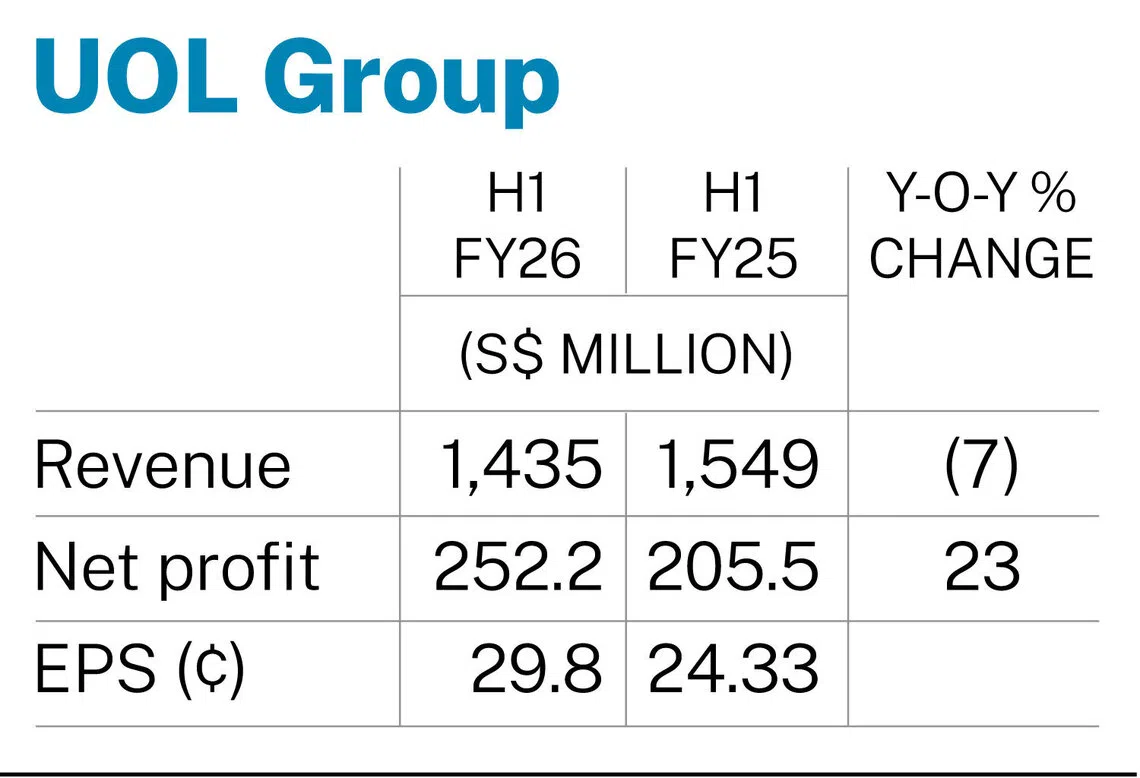
[SINGAPORE] Property developer UOL Group posted a 23 per cent year-on-year increase in net profit to S$252.2 million for the first half ended Jun 30, from S$205.5 million.
In an earnings briefing on Wednesday (Aug 12) evening, UOL chief executive officer Liam Wee Sin described the group’s half-year performance as a resilient, momentum-driven “strong set of results” delivered amid global headwinds.
“Singapore’s safe haven status has given us the momentum… not just in the financial results of our group, but also across our asset classes,” said Liam.
He cited strong residential sales across UOL’s projects, which gave the group healthy income visibility. Watten House and Skye at Holland are fully sold, while Pinetree Hill and Parktown Residence are nearly sold out. Around 20 per cent of units remain unsold at both Upperhouse at Orchard Boulevard and Meyer Blue.
Liam also pointed to “solid” rental reversions in the group’s commercial portfolio – at 7.3 per cent for offices and 5.5 per cent for retail – and a steady hospitality business despite continued uncertainty in the global travel market.
This helped lift operating profit after tax and minority interest (patmi) by 16 per cent to S$239.8 million, from S$206.6 million previously.
Earnings per share for H1 rose to S$0.2980 a share, from S$0.2433 a share in the same period a year prior.
The H1 results reflect the “tenacity and complementary strengths” of UOL’s diversified portfolio, Liam said. “We hope this momentum will carry on into the second half of 2026.”
Revenue, however, fell 7 per cent to S$1.4 billion in H1, from S$1.5 billion in the year-ago period.

Eric Ng, UOL chief financial officer, attributed the weaker topline to the group’s growing use of joint ventures for residential developments, such as Parktown Residence and Skye at Holland.
Earnings from these projects are recognised as the group’s share of joint-venture projects – which surged to S$83.8 million from S$24,000 previously – rather than revenue. This accounting treatment is expected to continue as UOL undertakes more residential projects through joint ventures, Ng said.
Revenue was also weighed down by an absence of contributions from AMO Residence, which obtained its temporary occupation permit in October 2025.
The decrease was partially offset by new revenue recognition from Upperhouse at Orchard Boulevard and higher contributions from Meyer Blue and The Sky Residences in London.
Meanwhile, revenue from property investments rose 4 per cent to S$316.7 million, supported by higher contributions from Singapore Land Tower and West Mall following the completion of asset enhancement initiatives, as well as Varley Park, which was acquired in August 2025.
This was partially offset by the disposal of Kinex for S$375 million in late 2025.
In the hospitality sector, revenue slipped slightly to S$373.2 million, from S$375.4 million previously.
Revenue per available room nonetheless rose across all markets.
Occupancy also improved across the board, except in Singapore where it held steady at 77 per cent.
‘Transformative” project
During the earnings briefing, analysts zeroed in on the proposed redevelopment of Marina Square.
UOL and subsidiary Singapore Land plan to transform the complex by adding three new buildings. These comprise a for-sale residential tower, a serviced apartment block and a mixed-use tower with hospitality, office and performing arts spaces.
The redevelopment will tap incentives under the government’s Strategic Development Incentive Scheme, which offer gross floor area (GFA) bonuses of 25 to 30 per cent.
The Business Times reported last week that at least two major tenants at Marina Square have already begun making plans to relocate from the mall. Liam declined to disclose further details about the redevelopment or its cost, but said a written permission from the authorities is expected imminently. No launch date has been set for the residential tower, despite market speculation of a possible Q4 launch.
He attributed the slight delay in updates to the complexity of the 9-hectare site, and the need for coordination and sign-offs across multiple government agencies, rather than any major change to the proposed asset mix or commercial parameters.
Liam added that the project will be “transformative” on a precinct-level, with asset enhancements of certain existing buildings, which would be “quite challenging”. “But I think the returns should be healthy for us.”
Asked about funding of the “massive” project, Ng said this could be done through a mix of internal resources and proceeds from its broader portfolio management initiatives, with the group’s relatively low gearing also providing debt headroom if needed.
No interim dividend was declared for the period, unchanged from the previous year.
On UOL’s dividend outlook amid the potentially higher capital expenditure given its pipeline of projects, Ng said UOL’s payout policy remains unchanged at 20 to 50 per cent of operating patmi, excluding non-cash gains.
He added that UOL should be able to sustain its ordinary dividend if operating performance remains firm, while any special dividend will be considered at year-end.
UOL’s net gearing ratio rose to 0.26 as at Jun 30, from 0.20 as at Dec 31, 2025, as higher borrowings were used to fund land and property acquisitions.
Net asset value per share rose 2 per cent to S$14.20, from S$13.92 previously.
Shares of UOL ended 2.4 per cent or S$0.24 higher at S$10.17 on Wednesday, before the results release.
Decoding Asia newsletter: your guide to navigating Asia in a new global order. Sign up here to get Decoding Asia newsletter. Delivered to your inbox. Free.
Copyright SPH Media. All rights reserved.
TRENDING NOW

MAS eases family office tax rules, widens AML checks as Singapore vies for global wealth

How BYD disrupted Singapore’s car market – and why the strategy is turning on itself

Vietnam seeks US$76 billion a year from capital markets to ease reliance on banks

SGX’s record year masks Singapore’s equities challenge

