Malaysia Budget 2027: Anwar faces cost-of-living and deficit test before election
Analysts expect more household aid, but costly fuel subsidies could leave the prime minister with less room to spend

[KUALA LUMPUR] Malaysian Prime Minister Anwar Ibrahim’s soon-to-be presented Budget 2027 will be scrutinised for his promise to deliver growth without losing fiscal discipline, as the country heads towards a high-stakes general election, and woes over rising household costs ratchet up.
Economists expect wage growth and cost-of-living relief to form the centrepiece of Budget 2027.
For investors, the spending bill will test whether Malaysia can build local industries around the semiconductor, artificial intelligence and digital infrastructure investments it has attracted.
When he tables the Budget on Oct 9, Anwar, 79, will have to show how Malaysia’s investment boom can generate higher-paying jobs, even as he finds room for more household assistance, with expensive fuel straining public finances.
The Budget will be the second under the 13th Malaysia Plan, the country’s five-year development blueprint. Last year, Anwar unveiled a record RM470 billion (US$115 billion) Budget, with nearly 72 per cent set aside for operating expenditure.
For voters, the question is more immediate: whether growth is easing the pressure on their incomes.
Malaysian workers earned a median monthly salary of RM2,940 in 2025, trailing the average of RM3,803. Despite modest wage gains and low overall inflation, a 4.1 per cent increase in dining-out costs has kept cost-of-living pressures high.
In the Ministry of Finance’s pre-Budget statement released in mid-August, it outlined 10 core focus areas and economic priorities ahead of the national Budget, putting greater emphasis on social justice, cost-of-living relief, and fiscal value.
Maybank Investment Bank economists, led by Suhaimi Ilias, project an additional RM2 billion to RM2.5 billion in cash-aid schemes such as Sumbangan Tunai Rahmah and Sumbangan Asas Rahmah – building on the RM15 billion allocated in 2026.
However, the businesses tasked with creating higher-paying jobs face headwinds of their own.
A survey of 670 manufacturers by the Federation of Malaysian Manufacturers (FMM) showed weakening activity in the first half of 2026, with 69 per cent reporting higher production costs.
Looking ahead to the second half, 38 per cent expect profits to decline – matching the share expecting an increase.
For Budget 2027, 46 per cent of respondents wanted tax or duty relief for essential inputs and machinery, while 24 per cent sought faster capital allowances for automation, digitalisation and energy-efficiency investments.
An election Budget?
The election calendar adds pressure to deliver visible relief. Anwar had previously indicated that his government would serve its full term, but said in May that he would consider an early poll if divisions within his ruling alliance widened.
His Pakatan Harapan coalition suffered a heavy defeat to its federal partner Barisan Nasional in July’s Johor state election. Parliament can run until December 2027, with a general election required within 60 days of dissolution.
With the general election coming into focus, UOB Kay Hian head of research Desmond Chong expects a more “rakyat-friendly (people-friendly) tilt”, with greater emphasis on household disposable income.
Kenanga Investment Research said that the balance between cost-of-living transfers and measures to strengthen recurring revenue will help determine whether the Budget bolsters confidence in fiscal consolidation.
Subsidies vs deficit targets
Economists also noted that balancing public support with fiscal discipline is proving increasingly challenging.
Budget 2026 set a deficit target of 3.5 per cent of gross domestic product, while the government’s medium-term fiscal framework aims to bring it down to 3 per cent by 2028.
The Finance Ministry said that this year’s fuel subsidy bill could reach RM40 billion as high oil prices increase the cost of shielding consumers.
Kenanga pointed out that although higher crude prices could bring in more petroleum revenue, the extra subsidy cost could be substantially larger.
It puts the annual increase in subsidies at about RM1.05 billion for each US$1 rise in the oil price, against a Finance Ministry estimate of RM300 million in additional petroleum revenue, excluding Petronas dividends.
However, as targeted subsidy reforms take effect, these figures illustrate the underlying risk rather than a definitive estimate of next year’s net cost.
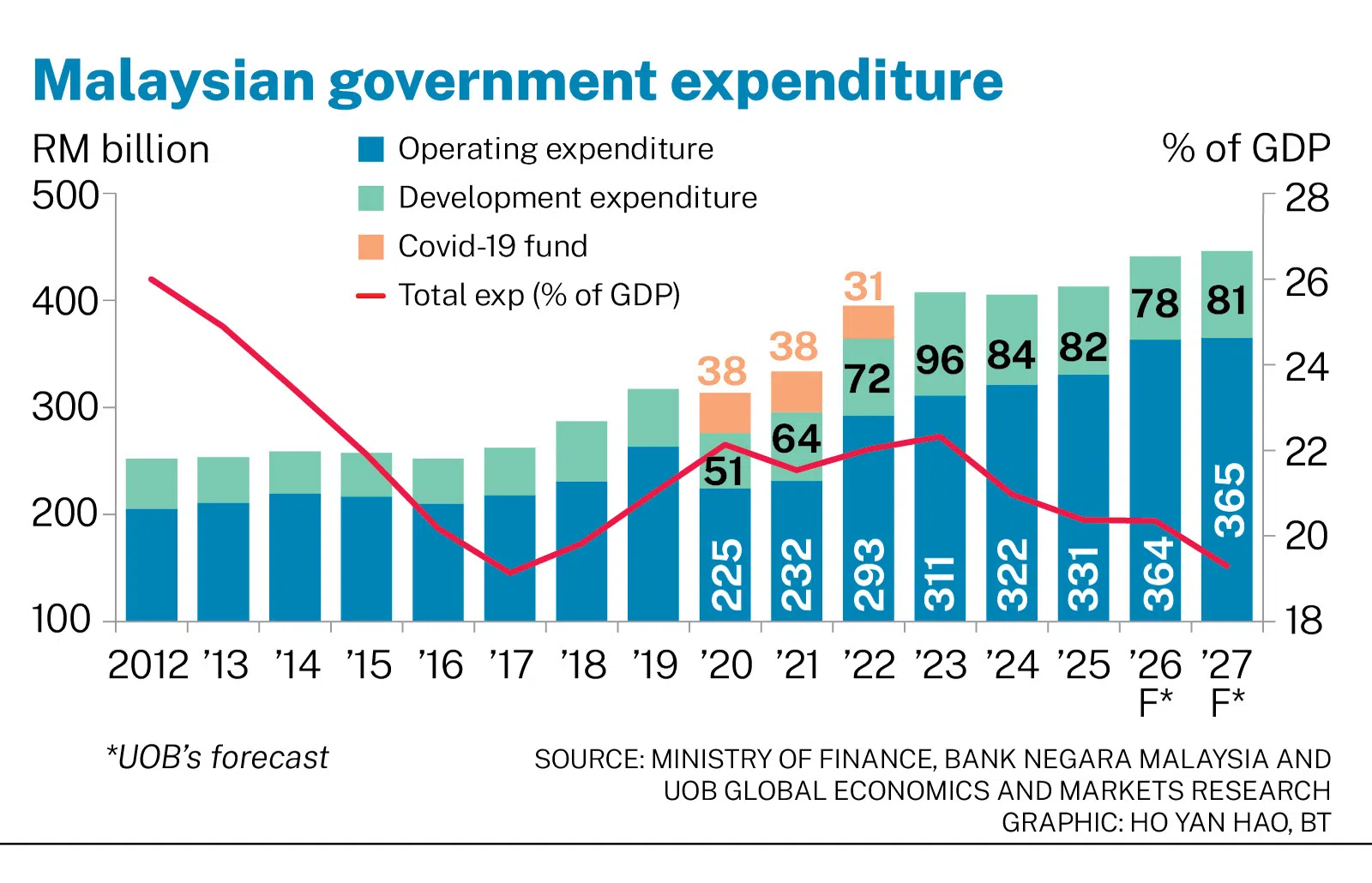
In a report by UOB economists Julia Goh and Loke Siew Ting, they forecast RM445.9 billion in federal spending (RM364.9 billion in operating expenditure and RM81 billion in development expenditure), which would nudge the deficit down to 3.3 per cent of GDP.
Supported by fiscal measures and tech-driven investment, they expect 2027 GDP growth of 4.5 to 5.5 per cent, alongside a potential 25-basis-point rate hike in late-2026.
OCBC senior Asean economist Lavanya Venkateswaran forecasts fiscal slippage with the deficit holding flat at 3.6 per cent of GDP, missing the government’s implied 3.2 per cent target under its medium-term frameworks, with further downside risk if Brent crude exceeds US$100 a barrel.
Business groups are also pressing for tax changes. The Malaysian International Chamber of Commerce and Industry says the expanded sales and service tax (SST) has added complexity, and wants the government to consider restoring the goods and services tax when conditions permit.
In FMM’s survey, 61 per cent of respondents supported replacing SST, although OCBC does not expect such a move in Budget 2027.
Potential beneficiaries
Beyond relief and revenue, the Budget must sustain investment in Malaysia’s longer-term competitiveness.
RHB Research senior economist Chin Yee Sian expects incentives for semiconductors, AI, advanced manufacturing and renewable energy, alongside help for smaller businesses to adopt technology and develop skilled workers.
Analysts see the clearest potential gains among companies exposed to domestic spending.
UOB Kay Hian’s Chong expects the Budget to be broadly neutral for the stock market, but said that consumer, construction, property as well as power and utilities companies could benefit from household assistance and infrastructure projects.
Maybank Investment Bank Research also sees a positive outlook for technology, water and transport infrastructure, affordable housing, industrial property and healthcare.