



Thailand opening markets wider to US to secure trade deal
Thai officials say they expect the US tariff rate on most Thai goods to remain at 19% while seeking lower or zero rates for selected products
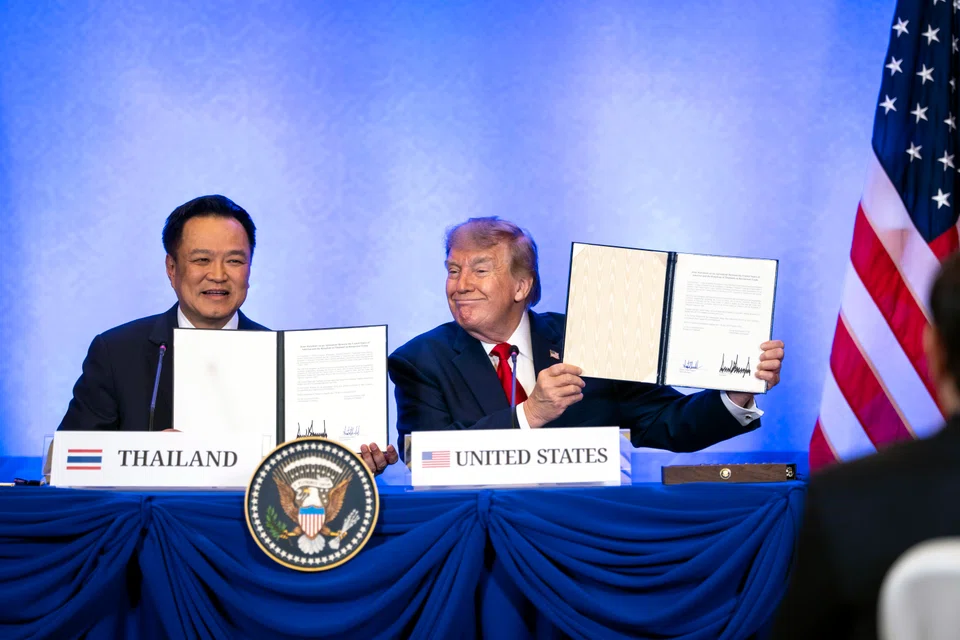
THAILAND and the US have nearly concluded months of trade negotiations after Bangkok made concessions to preserve access to its biggest export market, which buys about a quarter of the country’s overseas shipments.
President Donald Trump and Prime Minister Anutin Charnvirakul signed a joint statement in Manila on Tuesday (Nov 17) declaring that the two countries had substantially concluded negotiations. The final agreement still needs to undergo legal and domestic approval procedures before it can be signed and take effect.
“We all have to make sacrifices and compromises,” Thai Foreign Minister Sihasak Phuangketkeow said in a Bloomberg Television interview with Haslinda Amin after the signing. “But what can we do? The US is a big market.”
Sihasak confirmed Thailand would move toward zero tariffs and open its market to US pork, which Thai officials had previously described as a negotiating red line. Thailand will also buy American soybeans and other agricultural products, some of which will be used to manufacture goods for export.
Trump also said Thailand had agreed to eliminate tariffs on US exports and remove significant barriers to American products including vehicles, medical devices, pharmaceuticals, ethanol and poultry. He also cited about US$2.6 billion in additional purchases of US agricultural products.
Thai Commerce Minister Suphajee Suthumpun told reporters later on Tuesday that the government expected that by signing the agreement country would be able to face lower tariff rates Trump is seeking to apply through so-called Section 301 investigations.

The commitments announced on Tuesday build on a framework announced last year, under which Thailand had agreed to eliminate tariffs on about 99 per cent of US goods and provide greater market access for American agricultural and industrial products. The US said then it would maintain a 19 per cent tariff on most Thai goods while allowing selected products to qualify for a zero rate.
The joint statement signed on Tuesday didn’t spell out the final tariff terms. Thai officials have said they expect the US rate on most Thai goods to remain at 19 per cent while seeking lower or zero rates for selected products.
“We’ve been working on this deal for a long time, and it’s going to be a wonderful deal for both parties,” Trump said.
Anutin said some work remained before the final agreement could be signed. “There is still a little more to do,” he said. “I’m confident that the agreement will be ready for us to sign real soon.”
Any tariff under the trade deal would be separate from an additional 12.5 per cent US duty on most covered Thai exports imposed after Washington’s 301 investigation countries it said failed to effectively prohibit imports made with forced labour. The conclusion of a separate 301 investigation, on excess manufacturing capacity, is still ongoing.
Nations with trade deals would face 10 per cent tariffs under these 301 investigations, compared with 12.5 per cent without, Suphajee said.
Sihasak acknowledged uncertainty surrounding US trade policy and said Thailand would seek to reduce its dependence on any single market.
Bangkok hopes to conclude free-trade talks with the European Union by year-end and is seeking greater trade with Central Asia and Africa.
Tuesday’s signing comes a day after Washington imposed new licensing requirements on exports of advanced chips to Thailand and four other countries that it says face a higher-than-normal risk of the technology being diverted.
The measures are part of a broader US effort to prevent China and other countries of concern from gaining access to sensitive American computing technology through third countries. BLOOMBERG
Decoding Asia newsletter: your guide to navigating Asia in a new global order. Sign up here to get Decoding Asia newsletter. Delivered to your inbox. Free.
Share with us your feedback on BT's products and services
TRENDING NOW

South-east Asia has lost Nvidia’s best salesman
‘If there’s a price to be paid, so be it’: George Yeo says Singapore must safeguard its reputation

Demand, tech capabilities position Apac and AI as Skyscanner’s next growth frontiers: CEO Bryan Batista
CapitaLand, Far East, Sing Holdings team up for S$1.8 billion bid at S$910 psf ppr for Jurong Lake District site

