
‘Better outcome than we had expected’: Thai PM Anutin’s election win has analysts upbeat
The Bhumjaithai Party’s victory could improve political stability, boosting foreign inflows and the country’s economy
 Add BT as a preferred source
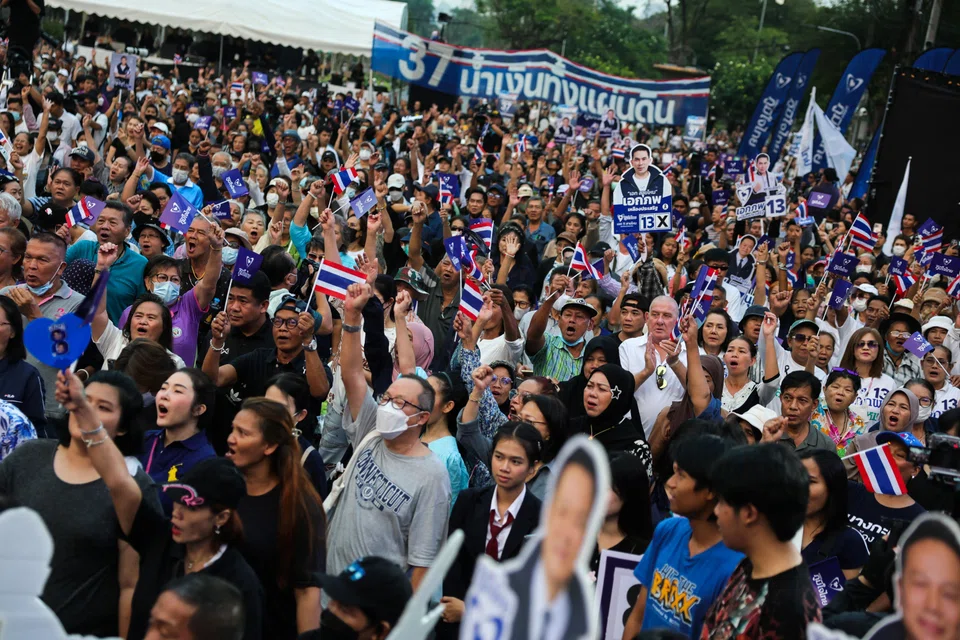
[SINGAPORE] The strong electoral performance of Thailand’s conservative Bhumjaithai Party could spark a positive market response, buoyed by the prospect of improved government stability and policy continuity, said CGS International (CGSI) on Monday (Feb 9).
On Feb 8, the Bhumjaithai Party led by Prime Minister Anutin Charnvirakul declared victory at Thailand’s general election. While the outcome is not yet finalised with votes still being counted, preliminary results showed the party secured about 192 of the 500 seats, with around 95 per cent of the votes counted.
“(Bhumjaithai) is likely to emerge as the biggest party after the election, which is a better outcome than we had expected,” said CGSI analyst Kasem Prunratanamala, adding that “the market is likely to react positively”.
He expects the party to join forces with the Pheu Thai Party, founded by former Thai premier Thaksin Shinawatra, to establish a new government – a move that could deliver a more stable political environment and bolster investor confidence.
CGSI raised its target for the Stock Exchange of Thailand (SET) Index to 1,480 points, based on a forecast price-to-earnings ratio of 15.6 times for 2027, which is a 0.25 standard deviation under the 10-year mean.
The previous target was 1,400 points, based on a 15 times price-to-earnings ratio forecast for 2027, a 0.75 standard deviation below the 10-year mean.
Navigate Asia in
a new global order
Get the insights delivered to your inbox.
“We expect stronger foreign inflows and an improved political outlook to act as key re-rating catalysts for the market,” the analyst said.
“Downside risks to our view include renewed political unrest and a weaker-than-expected domestic economy.”
Political clarity to drive growth
OCBC, UOB Kay Hian (UOBKH) and Macquarie Capital agreed that the election results signal greater political stability ahead.
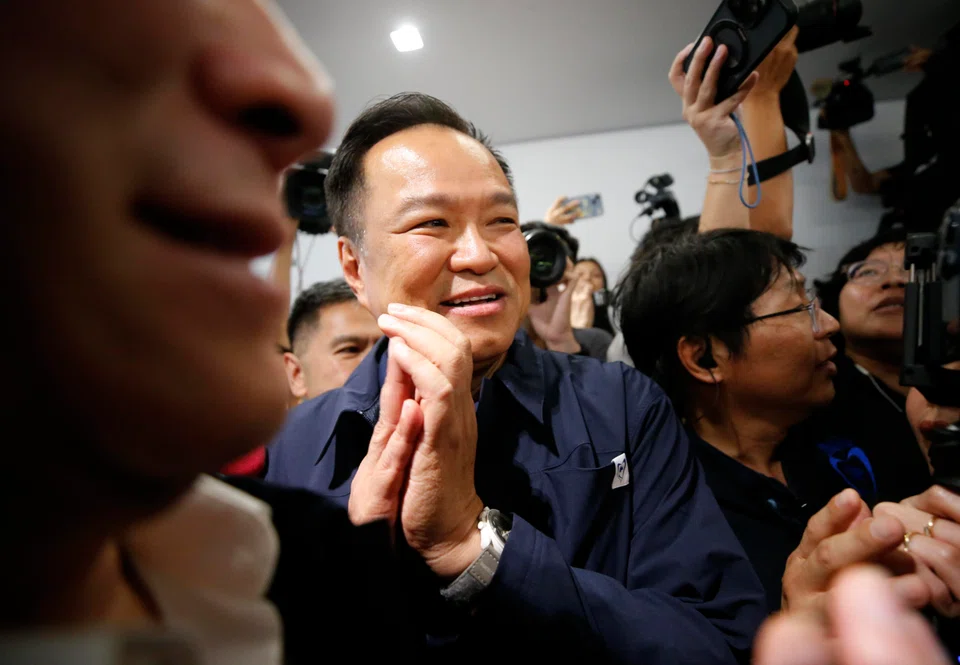
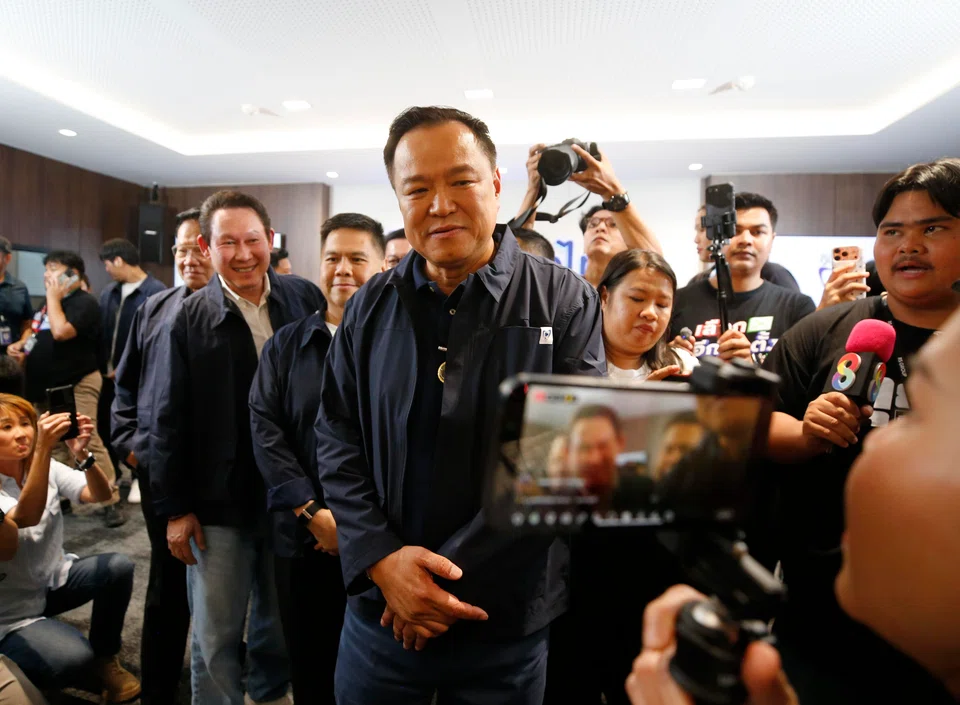
Given the “strong position” of the Bhumjaithai Party, a government could be formed as early as May, said Kaushal Ladha, head of Thailand research at Macquarie Capital.
“This government signals political stability, policy continuity and better execution. We see low headline risk,” he added.
Noting Bhumjaithai’s likely victory, OCBC senior Asean economist Lavanya Venkateswaran and Asean economist Jonathan Ng called a coalition with an aligned party the “best-case scenario after a series of gridlocked elections in 2019 and 2023”.
“The election outcome reduces political uncertainty (and) provides the new government with a mandate to introduce difficult, structural reforms essential (to) bolstering medium-term growth,” they said.
The “clear political outcome” also signals a “headline positive (that) will remove any near-term political overhang on Thai economic growth”, as well as significantly reduce the need for the Bank of Thailand to support growth, they added.
In recent years, the kingdom’s gross domestic product growth has lagged that of its regional peers significantly. A lack of clear policy direction and external headwinds have exacerbated structural problems, such as slowed consumption due to elevated household debt and an ageing population.
However, economic policies may take a turn for the better, under a “stable, durable government (that allows) the authorities to pursue much-needed structural reforms to lift medium-term economic growth”, the OCBC economists said.
They noted that the Bhumjaithai Party’s political manifesto aims to lower the cost of living and deliver an annual GDP growth of around 3 per cent.
Uptick in foreign inflows could boost market
Improved political clarity could also lead to a pick-up in foreign inflows, which will be a “key driver for the market”, said CGSI’s Prunratanamala.
Foreign investors net sold around 447 billion baht (S$18.2 billion) worth of SET Index equities from 2023 to 2025, he noted. This led to the index falling 19 per cent since the end of 2022, and “significantly underperforming regional peers”.
However, he also said that foreign investors have turned “marginally positive”, with net inflows for the SET Index standing at around 15 billion baht in the year to date.
“With the market currently trading at around 15 times 12-month forward price-to-earnings ratio – approximately one standard deviation below its 10-year average – we view valuations as attractive,” he added.
He recommended that investors rotate out of defensive stocks and sectors that have already outperformed the market, including telecommunications, energy and banks.
Investors should enter “lagging sectors” such as healthcare, tourism, consumer finance and industrial estates instead, he said.
Meanwhile, UOBKH analysts Kitpon Praipaisarnkit and Krit Tanarattananon reckon that tactically underweight domestic-oriented sectors are “unlikely to recover in the near term”.
This is due to a lack of short-term catalysts, a weak domestic outlook and potential delays in government spending, which tend to occur in the first year after an election.
“The implementation of economic stimulus measures may occur in (the second quarter) of 2026 at the earliest, and the impact of such stimulus measures would become visible only in July and August,” the UOBKH analysts noted.
For the early part of this year, external and defensive plays are likely to outperform domestic-oriented sectors, they said, adding that defensive and high-dividend stocks “remain effective hedges (against the) domestic economy’s weakness” in the first half of 2026.
Decoding Asia newsletter: your guide to navigating Asia in a new global order. Sign up here to get Decoding Asia newsletter. Delivered to your inbox. Free.
Copyright SPH Media. All rights reserved.

