



For China, a truce with Trump buys valuable time
Beijing needs room to tackle economic troubles at home while reducing its vulnerability to American pressure
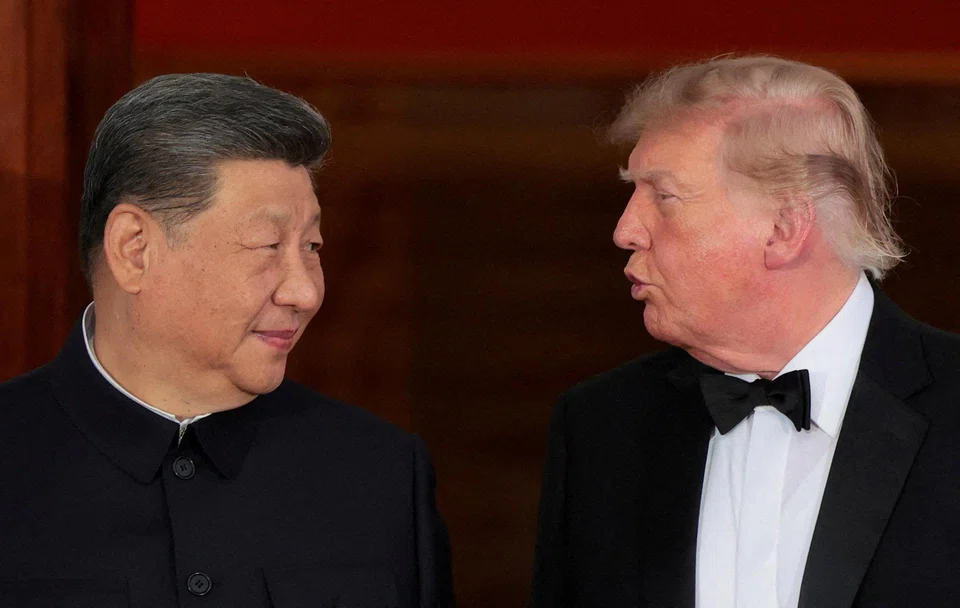
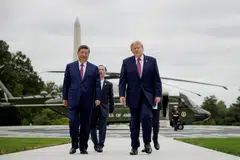
[BEIJING] For China and its top leader Xi Jinping, the biggest prize from a summit in Washington, notably free from confrontation, may be simple: time.
Time to cope with a housing market crash that has wiped away the savings of tens of millions of Chinese families. Time to deal with local governments running short of money as land-use revenue collapses. Time to make China even less vulnerable to economic pressure from the US and other industrialised countries.
And perhaps most consequentially, time to prepare for the once-in-five-years Communist Party national congress next autumn, which will choose a new slate of top leaders to work under Xi.
“By trying to stabilise relations with the US, China can better concentrate on its own priorities,” said Professor Wu Xinbo, a leading American studies scholar at Fudan University in Shanghai.
Turning tables
When US President Donald Trump returned to office last year, Beijing had little reason to expect such breathing room.
Trump had campaigned on imposing very steep tariffs on imports from China as part of an effort to rebuild the US’ industrial base. Three months after taking office, he briefly raised tariffs to 145 per cent, while his administration imposed stringent new restrictions on technology trade with China.
But the confrontation did not unfold the way Beijing had initially feared.
China demonstrated that it had economic weapons of its own, most importantly its dominance of rare-earth metals and magnets essential to the production of cars, electronics and weapons.
After Beijing restricted rare-earth exports to the US, Washington backed away from some of its most aggressive measures. Tariffs fell from their peaks, some export controls were eased and the two governments began negotiating a series of temporary truces.
SEE ALSO
Economic brinkmanship continues between the two countries, especially in emerging industries such as artificial intelligence and robotics. But the Trump administration has shifted from the extraordinary escalation of its first months to a less confrontational relationship in which China has shown that it, too, can inflict considerable pain on the US economy.
Many China experts in the US now see the Trump administration as pursuing a less combative policy toward Beijing than the posture favoured by many Democratic and Republican leaders.
“I see the current policy as far too weak and contrary to the views of senior leaders in both parties,” said R Nicholas Burns, who served as US ambassador to China under president Joe Biden and previously held senior posts elsewhere under president George W Bush.
Beijing aims for self-reliance
Trade frictions with the US have consequently receded as an immediate concern in China after seeming to pose a severe threat early in Trump’s second term. Beijing, however, has not slowed in its longstanding push to become less dependent on the rest of the world for technology or energy.
“They want time and stability because it helps them build a more resilient, more self-reliant economy,” said Professor Evan Medeiros of Georgetown University, a former senior Asia director on the National Security Council under president Barack Obama.
“It gives them time to reduce their exposure to the US.”
For two decades, Beijing has pursued a consistent policy of replacing high-tech imports with domestic production. That push has helped China become a dominant producer of everything from batteries and solar panels to telecommunications equipment and electric vehicles.
It has also made China less vulnerable to foreign economic pressure while leaving other industrialised countries increasingly dependent on Chinese supplies of key raw materials or manufactured goods.
Beijing has pursued a similar strategy of energy self-reliance. Its enormous investments in electric vehicles, wind and solar power, as well as its national electricity grid, have reduced its dependence on imported fossil fuels, helping insulate the economy from high oil prices and supply shortages caused by the war in Iran.
China is also using the lull in trade tensions productively.
Its overall trade surplus has surged since Trump returned to office and is on course to match or surpass last year’s record of roughly US$1.2 trillion.
Chinese exporters have expanded rapidly into South-east Asia, Latin America and other markets, reducing their direct dependence on the US even as many goods reach American consumers through third countries.
US Treasury Secretary Scott Bessent said at the start of the summit that China and the US had agreed to extend their trade truce until Jan 10, 2027. China’s Ministry of Commerce confirmed an extension, without specifying a duration.
The relatively short extension could reflect a calculation in Beijing that its bargaining position may improve with time, especially if the Republican Party loses badly in the midterm elections.
“Suddenly, the negotiation price changes because Trump will be on his back foot, he’ll be weak against China, and he’ll need China even more than he does today,” Prof Medeiros said.
For US negotiators, the extension allows them to continue seeking a deal as soon as possible after the midterm elections.
The summit has also given Xi a chance to portray himself at home as a powerful and respected world leader. Trump welcomed Xi as he disembarked from his plane, whereas Xi sent Vice-President Han Zheng to the airport to welcome Trump to Beijing in May.
A display of Xi’s stature – and, by extension, China’s – is particularly useful as Beijing seeks a tranquil international environment before next year’s Communist Party congress.
Xi appears highly likely to remain in charge even as leaders around him may change. But the gathering will still require extensive manoeuvring over senior appointments and policy priorities.
Repeated meetings with Trump could help keep China’s most important foreign relationship stable as Xi turns his attention to domestic politics.
And few domestic problems are more pressing than the country’s housing market crash.
The property downturn has created a cascade of problems. Falling apartment prices have eaten into household savings, while the collapse in property development has gutted the land-use revenue many local governments depended on.
Apartment prices have already fallen twice as far as they did in the US during the American housing market debacle nearly two decades ago.
Chinese families have responded by cutting back sharply on spending. Restaurants, shopping malls and car dealerships are struggling, while weak domestic demand has left China increasingly reliant on its export industries to sustain growth.
Trump returned to office threatening tariffs severe enough to reshape China’s export economy. Nearly halfway through the US president’s second term, those tariffs are modest, China’s trade surplus shows no signs of slowing, and Beijing has demonstrated considerable economic leverage.
For Xi, then, another summit that ends without the steep US tariffs once threatened against Chinese exports may represent the biggest victory of all. NYTIMES
Decoding Asia newsletter: your guide to navigating Asia in a new global order. Sign up here to get Decoding Asia newsletter. Delivered to your inbox. Free.
Share with us your feedback on BT's products and services
TRENDING NOW
Incidence of civil servants buying property near unannounced MRT stations ‘a concern’, but may not establish misconduct: PSD

Grab CEO’s wife Chloe Tong on life with Anthony Tan and finding her purpose

Income Insurance appoints former Manulife Singapore top man as new CEO

HDB reviewing ‘jumbo’ flat scheme after Telok Blangah unit listed for sale at S$2.18m

