



What’s on the agenda when Xi and Trump meet in Washington
Summit offers both leaders a chance to improve ties and seek common ground on contentious topics
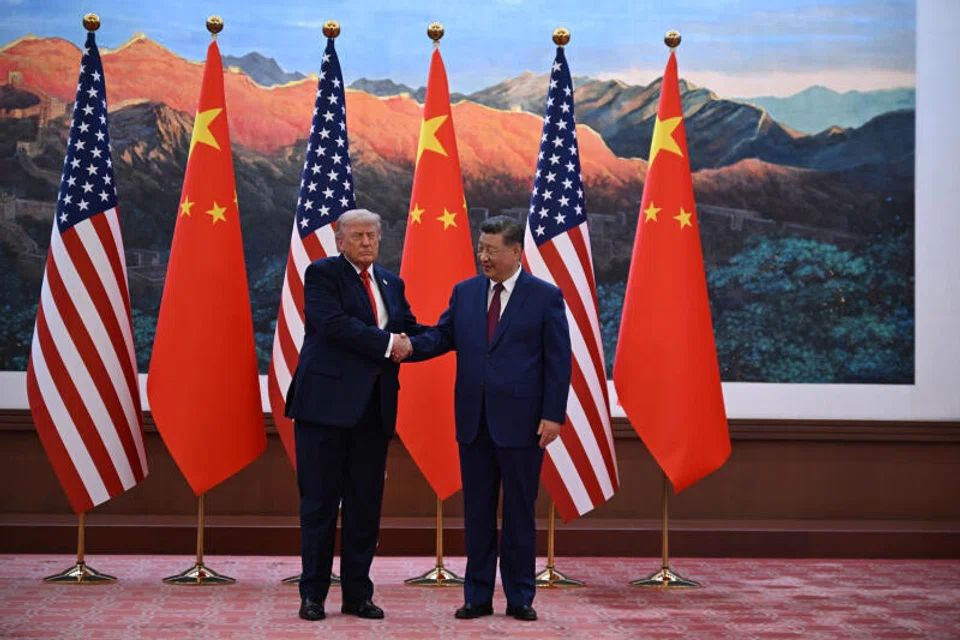
[BEIJING] When Chinese President Xi Jinping touches down in Washington on Wednesday (Sep 23), it will mark three years since he last visited the US.
His much-anticipated one-day summit with US President Donald Trump the following day will offer the leaders of the world’s two largest economies a chance to improve personal ties and look for common ground on contentious topics including trade, artificial intelligence, the Iran war and the future of Taiwan.
Here are the issues that are likely to dominate the agenda.
Trade and tariffs
Xi and Trump are expected to seek an extension of the October 2025 truce in the trade war that Trump initiated on his return to the White House.
The truce scaled back the tariffs both countries had imposed on each others’ goods and suspended some proposed export controls on shipments of products including Chinese rare earths.
The two nations were discussing whether to go further and to slash duties on goods including US energy and agricultural products ahead of the leaders’ summit this week.
That is under an earlier initiative to ease import barriers on US$30 billion worth of products from each side under a Board of Trade mechanism. Most-favoured-nation rates would be applied to some items from China.
But a tariff detente is far from assured.
China’s government has long complained about US import levies, and Washington has launched investigations into other countries’ trade practices that could give it the option to impose new measures against China to replace the “reciprocal tariffs” struck down by the US Supreme Court in February.
If it does so, new tariffs could be levied at a rate of 7.5 per cent. The US is expected to hold off on any formal announcement until after the summit.
Speaking with Bloomberg Television on Monday, US Trade Representative Jamieson Greer said China and the US remain divided on the terms of an extension to the tariff truce, suggesting that three to six months was a range that Washington could support.
Purchasing commitments and investment
Japan and South Korea have made large-scale commitments to invest in the US or purchase more American goods as a way to meet Trump’s demands on trade, and his administration is pursuing the same approach with China.
China is making steady progress on a pledge to buy 25 million tonnes of US soybeans annually through 2028, recently passing the halfway mark for 2026.
Progress on a separate commitment to spend at least another US$17 billion on American crops looks more challenging.
The target is “achievable if political relations remain constructive and tariff barriers continue to ease”, said Kang Wei Cheang, an agricultural broker at StoneX Group in Singapore.
Other purchases from the US have been slow. Beef imports, for example, totalled just US$7 million in the first seven months of 2026 – a fraction of the US$556 million in 2025, according to Bloomberg Economics.
China renewed permits for supplies from hundreds of American beef processing plants in May, but shipments have barely recovered as surging US prices and weak Chinese demand curbed purchases.
In May, Trump said China had committed to buying 200 Boeing planes. Greer has said China is making progress on the commitment.
The investment part of the negotiations remains challenging. While Trump has sent mixed signals on Chinese car imports to the US – he has mulled in public whether to allow China to build US auto plants if they hire American workers – the idea is politically explosive in the US.
Any such deal would still have to satisfy national security rules in order to proceed, one US official said.
AI
The US and China are in a race for leadership in AI and have both taken steps to restrict access to the other’s technology.
Since the leaders’ last meeting in May, rapid developments in AI have made talks on the topic more urgent and more contentious. US Treasury Secretary Scott Bessent has warned “there is no day after tomorrow if China wins” the AI race.
The performance of China’s cutting-edge AI models has been approaching that of their US rivals, and Beijing sees AI as a once-in-a-lifetime chance to tilt the technological rivalry with Washington in its favour.
After US AI industry leaders called for a more careful pacing of frontier AI development in the interests of safety, Beijing pushed back, dismissing their proposal as self-serving fearmongering.
Chinese chipmakers have been racing to develop processors capable of handling complex AI workloads after US export controls made it harder for China’s AI industry to access the most advanced chips from US companies such as Nvidia.
On Tuesday, Alibaba rolled out what it called China’s most powerful AI chip, an accelerator to compete with Nvidia and underpin a massive expansion of data centre capacity in coming years.
A further source of tension has emerged this year after US AI labs accused Chinese developers of using the outputs of their cutting-edge models to produce rival systems at a fraction of the cost.
The White House has unveiled measures aimed at preventing this practice, known as “adversarial distillation”.
Critical minerals
Critical minerals such as rare earths have become a contentious topic as they are vital for making high-end goods such as robots, electric vehicles and precision-guided weapons, and China dominates their production.
This gave Beijing useful leverage in 2025’s tariff standoff with the US, when it imposed export controls to restrict foreign access to Chinese rare earths.
Following the October trade truce, China resumed some exports of the products. But the Trump administration has complained that Beijing is slow-walking shipments, and China’s rare earth magnet exports to the US fell in August.
Beijing hopes to offer additional export licences as a bargaining chip at the summit, according to people with familiar with the matter.
Despite Washington’s efforts to diversify its sources of critical minerals, the US is probably still years away from loosening China’s grip on rare earth mining and processing, according to Bloomberg Economics.
Beijing has issued new rules aimed at countering foreign efforts to shift global supply chains away from Chinese suppliers and restrict China’s access to key materials and technology.
China’s government has begun to roll out a new system of streamlined export permits through general licences. However the impact of these measures remains unclear, with global buyers expressing concern that approvals are still being slow-walked.
Iran war
Trump is under pressure to end a conflict that has triggered a global energy crisis, and China has been throwing Teheran an economic lifeline as its biggest buyer of oil.
It has also provided a measure of diplomatic support for the country on the world stage, and there have been reports that Iran’s military has also received some help from China.
The government in Beijing has ordered Chinese companies to defy US sanctions targeting their Iranian oil purchases, deploying a blocking measure introduced in 2021 aimed at protecting its firms from foreign laws it deems unjustified.
The Chinese Foreign Ministry has repeatedly voiced opposition to what it calls illegal, unilateral sanctions affecting Chinese companies, and urged the US to avoid a collapse of the current ceasefire with Iran rather than “throwing mud at China”.
In August, Bessent said Washington was launching an “economic onslaught” against Iran’s financial connections around the world.
When asked if the US was prepared to cut off major Chinese banks for facilitating trade with Iran, he said “no one is above the reach of US sanctions”.
The same month, the US sanctioned Chinese and Hong Kong entities over alleged economic ties to Iran. It has also sanctioned several Chinese firms over their oil purchases.
Beijing responded by saying its relationship with Iran “should not be disrupted or undermined”, and it would safeguard its interests.
Trump is expected to continue to press Xi over China’s relationship with the Middle Eastern nation. Xi appears to be in no rush to help Trump in his efforts to hurt Iran economically. Still, ignoring Trump completely could antagonise the American leader.
Taiwan
Taiwan remains one of the most sensitive and potentially volatile issues in US-China relations. One main focus for Chinese officials: blocking a US$14 billion proposed US weapons package for Taiwan.
While Beijing claims the island as part of its territory, the US supports the self-ruled democracy militarily and maintains robust but unofficial ties with its government.
Beijing has previously asked the Trump administration to officially declare that it “opposes” Taiwanese independence, a concession that would give it a major diplomatic win.
After the US president met with Xi in Beijing in May, Trump said they had discussed US arms sales to Taiwan and remarked that he did not want “a war that’s 9,500 miles away”.
If the island comes up in this week’s discussions, the question is whether Trump would trade away some of its interests in return for concessions from Beijing. BLOOMBERG
Decoding Asia newsletter: your guide to navigating Asia in a new global order. Sign up here to get Decoding Asia newsletter. Delivered to your inbox. Free.
Share with us your feedback on BT's products and services
TRENDING NOW

Once staunchly pro-China, Malaysian Chinese businesses are now distancing themselves from Beijing

Looking beyond looming CEO succession, should UOB potentially pursue a transformative merger?

Could stablecoins be the future of money?

Grab CEO’s wife Chloe Tong on life with Anthony Tan and finding her purpose

