
Nephew of former Thai premier Thaksin faces balancing act to win over electorate
Yodchanan Wongsawat is now one of the front runners to be Thailand’s next leader
 Add BT as a preferred source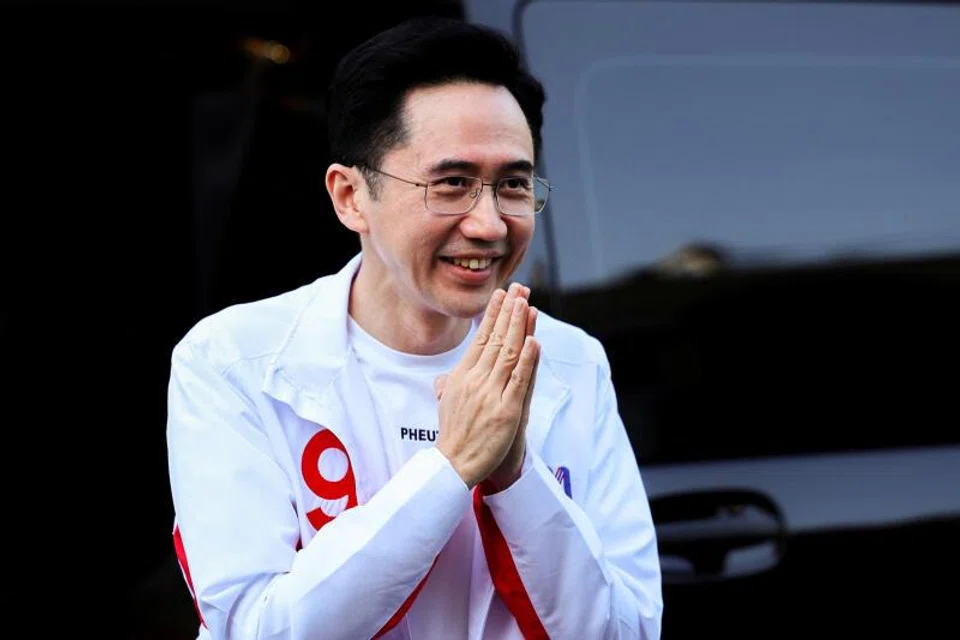
[BANGKOK] Yodchanan Wongsawat, the Pheu Thai Party’s top candidate for prime minister, faces a delicate balancing act in his quest to run the South-east Asian country – he must leverage his family’s legacy to win the support of the party faithful, while showing he has fresh ideas to revitalise the economy.
The biomedical engineer and nephew of jailed former Thai premier Thaksin Shinawatra, whose family-backed parties have won all but one election since the turn of the century, said he believes he can achieve an annual economic growth rate of 5 per cent by developing the country’s medical sector.
“We have a lot of researchers, we have a lot of opportunities, just only need to make a little bit of investment on the infrastructure and technology transfer, then we can build a new sector of cancer treatment service,” Yodchanan said in an interview with Bloomberg News on Saturday (Jan 10) in the northern city of Chiang Mai, his hometown, where he led a campaign to rally supporters ahead of the Feb 8 snap election.
Yodchanan said he believes the wellness industry has potential to eclipse other sectors in Thailand and act as a new growth engine. The nation is already a formidable player in global medical tourism, with hospital operators such as Bangkok Dusit Medical Services and Bumrungrad Hospital leading efforts to attract foreign visitors for medical treatment.
“Instead of the automobile or electronic industries, we can make medical devices, which would yield higher income with the same infrastructure,” he said. “We can make semiconductors for data centres and especially for medical AI (artificial intelligence).”
The son of former leader Somchai Wongsawat, Yodchanan has emerged as the surprise new face of Pheu Thai and is now one of the front runners to be Thailand’s next leader, potentially its fourth in three years. He represents a strategic reboot for the Shinawatra-linked political machine after last year’s ouster of his cousin, Paetongtarn Shinawatra, from the top office by the Constitutional Court over an ethics violation case.
Navigate Asia in
a new global order
Get the insights delivered to your inbox.
Yodchanan is seen as a bridge between the party’s populist past and a high-tech future, appealing both to voters in the northern and north-eastern rural heartlands who remain loyal to Thaksin and the sceptical Bangkok electorate that favours progressive economic reforms.
Still, he will need to shake the perception that he is a proxy for his uncle, who is serving a one-year prison sentence for corruption during his time in office from 2001 until being toppled in a coup in 2006.
The power struggle between Thaksin and the military-royalist establishment has dominated much of Thai politics over the past two decades, which have seen five prime ministers linked to him ousted by the military or by the Constitutional Court.

Yodchanan stated he’s “very confident” that, within four years, he can close the gap between Thailand and its South-east Asian neighbours, whose economies are growing at double the pace or more. To achieve that, he will need to address deep structural issues in Thailand, which has one of the highest household debt-to-GDP ratios in the world and a yawning wealth gap between the rich and poor.
The 46-year-old plans immediate assistance measures for citizens, including annual cash handouts of up to 36,000 baht (S$1,475) for those living below the national poverty line, aggressive debt relief, a three-year debt moratorium for farmers and a 30 per cent crop profit guarantee. Rural voters are a powerful element of the electorate and have been key to the success of Thaksin-linked political parties.
In the metropolis of Bangkok, Yodchanan has pledged to cut prices of transport in an appeal to the growing number of urban voters struggling with higher costs of living.
“We need to help clear the debt burden in parallel with lowering the cost of living,” Yodchanan said, adding that his Pheu Thai Party is the only one that can effectively tackle the two problems and boost the economy. “Innovation-driven economic growth is my expertise.”
Yodchanan, a professor, said he believes his experience in the laboratories and hallowed lecture halls of Bangkok’s prestigious Mahidol University provides him with a unique perspective, helping him understand that innovation-driven economic growth is the way forward Thailand.
While he said he believes he is his own person, Yodchanan acknowledged that his family relations would be an advantage if he were to become prime minister.
“I’ll be on my own, but for execution you need highly experienced people to help and I’m on the shoulders of giants,” he said. “I know all the old team, which can help build on the success of the country.”
Still, “If I continue talking about innovation and how we execute things, I think people will forget about my last name”, he said.
In rallies in Chiang Mai on Friday, Yodchanan appealed to Thaksin’s supporters for help, asking them to vote for “Thaksin’s nephew”.
At one of the rallies, 67-year-old juice vendor Jadet said she supported Yodchanan because she was hopeful he could fix Thailand’s economic woes, not because of his family name.
“I like him because he is humble despite his many achievements,” said Jadet. “The economy is bad. I sell smoothies at just 10 to 20 baht, the villagers still struggle to afford it and count their 1-baht coins.”
Yodchanan faces formidable rivals in the reformist People’s Party’s Natthaphong Ruengpanyawut and Anutin Charnvirakul of the ruling conservative Bhumjaithai.
Despite announcing his candidacy only in mid-December, Yodchanan is rising in the polls. A popularity survey by Suan Dusit University late last month showed him winning 22 per cent of support, ranking second behind Natthaphong who received 24 per cent backing.
On Thursday, a joint survey by Thai-language newspapers Matichon and Daily News ranked him as the most preferred prime ministerial candidate, with 39.2 per cent support, compared with Natthaphong’s 38.8 per cent.
His party, Pheu Thai, lost out to a predecessor of the People’s Party in the 2023 election, and is predicted to come in second or third in next month’s vote. Yodchanan said he would be happy to join a coalition with any of the parties, but the ministers in his Cabinet must be free from corruption allegations.
In his first 100 days in office, Yodchanan plans to focus on rebuilding trust to attract foreign direct investment to fund his vision for supply-chain upgrades by pitching Thailand’s strategic locations and manufacturing strength.
In the longer term, he plans to refine and upgrade the skills of the Thai workforce to meet the demands of new investors, whom he believes will be attracted to Thailand’s developed supply chains.
“You can use our global supply chain; you can use our supply chain from South-east Asia,” he said, in an appeal to foreign investors. BLOOMBERG
Decoding Asia newsletter: your guide to navigating Asia in a new global order. Sign up here to get Decoding Asia newsletter. Delivered to your inbox. Free.
Share with us your feedback on BT's products and services

