
5 art shows to see in March
From Luke Heng to Rirkrit Tiravanija, here are the standout artists and exhibitions to catch
 Add BT as a preferred source
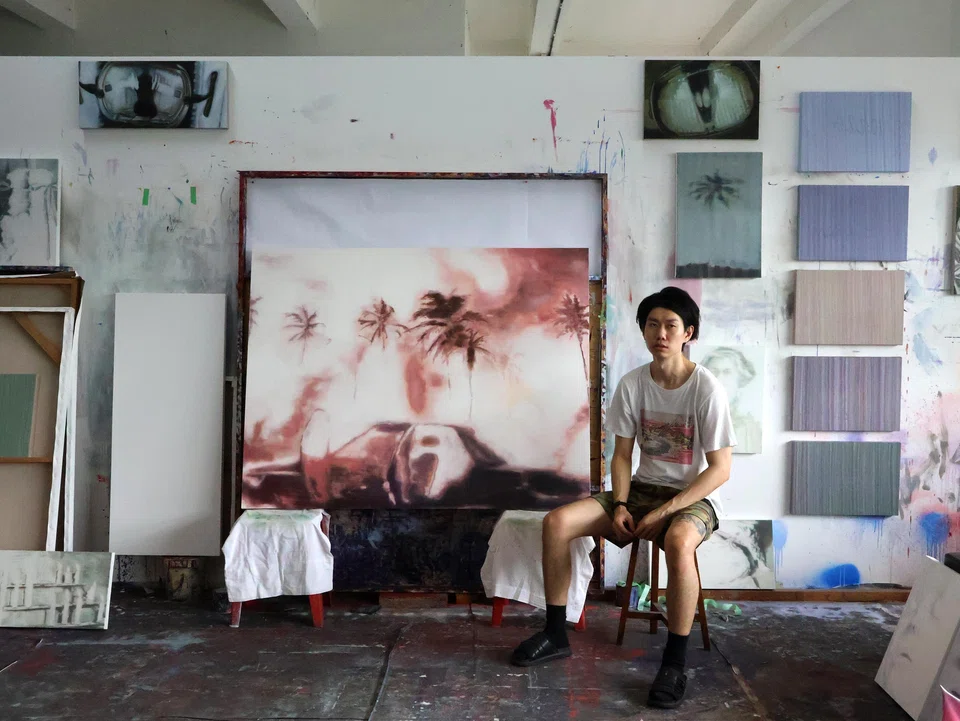
Luke Heng: Mechanics of the Snap
Yeo Workshop, Gillman Barracks
It is fitting that the images in Luke Heng’s latest paintings appear ghostly. For the past few years, the artist has largely withdrawn from public view – “ghosting” the public, if you will – hiding in his studio to rethink the direction of his practice.
Once regarded as a promising young voice in minimalist abstraction, Heng returns with a body of paintings that edges towards figuration – though only in the most elusive, hard-to-pin-down way.
At first glance, the shift seems decisive. The canvases are populated with recognisable motifs – cars, palm trees, swimming pools, birthday cakes – drawn from the visual fragments of contemporary life.
But any sense of clarity is quickly undone, as Heng’s images refuse to settle. Painted in thin, almost evaporative layers of oil, the images seem to hover on the surface, as though on the verge of disappearing.
The works are derived from film stills, news imagery and digitally sourced fragments – images that have been endlessly circulated digitally. But Heng halts their movement by committing them to paint, creating a tension between appearance and disappearance, forcing us to also slow down and look at them more attentively.
Navigate Asia in
a new global order
Get the insights delivered to your inbox.
In one painting, a crumpled car sits beneath two palm trees, its contours partially bleached out by a blinding whiteness. In another painting, another car appears to be engulfed by a white haze suggestive of heat or smoke.
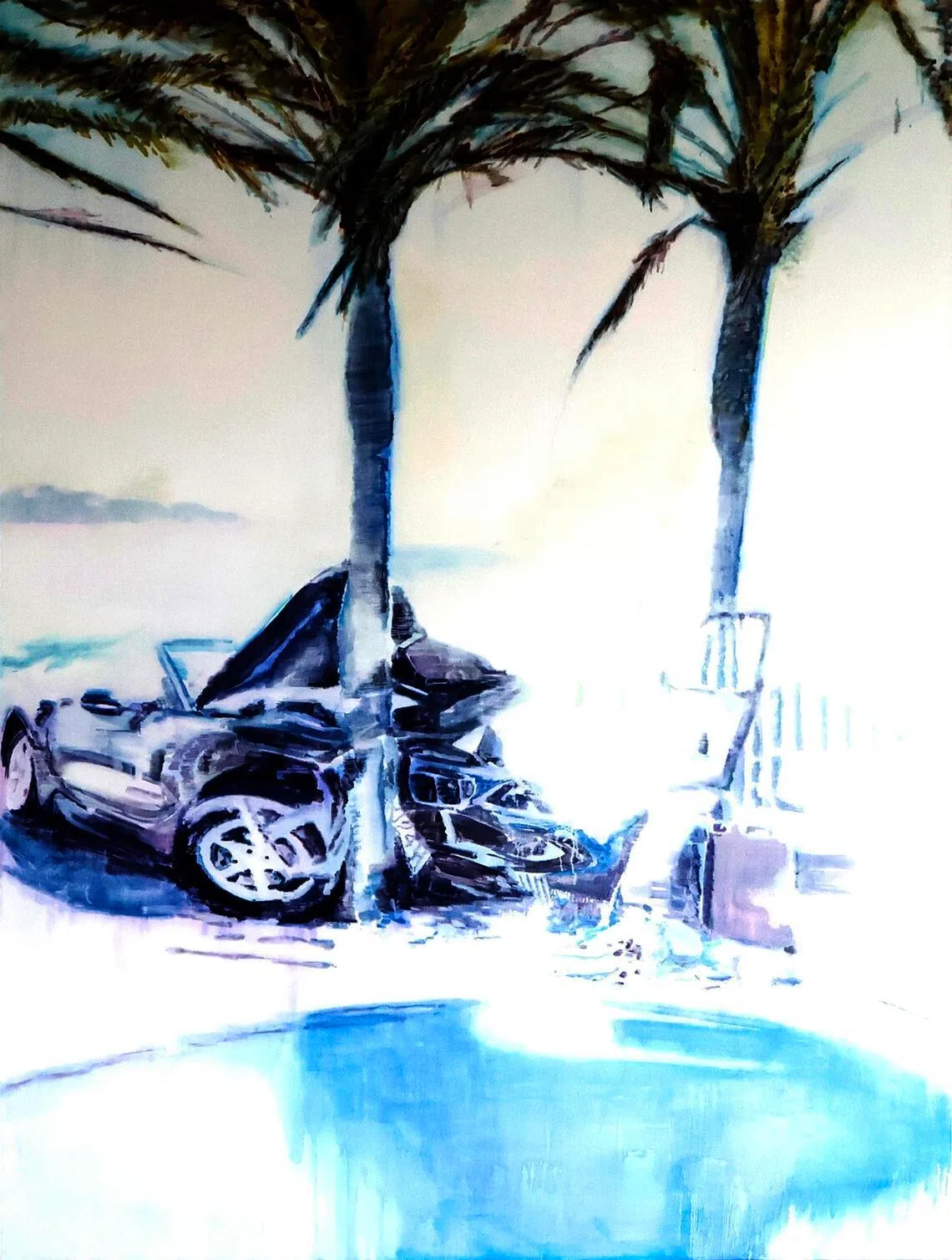
We have seen these images before: in movies, newspapers and social media. Repeated to the point of numbness, they no longer register. But Heng forces a pause by slowing the image down and stripping it of context, giving it back a measure of tragedy that we have learnt to ignore.
The exhibition is titled Mechanics of the Snap, showcasing images of how structures – physical, psychological or even perceptual – give way under pressure. Beneath these familiar imagery lies an unsettling suggestion that, in a world flooded with pictures, we no longer fully absorb or care about what we see.
Heng’s paintings are at once fixed and slippery: The longer one looks, the more unstable the image becomes.
Boris Torres: Saturdays
Richard Koh Fine Art, Gillman Barracks
Just next door to Heng’s show at Yeo Workshop, Ecuadorian artist Boris Torres makes his Singapore debut at Richard Koh Fine Art. Where Heng’s images tend to fade and dissolve, Torres’ hold their ground.
His figures are recognisable, his scenes quietly familiar: a couple asleep in bed, a man studying himself in the mirror, two friends leaping off a pier, a small group gathered in a clearing. Most are simply at rest on a Saturday – the premise that gives the exhibition its title.
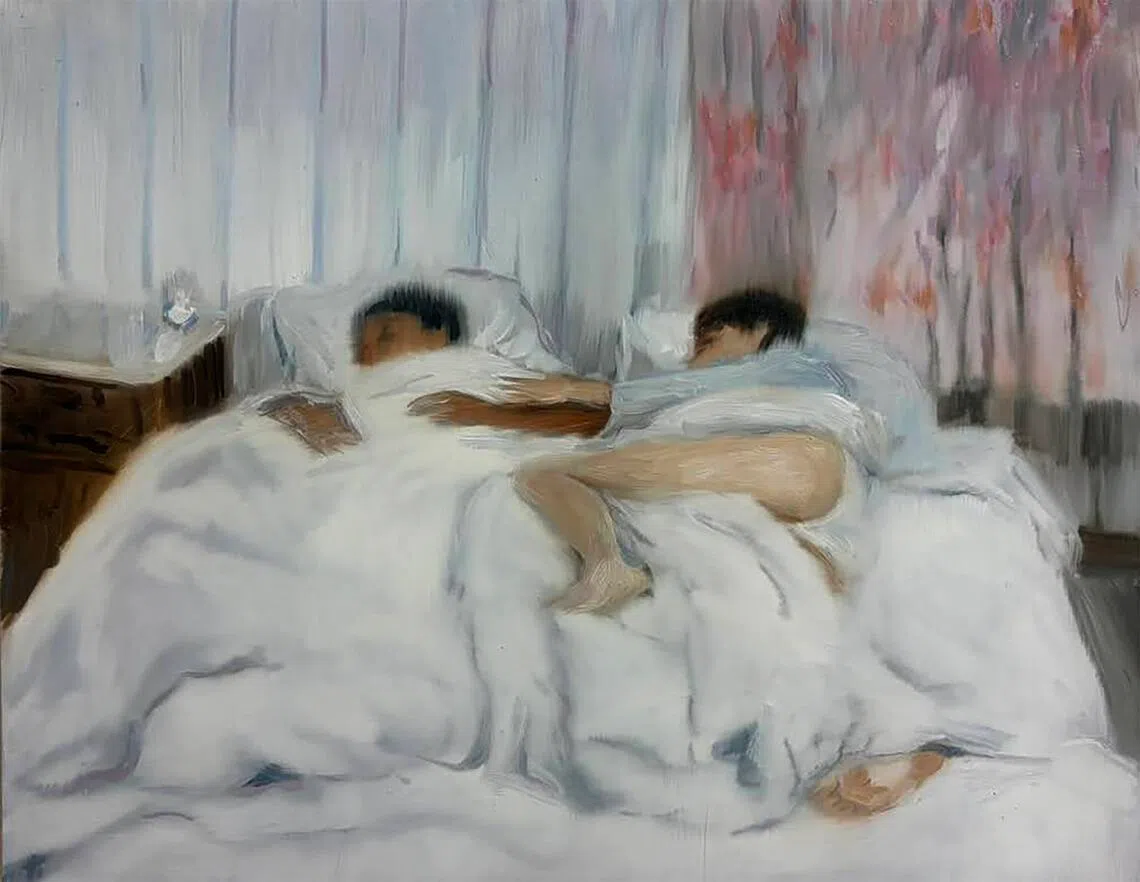
Torres pares each image back to its emotional core, working on deliberately small canvases – some as small as 20 by 25 cm – to pull the viewer in. These are not grand narratives, but intimate moments that linger in your imagination.
Faces blur, edges soften, yet the feeling is unmistakable: intimacy, desire and companionship, all rendered with simple clarity and restraint.
Rirkrit Tiravanija: Say Yes to Everything
STPI, Robertson Quay
Thai-Argentinian conceptual superstar Rirkrit Tiravanija is always a welcome presence at STPI. But this time, rather than showing a single new body of work, STPI is presenting a compact survey of his practice, bringing together works from the 1990s to the present to trace his longstanding preoccupation with the everyday.
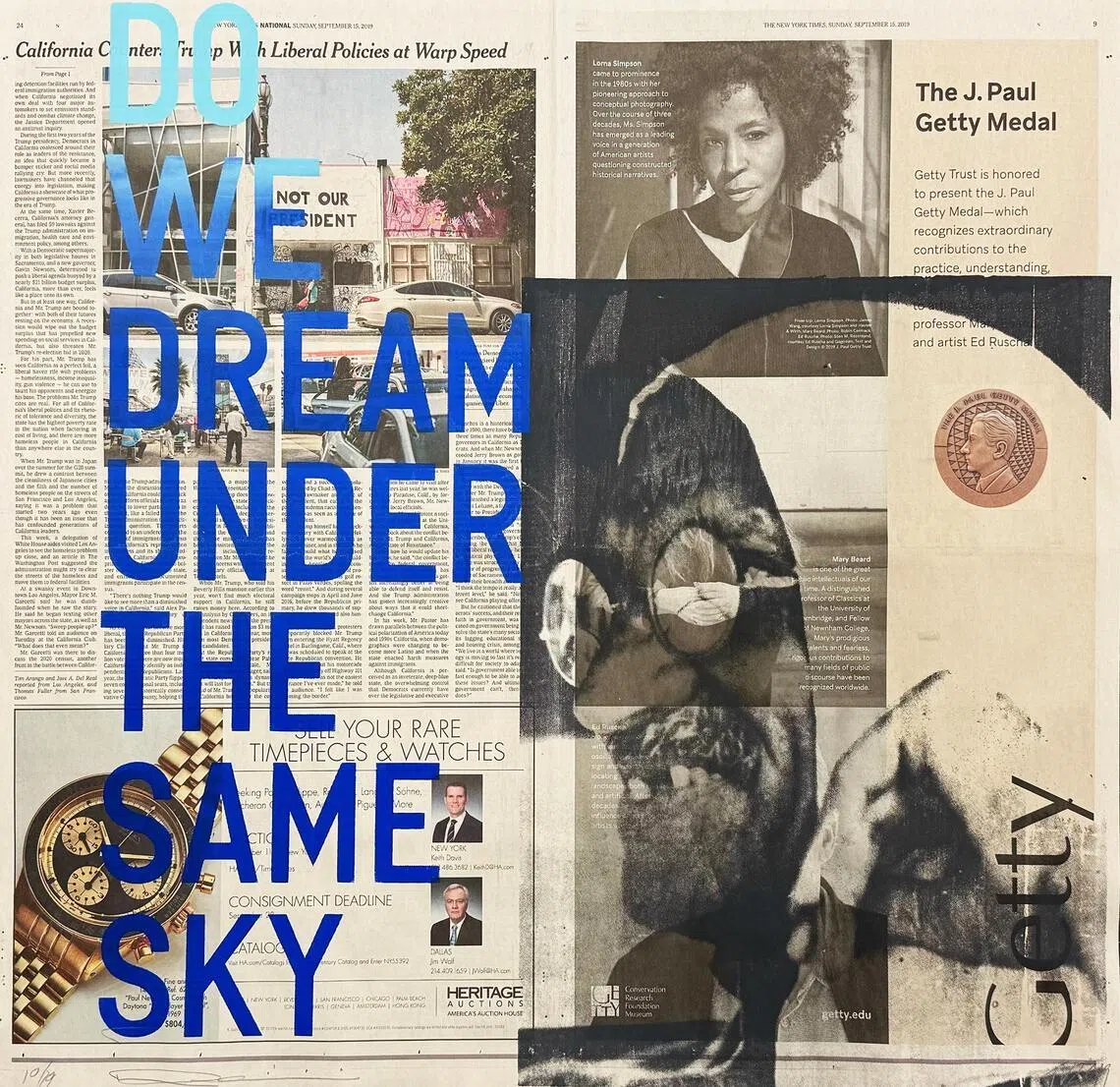
In his untitled “newspaper” works, he overlays bold text onto pages of The New York Times, disrupting headlines and advertisements. In one work, a block of blue text saying “DO WE DREAM UNDER THE SAME SKY” cuts across news articles and images of people of different races, posing a question of how news establishments construct or distort our shared realities.
Elsewhere, a very long scroll of passport pages layered with maps and drawings functions as a visual travelogue. Meanwhile, groups of personal photographs – placed without context or hierarchy – suggest that every moment, however small, carries meaning.
As always, Rirkrit works through the materials of everyday life to surface the social and political currents embedded within them.
Tiffany Loy and Kirsten Coelho: Between Line and Form
Sullivan + Strumpf, Yong Siak Street
In this duo exhibition by Singapore’s Tiffany Loy and Australia’s Kirsten Coelho, the gallery in Tiong Bahru feels austere – almost ascetic – with Loy’s woven works draped on the walls and Coelho’s ceramic vessels perched on ledges.
Their two practices are similar in that they’re grounded in patience, discipline and control, where form emerges slowly through a careful, deliberate process.
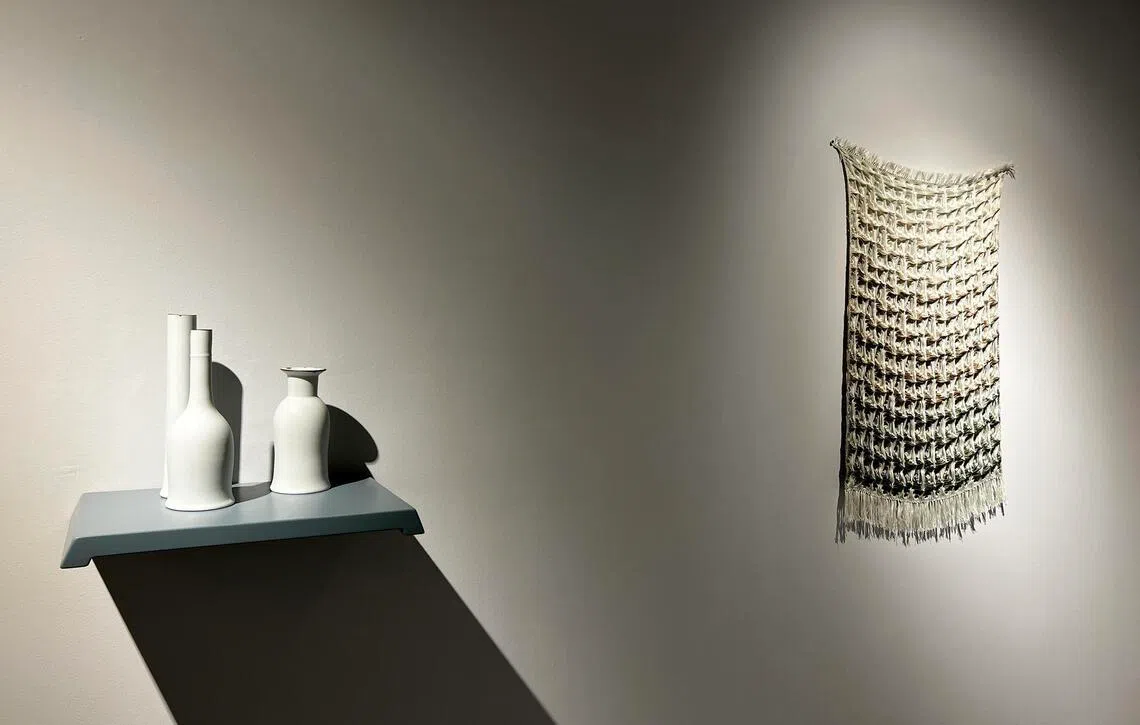
Loy’s meticulously handwoven works sit somewhere between textile and sculpture, their peaks and troughs catching the light so that colour seems to shift as you move towards them. From a distance, they appear as orderly structures. But up close, they transform into a field of small, precise gestures.
Meanwhile, Coelho’s porcelain vessels appear pristine: columns, jugs and cylindrical forms rendered in pale, matte glazes. But closer inspection reveals subtle irregularities such as faint iron oxide traces, softened rims and the gentle asymmetry of something shaped repeatedly by hand.
Her practice treats the vessel not as an object, but as a repository of memory, gesture and time itself.
Everyday We Create Histories
ShanghART Singapore, Gillman Barracks
ShanghART Singapore’s group exhibition brings together a strong line-up of artists, including Sun Xun, Lai Yu Tong, Melati Suryodarmo, Boedi Widjaja, Li Shan, Lu Lei, Arin Rungjang, Xu Zhen and Yang Fudong – each offering a different lens on how histories are constructed, obscured and retold.
Sun’s short film is a clear highlight – a mesmerising, old-world animation built from thousands of hand-drawn images. It weaves together memory, myth and propaganda to probe how history is shaped and continually rewritten.
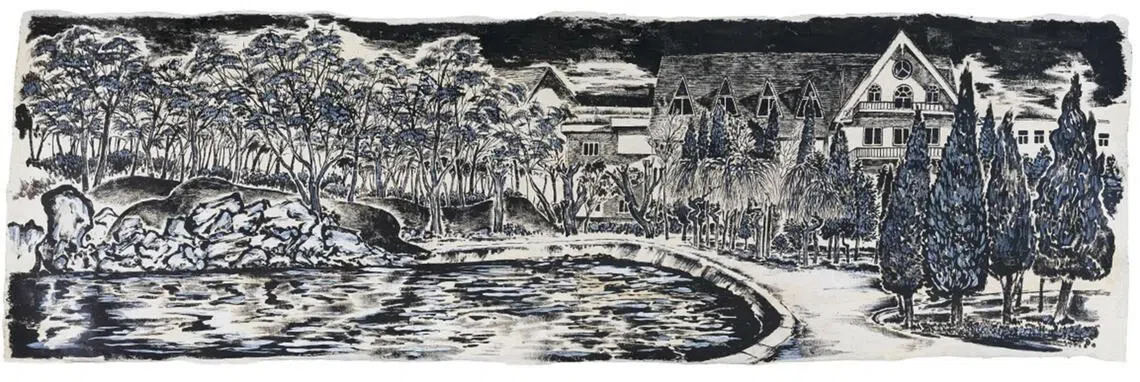
Lai’s works, in which he paints over and selectively obscures newspaper pages to leave only fragments of images, operate as incisive studies of how information is filtered and reassembled into meaning.
Melati, best known for her performance art, turns here to charcoal drawings and screenprints to mine a darker historical register.
Together, the works suggest that history is not something we inherit naturally, but something that’s constantly edited and contested.
Decoding Asia newsletter: your guide to navigating Asia in a new global order. Sign up here to get Decoding Asia newsletter. Delivered to your inbox. Free.
Copyright SPH Media. All rights reserved.

