

An urban designer’s own, multi-generational home
This intermediate terrace house defies convention to deliver light and life in shared spaces to its occupants
 Add BT as a preferred source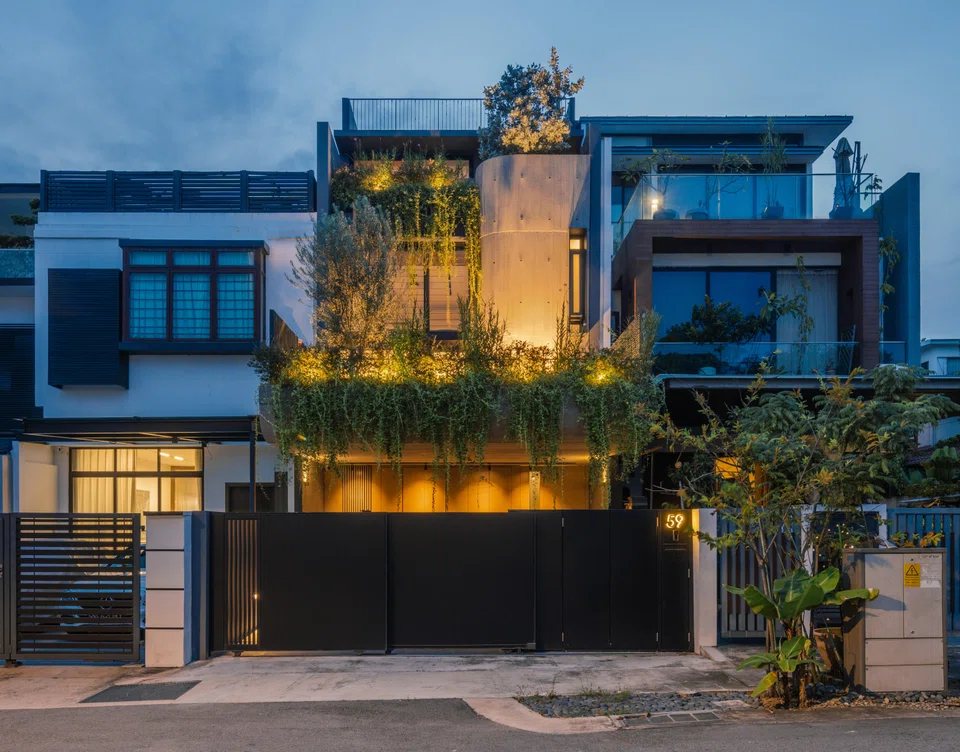
[SINGAPORE] Urban design is a collaborative process of shaping physical spaces that define how people experience a city. So when it came to building his own home, a lecturer in architecture with a masters in urban design relished the opportunity to distill his knowledge into the process and invite his architect friend to work on it with him.
“I think it would be fun,” Chow, as the homeowner prefers to be known, recalls telling Carl Lim of Czarl Architects. The project would involve an old, single-storey intermediate terrace house in Sembawang that he found.
The duo pulled together architectural inspirations, practical considerations, as well as the desire for the home to age alongside the household, which would now include Chow’s in-laws, as well as his lawyer wife and two daughters, aged 12 and 10.
Crucially, the family had a four-year “experiment” of three-generational living in a large, rented apartment that helped Chow crystallise his ideas.
“That’s when you get a sense that there are certain spatial needs for every generation, but you also want other spaces that bring everyone together.”
Spatial equity
Chow was certain it was “more liberating” for his in-laws to have convenient access to the entire house, instead of being confined to a “granny room” downstairs.
Navigate Asia in
a new global order
Get the insights delivered to your inbox.
This necessitated a traction lift, which, in turn set the stage for the maximum number of levels – in this case, five – for the house.
As is characteristic of intermediate terrace houses, the 2,121-square-foot site is narrow, although its east-west orientation means there is ample opportunity for daylight to reach its occupants.
Given that the property is 32 metres deep, there was a need for a light well in the middle of the house, “akin to the traditional shophouse designs of old”, says Lim.
SEE ALSO
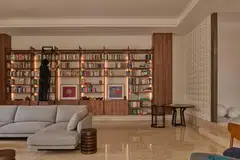
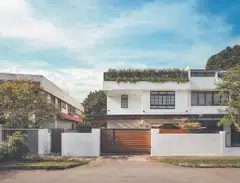
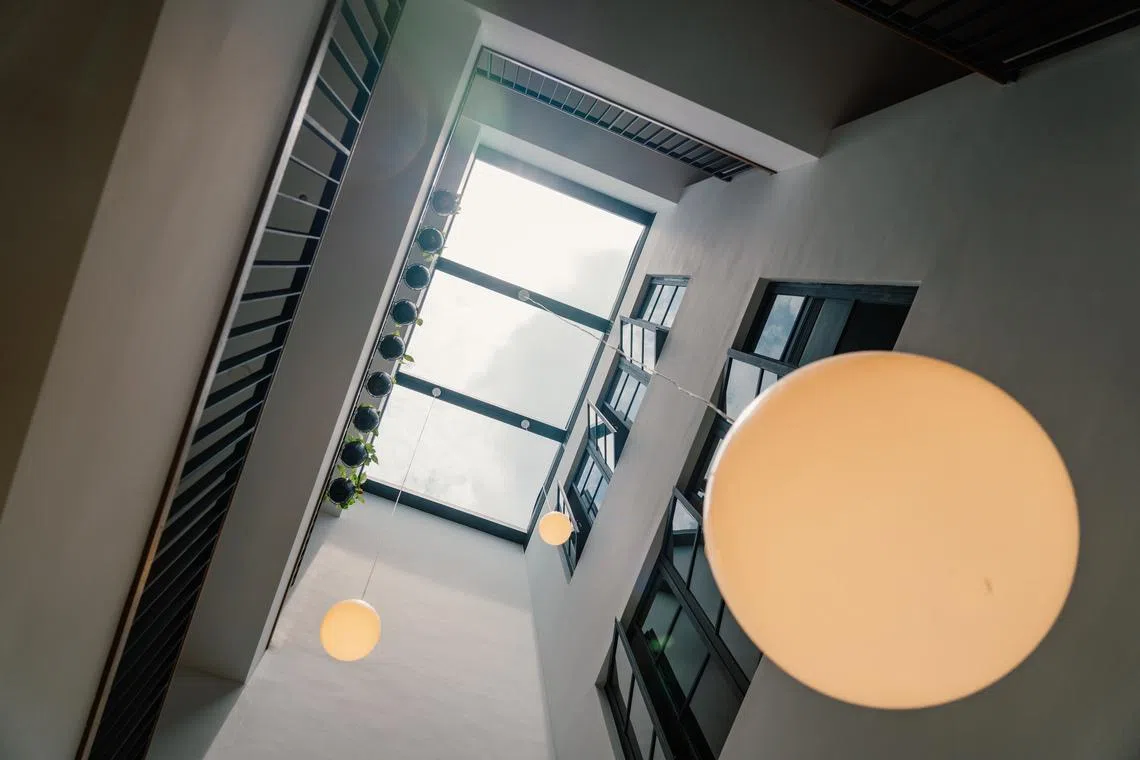
The rooftop skylight, accompanied by air vents for passive ventilation, then became the key idea, and the starting point for the demarcation of spaces.
“Through that rental home, we realised that the main family space is the dining room,” says Chow. “It’s where everyone goes to, so it had to be a bit more special.”
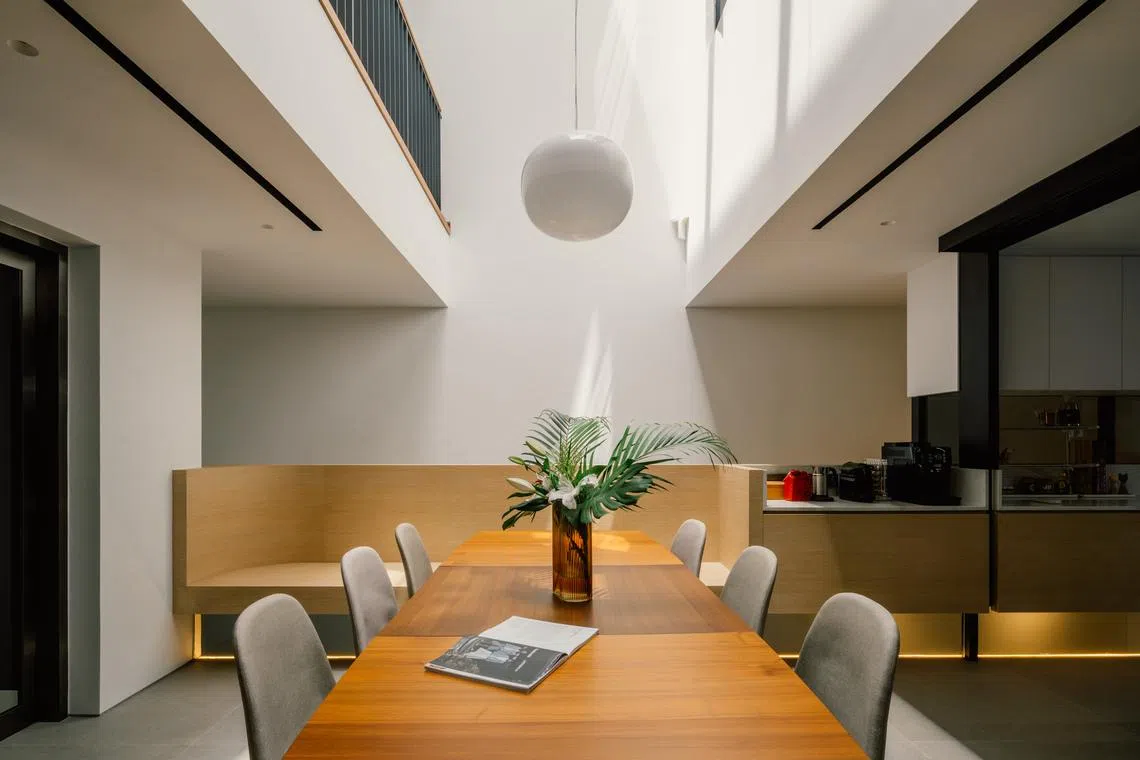
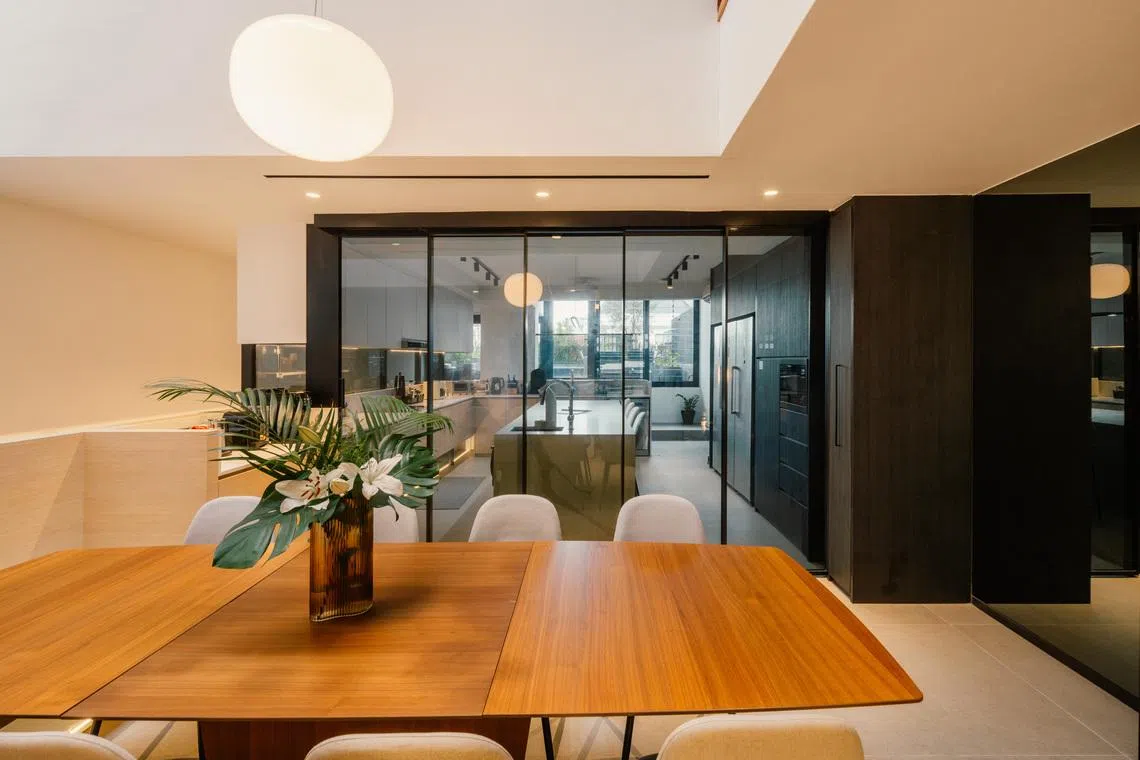
They positioned it right under the skylight, and lifted it onto the mezzanine for more privacy.
Dining on the mezzanine
Spatial planning and circulation for the rest of the house developed around the dining space.
Both liked the idea of locating the living room at the back of the house for privacy and to avoid facing the car porch as well as vehicular headlights and exhaust.
It helped that the land had an old rubble retaining wall at the back, which became the backdrop to the living room, according it a bit of character as well as some visual extension.
“With the more public spaces in the house, we tried to use different volumes to give it different kinds of feel,” says Chow of the varying widths and ceiling heights throughout the home.
The result is a layout offering tantalising hints of spaces to discover.
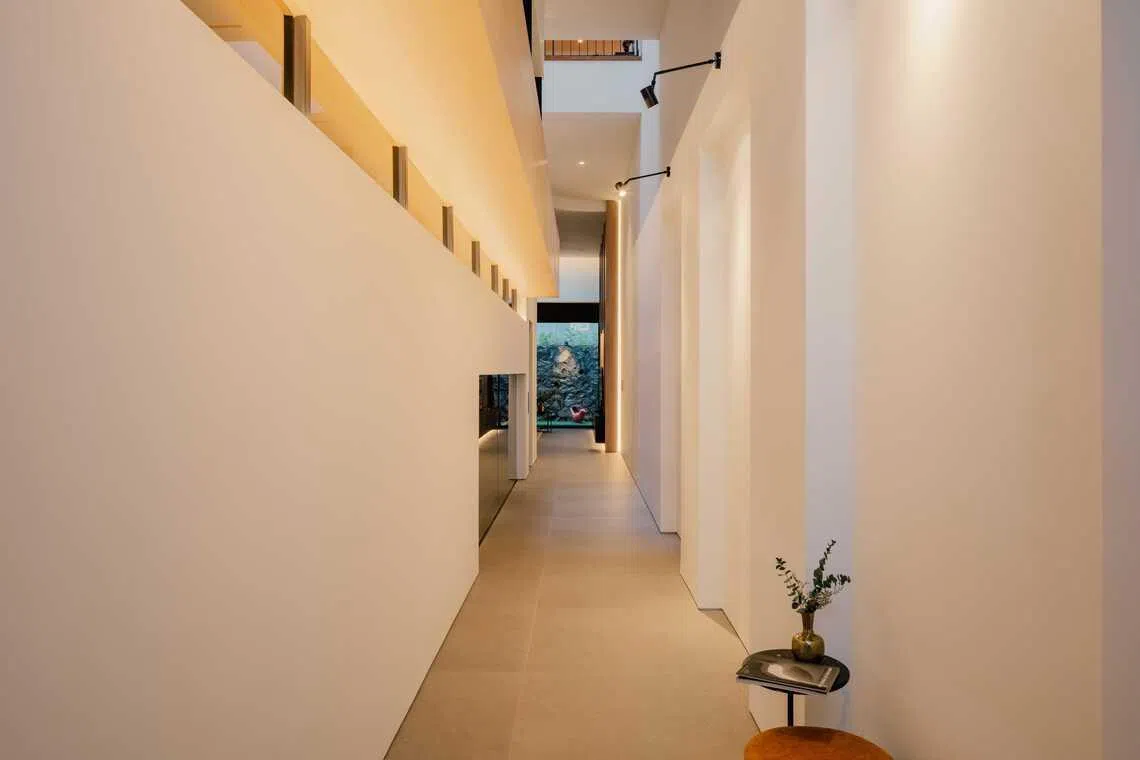
For instance, coming through the main door, you face a long, (mostly) double-volume corridor, with a glimpse of the retaining wall at the end. On your left, however, there is a half flight of stairs leading up to the mezzanine.
Should you choose to head down the corridor, you will encounter a “box” floating above you on your left, with slit windows just beneath it. That would be the back of the kitchen cabinets, with the windows enabling light to filter between the two spaces.
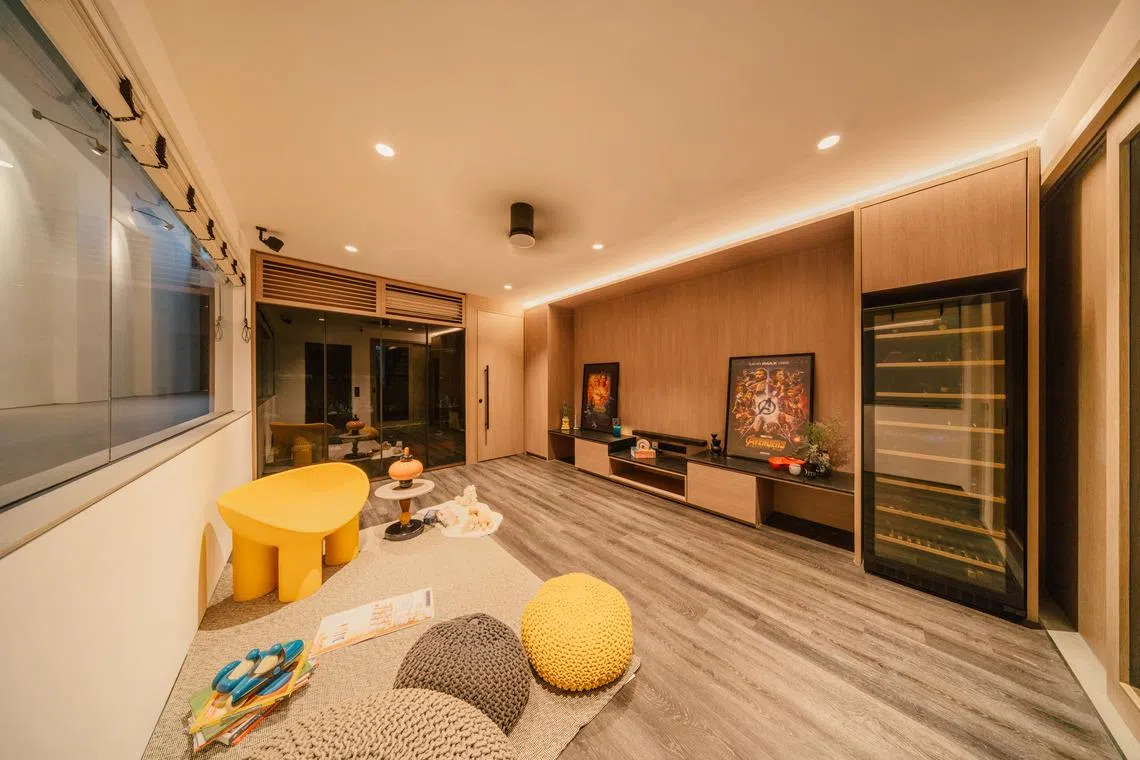
A little further on, there are glass panels on the bottom half of the wall, allowing you to look into the entertainment room on the lower ground level. As you walk along this passageway, you would have also passed under a quadruple-volume space beneath the skylight.
Some may think the corridor represents wasted space, but you are inclined to agree with Chow – that it is “almost processional”. “I also think this house is interesting because of this space, it’s like a canyon,” adds Lim.
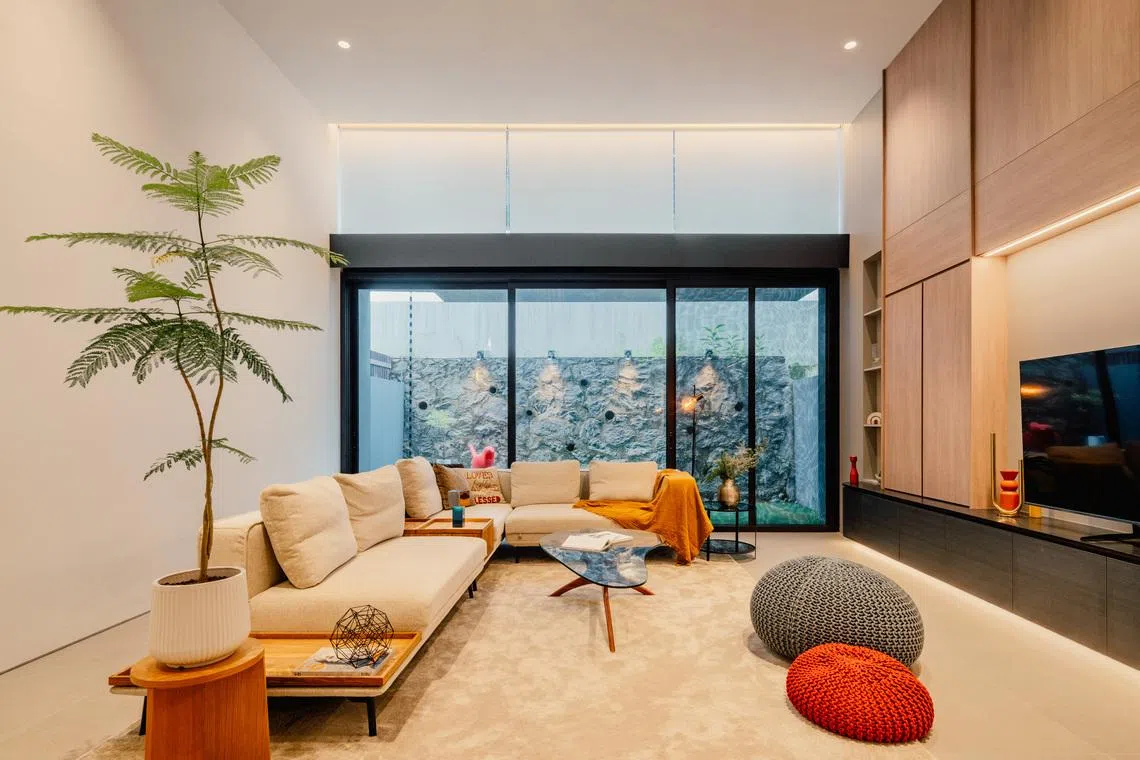
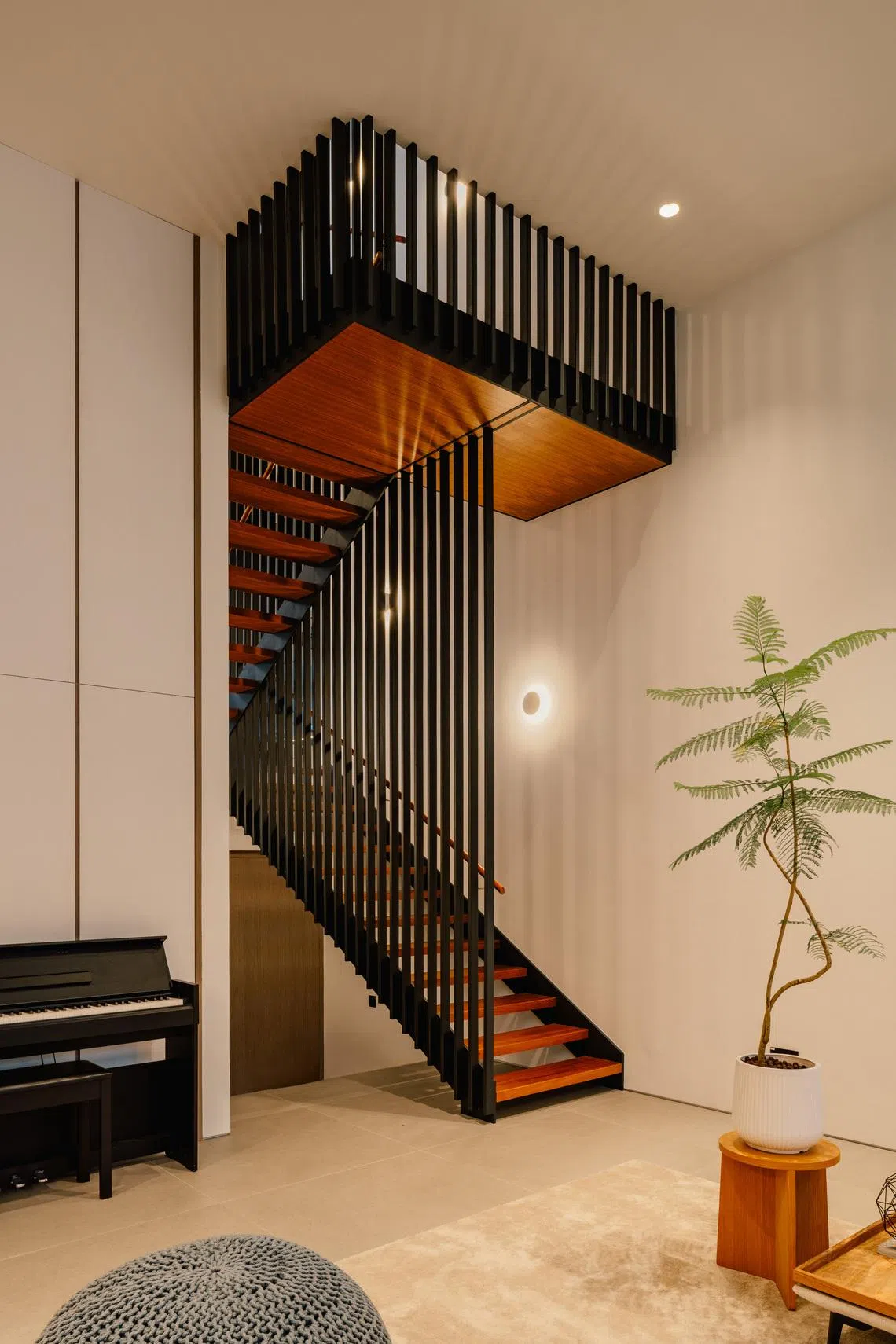
Finally, the end of the corridor opens into the tranquil sanctuary that is the double-volume living room, well-illuminated by natural light from the backyard.
Lay of the land
The void beneath the skylight serves both as an acoustic buffer between the sleeping zones of the home, as well as a connector of its front and rear “wings”.
Sited in the front are the laundry area and storerooms on the lower ground level, kitchen and terrace on the mezzanine, master bedroom on the second floor and the girls’ shared bedroom and roof terrace on the attic floor.
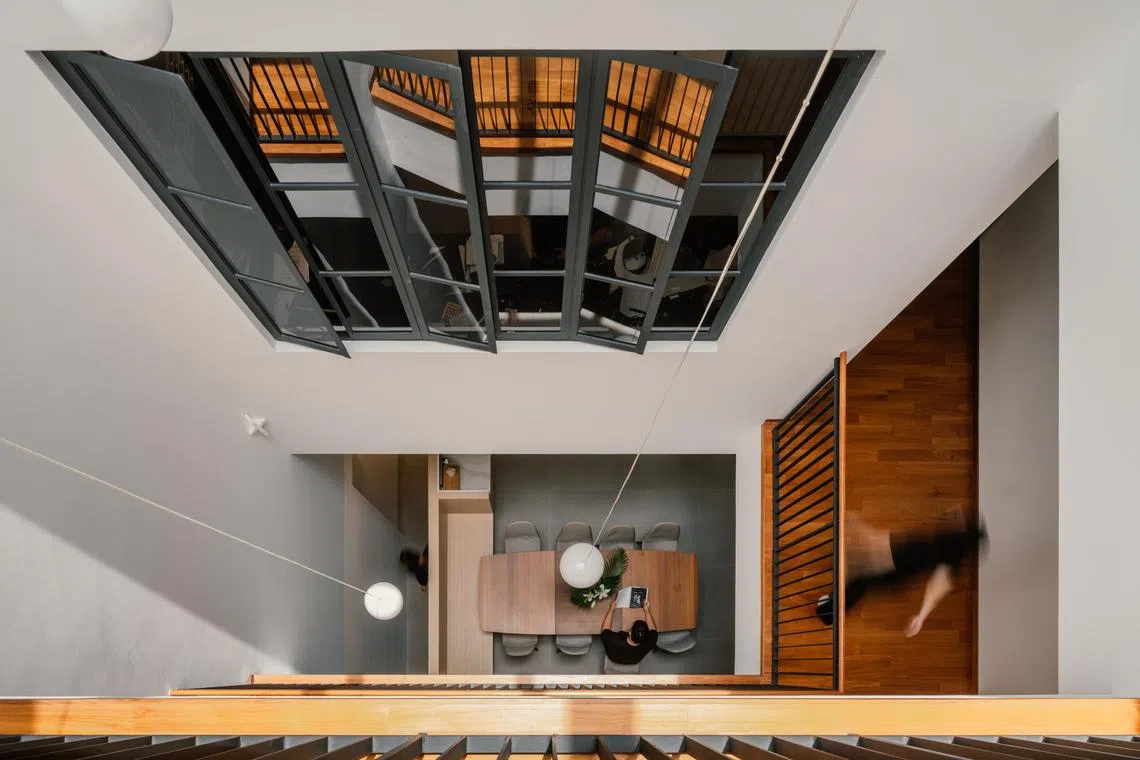
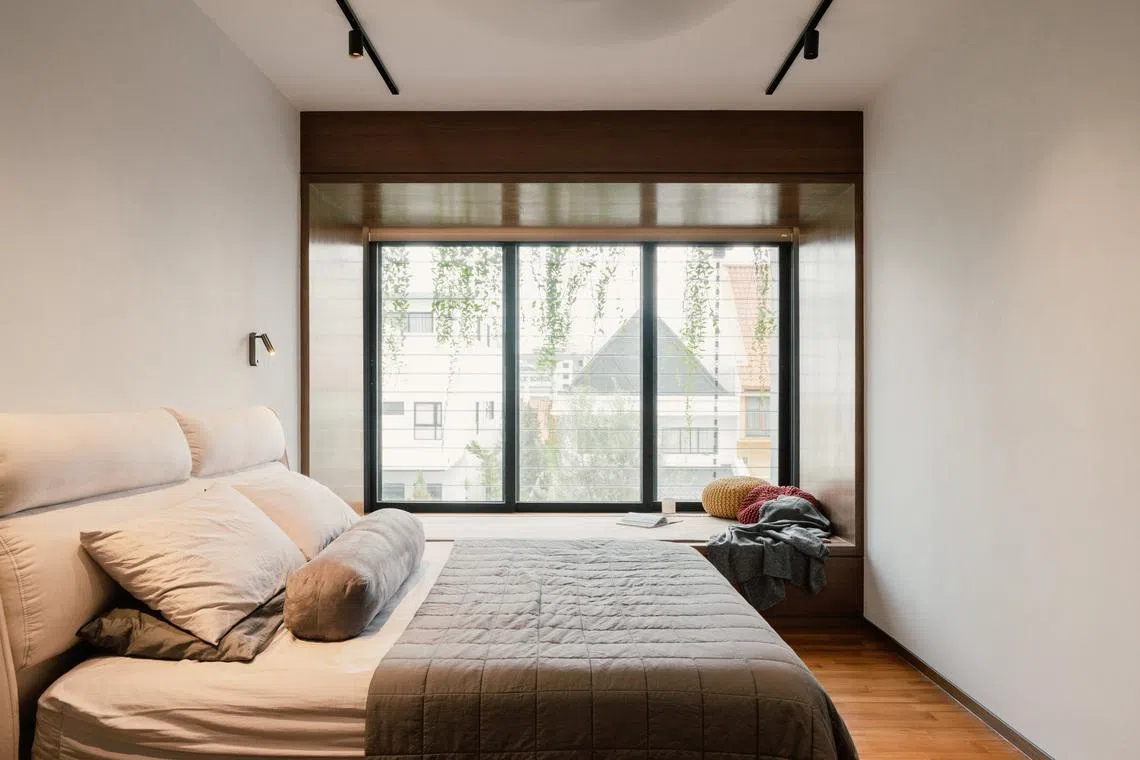
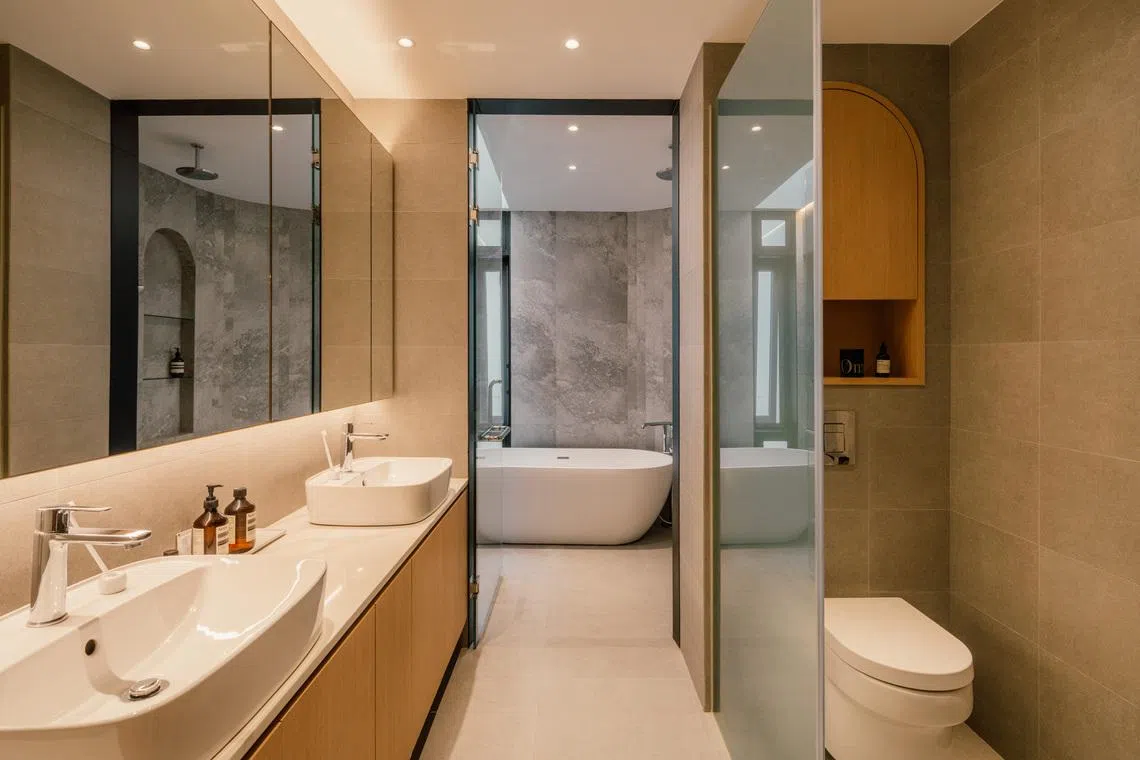
In the rear are the entertainment and living rooms on the lower ground and ground floors, respectively, Chow’s in-laws’ bedroom on the second floor, and a gym and roof terrace on the attic floor.
Helping to further cushion sound transmission are the family room or ancillary studies outside the entrance to each room upstairs.
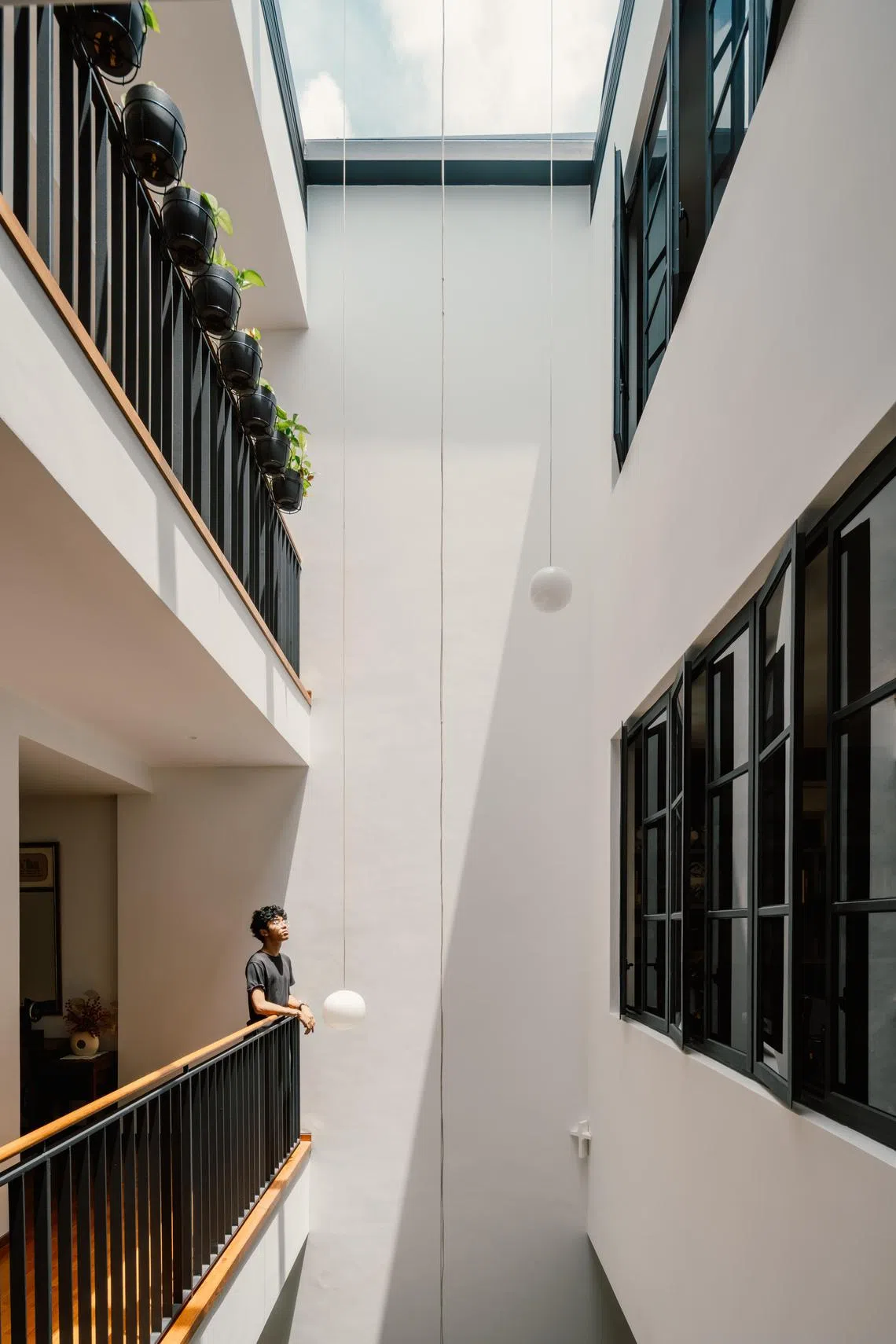
Throughout the home, light penetrates numerous windows that open into the central light well, and via the thoughtful insertions of skylights. At the same time, each family member has his or her own space to retreat into on the upper floors, as well as common spaces on the lower levels – connected via the centrally located stairs and lift – to gravitate towards.
The materiality of time
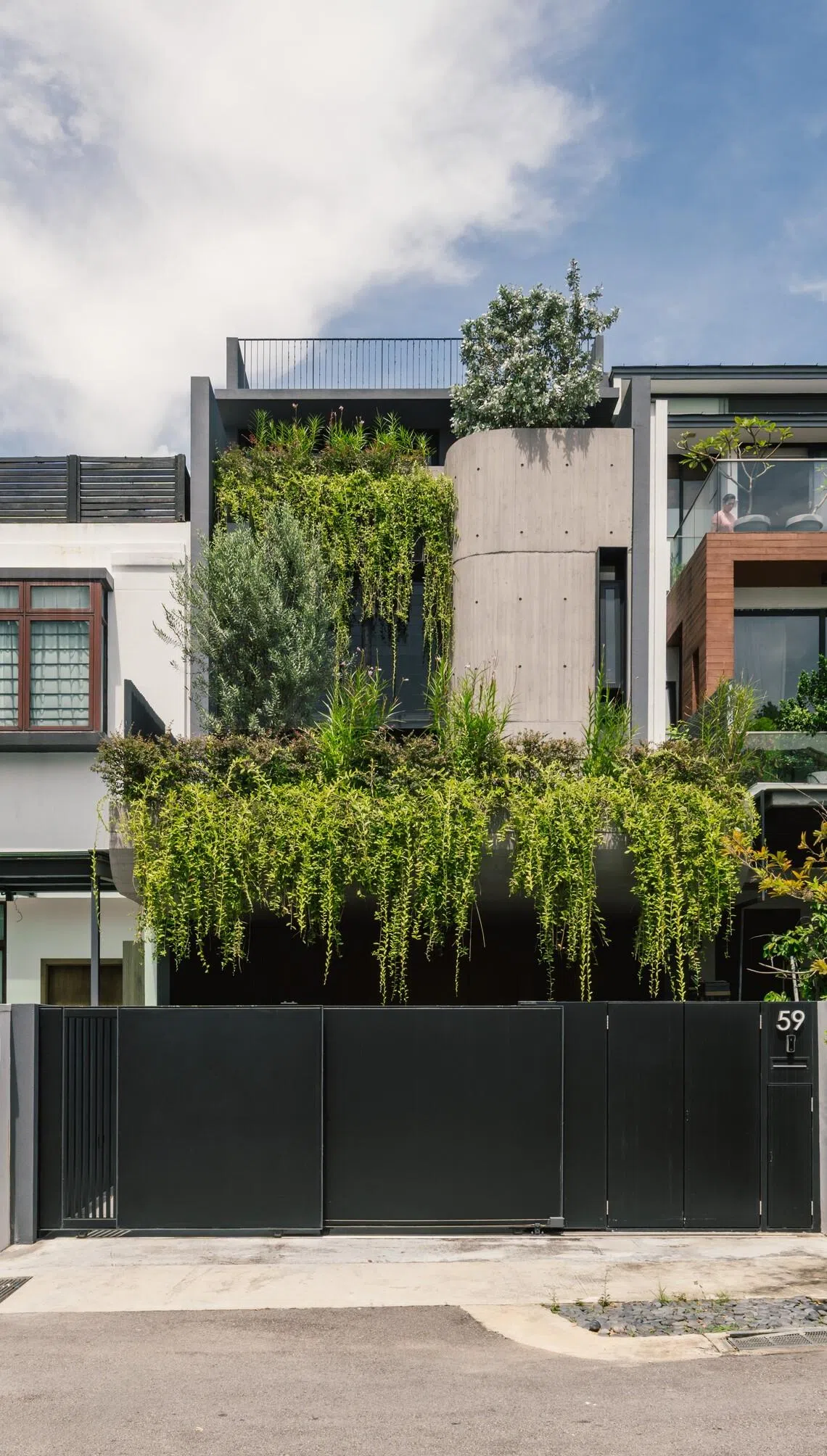
Just as the home is built to be resilient – accommodating different stages of life – it ought to also age gracefully over time. Thus, timber formwork was chosen to mould the curved concrete facade and car porch roof, giving the material an interesting texture and appeal.
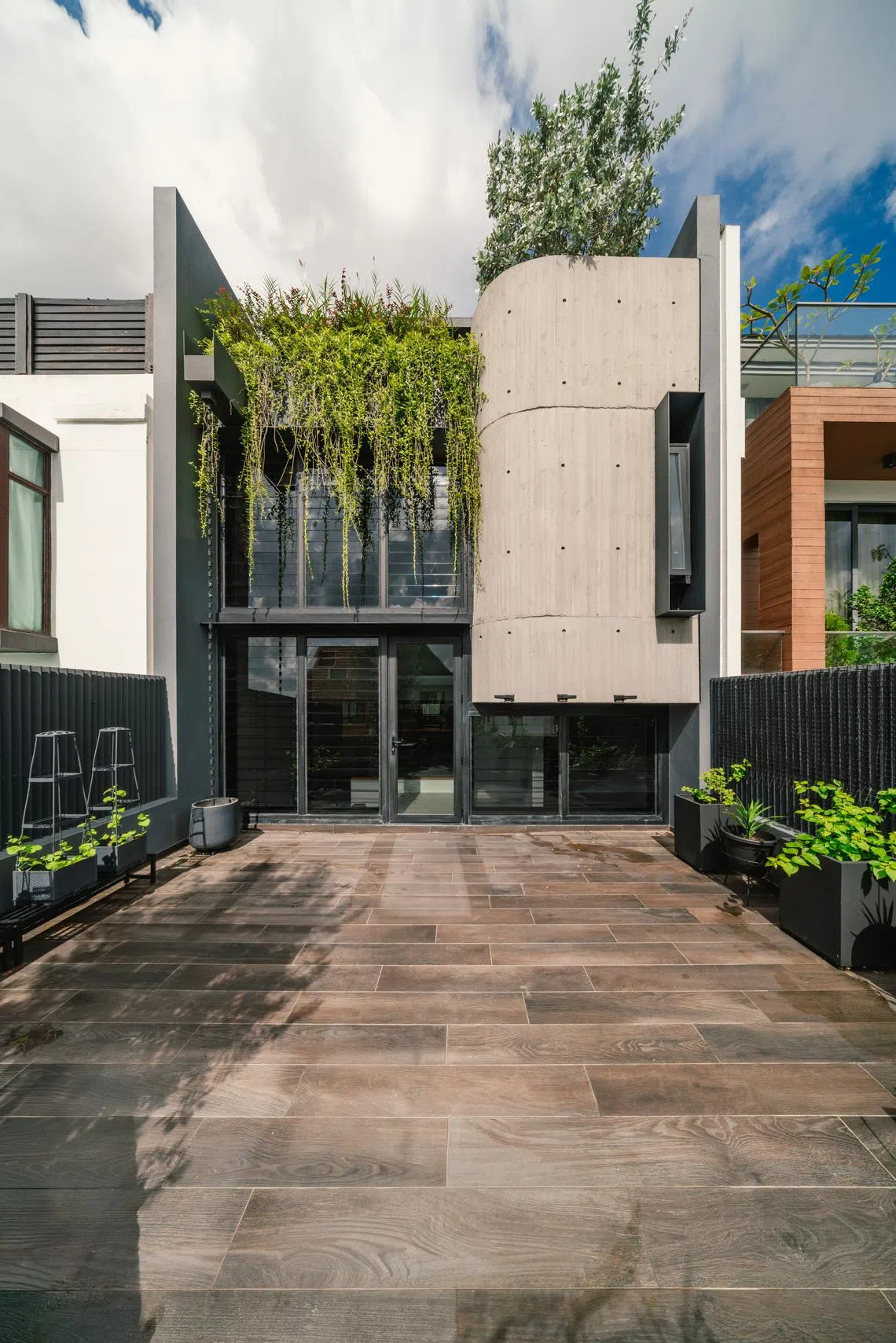
“Many clients don’t appreciate this because they want smooth, plastered surfaces that will look the same over time,” says Lim. “But after many years, there will eventually be mould growing over this surface.”
And that is something Chow is cool with. “I like the aesthetics of it. I like facades that age properly, which still have character when they get old and dirty. ”
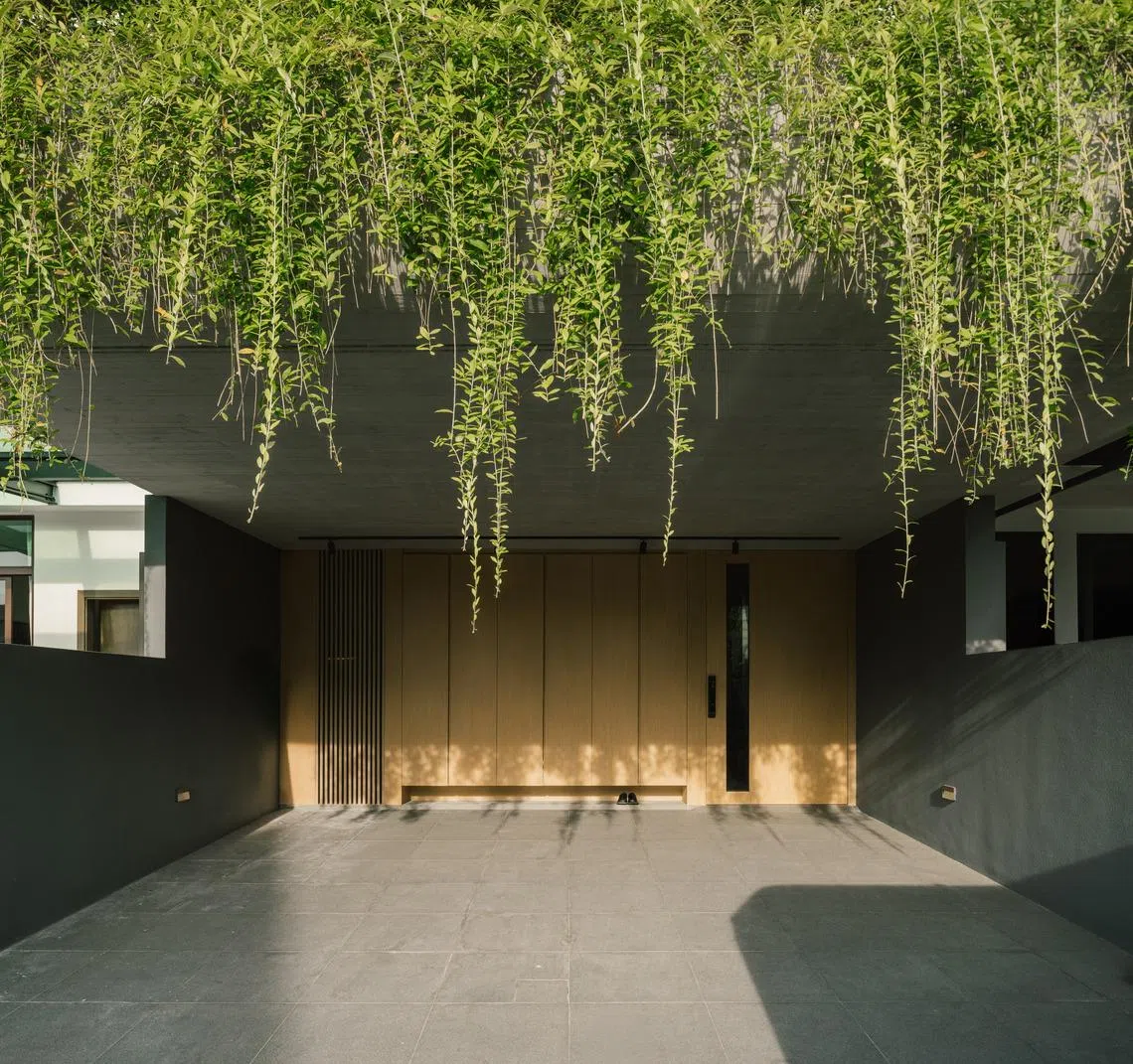
He also sought to get the house “as green as we can”. There were two plants he wanted for the facade: “One is the olive tree, and the other is the Lee Kuan Yew vine – my personal homage to our nation’s founding father.”
The vines (vernonia elliptica) were nicknamed after the late prime minister because it was widely planted in Singapore in the 1970s as part of his initiative to turn the island-state into a “Garden City”.
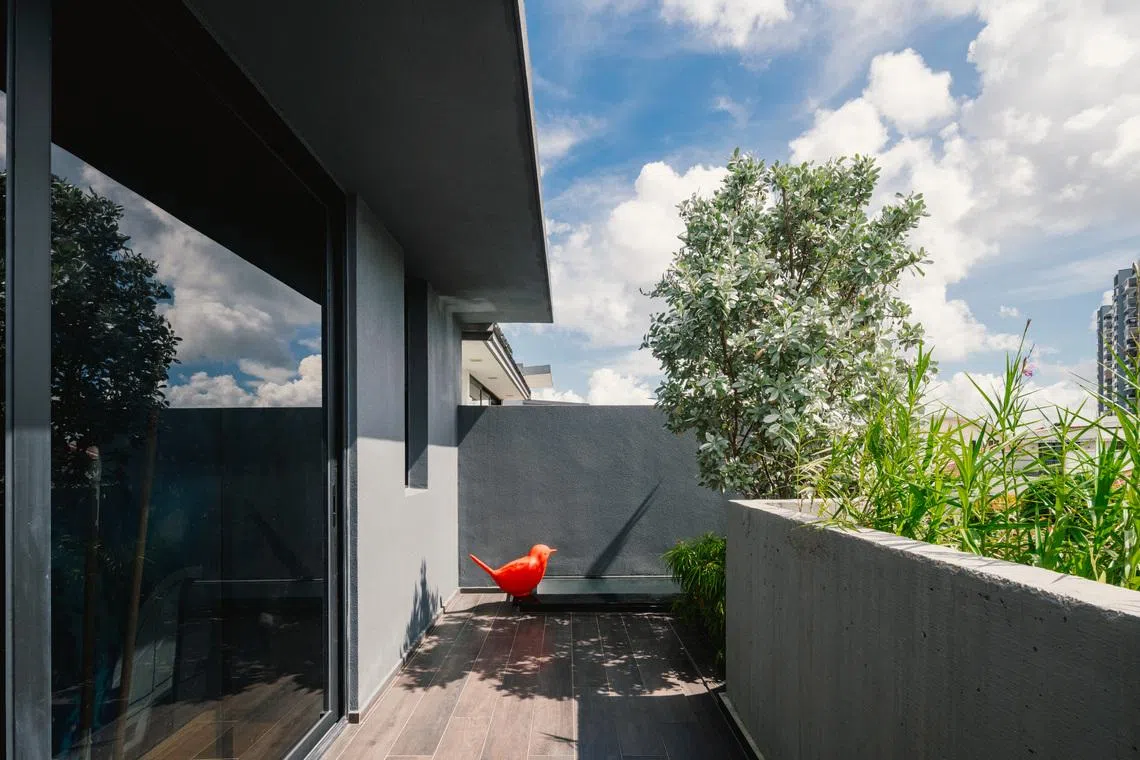
The vines are now flourishing, cascading down the front terraces. Other plants include papaya and lemon trees, a blue pea plant and the buttonwood shrub (conocarpus erectus), the ashy, silvery-green leaves of which add a wintry touch to the tropical setting.
Chow says he learnt much on his trip to Pennsylvania some 15 years ago to see Fallingwater, the house designed by the late American architect, Frank Lloyd Wright. The private residence is a masterpiece built directly over a nine-metre-high waterfall to harmonise with its natural environment rather than dominate it.
“There was one moment when it was really impressed upon me – that you need to take care of what you define as the most intimate space, then somehow, the rest of the house will take care of itself.”
Decoding Asia newsletter: your guide to navigating Asia in a new global order. Sign up here to get Decoding Asia newsletter. Delivered to your inbox. Free.
Copyright SPH Media. All rights reserved.
TRENDING NOW

On the board but frozen out: The Taib family feud tearing Sarawak construction giant apart

Thai and Vietnamese farmers may stop planting rice because of the Iran war. Here’s why

Are Keppel’s dividends truly unsustainable – or just misunderstood?

COEs for large cars up 4.3% at S$126,236, mainstream cars near S$125,000

