

After the gold rush: Malaysia’s durian industry gets thornier
Falling prices force the sector to find new value in branding, tech and waste

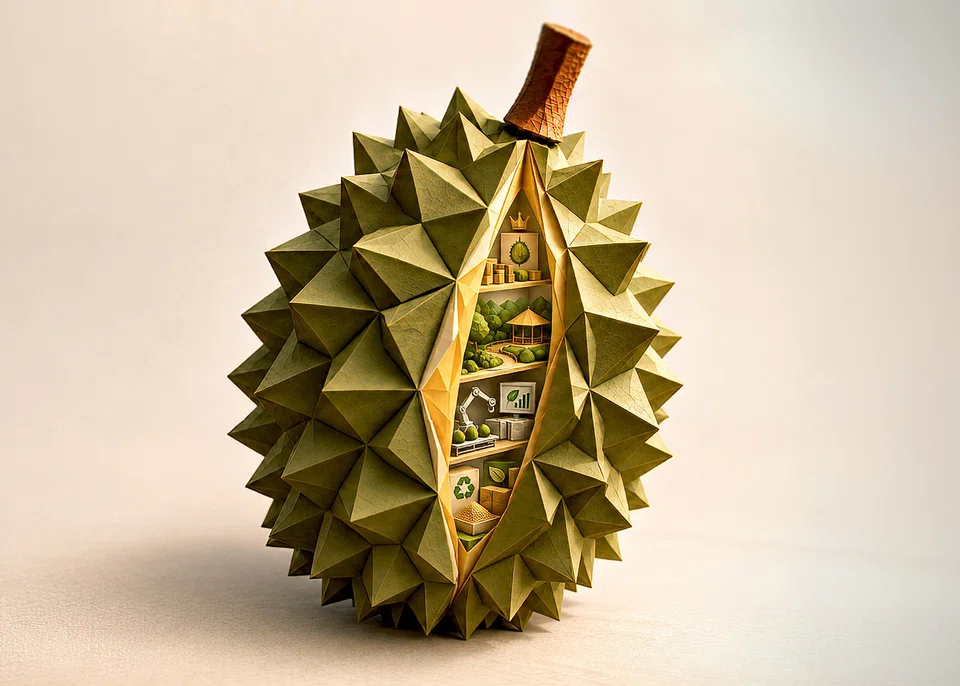
[KUALA LUMPUR] Every year, durian growers from across Malaysia send their finest fruit to compete for the coveted “King of Kings” title.
Agricultural scientists, industry experts and chefs judge entries on criteria such as taste, texture, appearance and aroma.
This July, a Black Thorn from Pahang beat out 192 competitors to come out on top. But it was not just the victory that caught the industry’s attention.
The winning fruit did not come from an old tree perched on a cool mountainside – two attributes traditionally associated with premium durian.
Instead, it came from a seven-year-old tree grown on relatively flat land.
For durian expert Lim Chin Khee, the result delivered a clear message to an industry navigating a massive supply surge and falling prices.
Elite fruit is no longer the exclusive domain of legacy trees or prime mountain terrain. “With the right cultivation techniques and precision management, younger orchards can compete on quality too,” Lim tells The Business Times.
But this democratisation extends beyond Malaysia. Pointing to growers in Vietnam and the Philippines, he cautions: “It is only a matter of time before regional competitors can match the quality of Malaysia’s Musang King.”
The lesson arrives at an important moment for the country’s durian industry.
Years of aggressive planting are now forcing growers to rethink an old formula built around planting more trees and waiting for premium prices.
As Malaysia’s “green gold” industry enters a more challenging phase, the next winners may be those who can create more value from the fruit.
From boom to glut
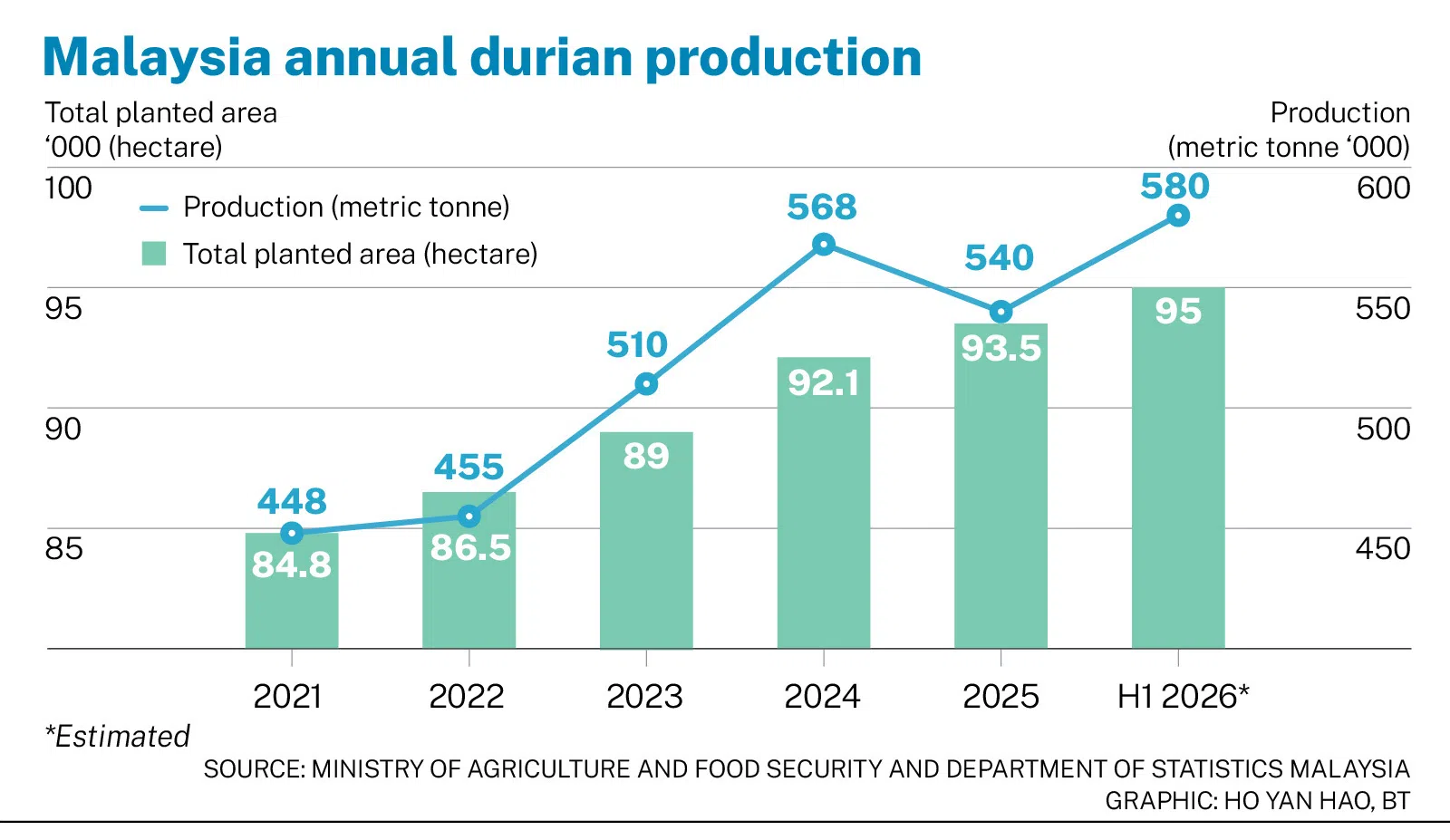
Malaysia’s durian industry is confronting what Yeah Kim Leng, an economics professor at Sunway University, describes as a classic boom-and-bust cycle.
Surging demand from mainland China and resulting premium prices encouraged a rush into durian cultivation over the past decade.
“Malaysia’s durian sector saw an unprecedented investment surge between 2015 and 2020,” Prof Yeah says.
But new orchards take years to mature, and trees planted during the investment boom are now bringing a delayed wave of supply onto the market. This massive supply glut has affected retail prices, he adds.
The consequences became stark during the 2026 harvest.
Musang King, Malaysia’s best-known premium variety, could previously fetch RM50 (US$12.40) or more a kilogram. Last year, prices during the peak harvest dropped to around RM20 to RM30 in parts of the market. Lower grades and other varieties fell even further, according to local media reports.
Despite the crash in domestic prices, Malaysia’s exports still hit all-time highs.
After the Chinese market was opened to fresh Malaysian durians in August 2024, exports of the fruit to China jumped from about US$5 million in 2024 to US$37 million in 2025. That momentum accelerated further in 2026, with exports reaching US$77 million in the first quarter alone.
However, Lim notes that overseas demand remains insufficient to soak up the domestic glut. Malaysia also operates at a structural disadvantage against Thailand and Vietnam.
While those competitors flood the market with early harvested fruit, protocol mandates that Malaysia exports only fully tree-ripened fresh durians, limiting shelf life and volume scalability.
Fruit that cannot be shipped and sold immediately flows straight back into the domestic market, compounding local price pressures.
The scale of the challenge is evident in China’s import figures.
The country imported 1.1 million tonnes of durian in the first half of 2026. Of this, Thailand captured 81 per cent of the import value, and Vietnam another 18 per cent. For Malaysia, competing purely on volume is a losing battle.
“Demand from China remains strong in the long term, but it has not expanded at the same pace as production,” Lim cautions.
Malaysia’s path forward relies on strategic differentiation, he argues – that is, a focus on premium quality, brand provenance and maximising value across the entire crop lifecycle.
Scaling up orchards
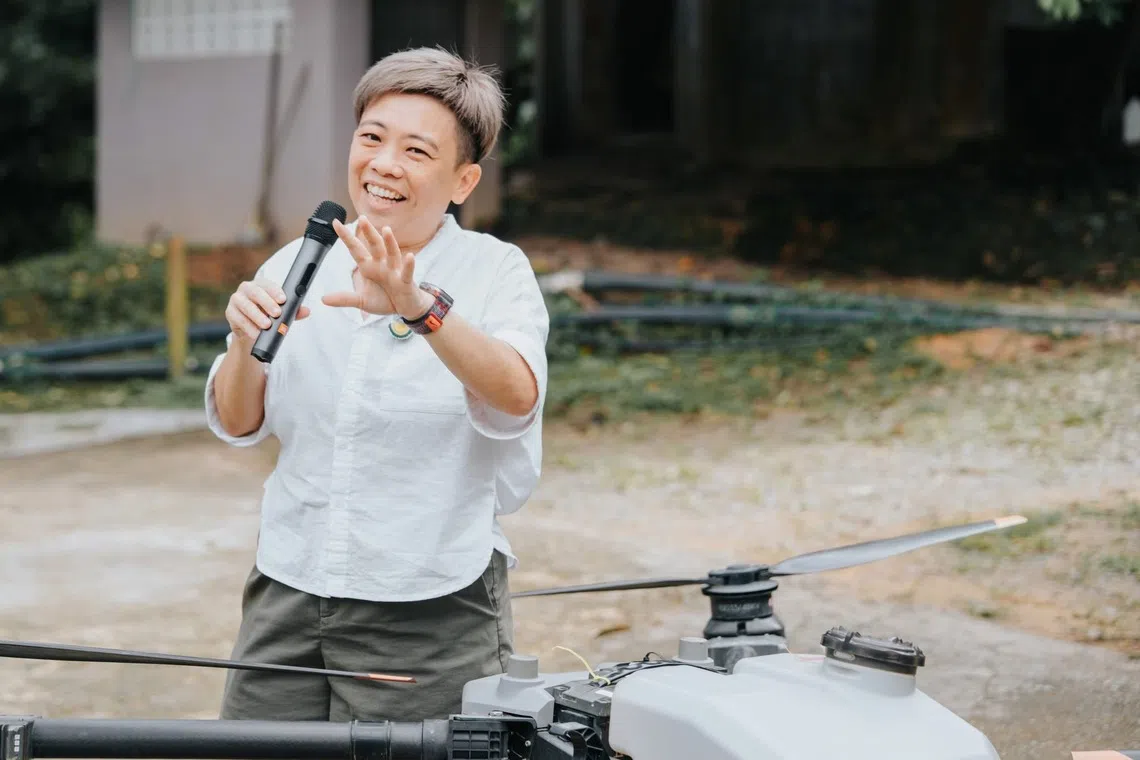
Acid Yong experienced the evolution first-hand.
The former teacher and marketer entered the durian business during the Covid-19 pandemic after investing with friends in a small orchard in Pahang.
With movement restrictions in place and Malaysians craving durian at home, Yong and her team had 10 days to create a name, packaging, website and social-media presence for a business that eventually became Dooran Dooran. At the peak of the lockdown, they sold around 1,300 packs of dehusked durian a day, she said.
Five years later, Dooran Dooran has around 1,300 acres of durian orchards under management across peninsular Malaysia, including farms managed for other owners under revenue-sharing arrangements.
Rather than simply selling well-known varieties, Yong wants customers to eventually buy durians on the strength of the Dooran Dooran brand.
She likens purchasing a durian to opening a blind box – a high-stakes gamble where expensive price tags do not always guarantee quality.
A trusted brand can provide an assurance of quality that a cultivar name alone cannot, Yong says. “The future of the business is about gaining trust.”
Dooran Dooran has also built a fan base around the brand – which led to another opportunity when customers began asking about visiting the orchards.
Yong said her team invested about RM2 million within a year on roads and infrastructure at its Raub orchard to improve access for visitors.
The company now runs farm tours followed by an all-you-can-eat durian buffet, at RM186 for adults and RM80 for children and seniors.
Dooran Dooran also expanded its farming operations after owners of larger orchards began approaching the company to manage their farms.
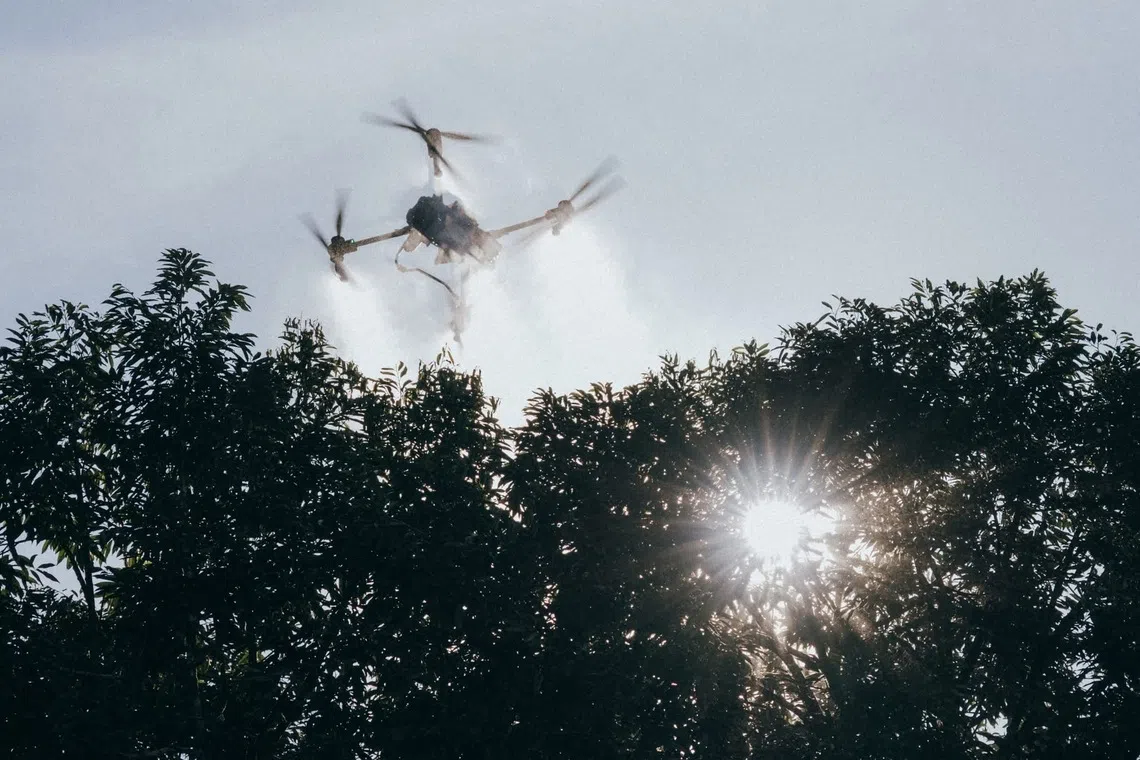
To boost efficiency and address the challenge of an ageing orchard workforce, Dooran Dooran started using drones for fertiliser and pesticide spraying.
The company now carries out drone spraying for around 2,000 acres of other growers’ land as well. Newer equipment lets it offer this service for 49 sen per litre, which is competitive with the cost of manual labour, Yong said.
Selling the culture around the fruit
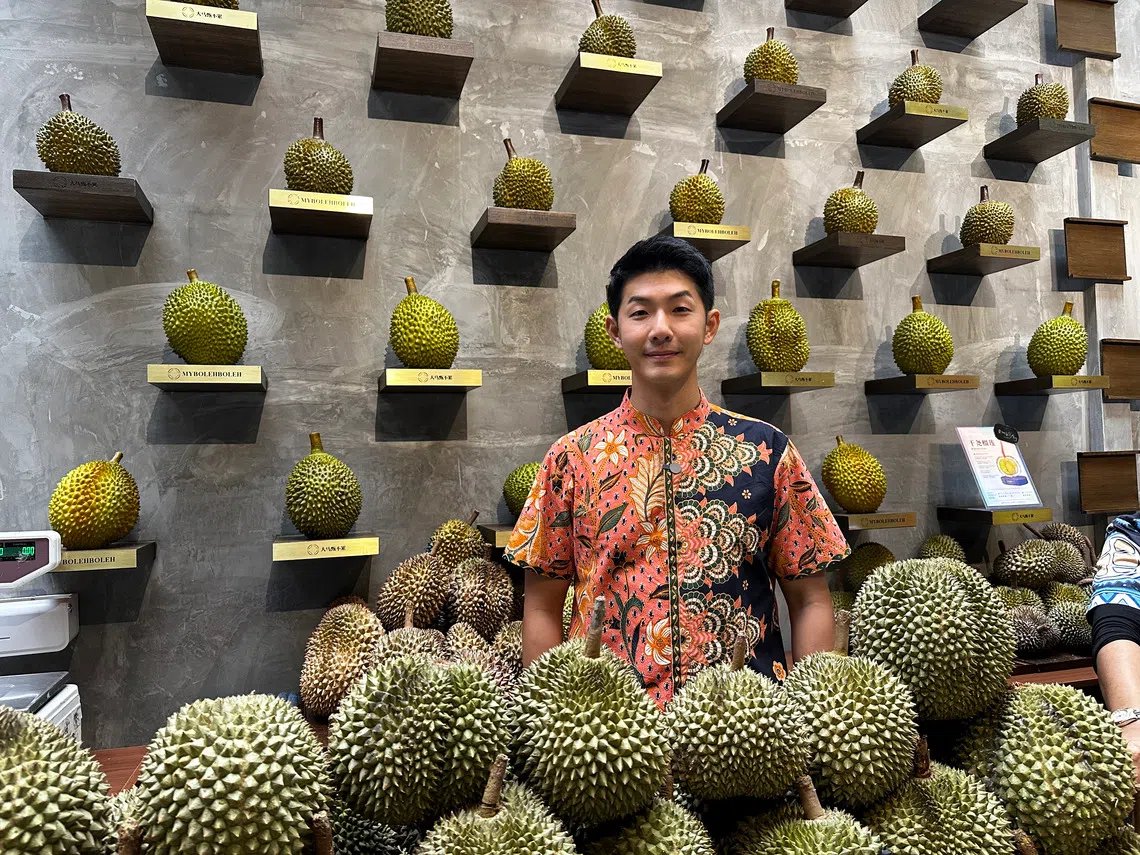
Social media influencer and entrepreneur Edison Ang has opted not to shuttle tourists out to remote durian farms. Rather, he is bringing the premium orchard experience directly to tourists in the heart of Kuala Lumpur.
Ang, who initially built his brand as a durian content creator and livestream host, started with an air-conditioned storefront in Petaling Street.
But as competitors quickly replicated the concept, he asked: Could the durian serve as a flagship cultural attraction?
Opened by Ang and his co-founders in June, the 20,451 square foot Kuala Lumpur Durian Experience Centre (KLDEX) is an RM8 million urban edutainment complex that combines durian tastings with exhibits, live theatre and an art gallery.
Just 600 metres away from the iconic Petronas Twin Towers, KLDEX aims to decouple durian tourism from rural orchards and seasonal harvest cycles.
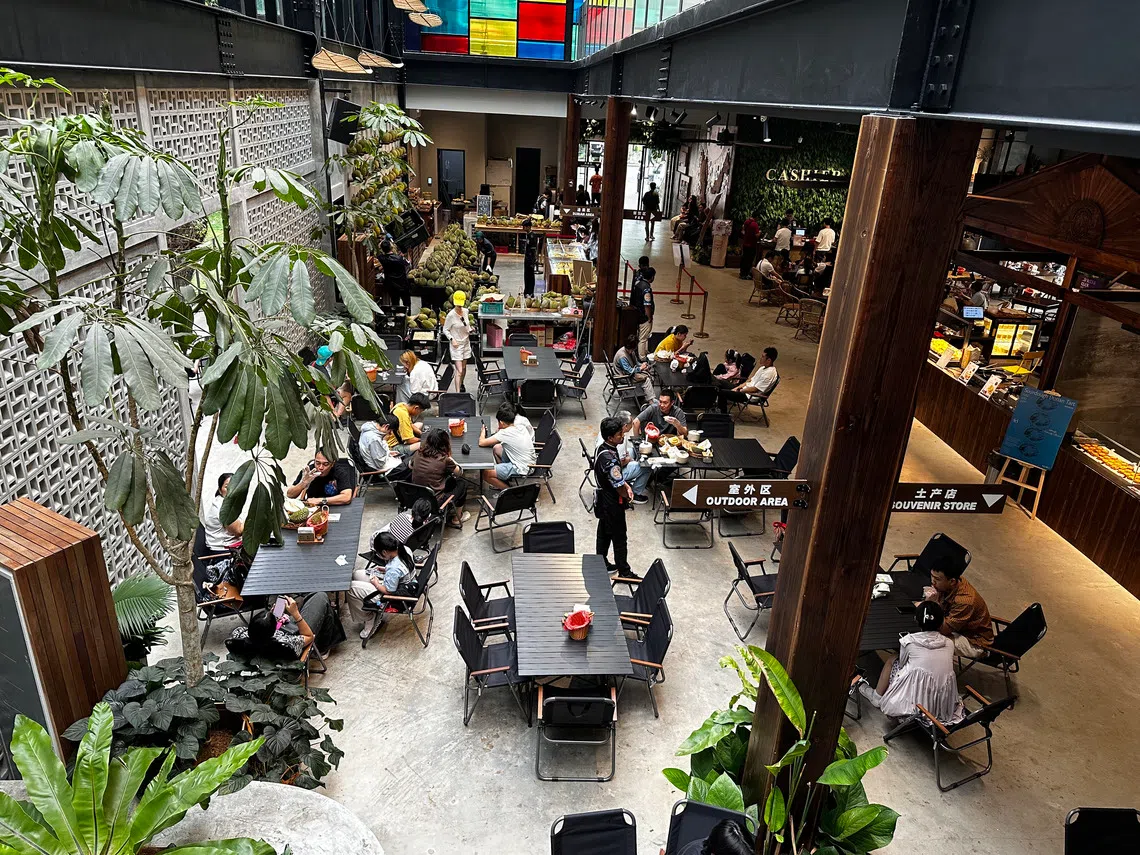
By offering a year-round, climate-controlled destination in the heart of the capital, the centre has drawn an average of over 1,000 visitors daily since its opening, peaking at around 3,000 on weekends.
Ang also wants to define what makes Malaysian durian distinctive.
KLDEX plans to work with researchers to study how factors such as location, altitude, tree age, as well as soil and water conditions relate to durian characteristics – applying scientific rigour to ambiguous terms such as “highland old tree”.
He hopes to rope growers into developing this framework, while introducing greater farm-to-consumer traceability.
The aim is eventually to give consumers a better understanding of provenance, similar to how wine and speciality coffee are marketed.
Amid competition for the durian dollar, investment in consistent taste and documented provenance could be increasingly important to commercial value.
Finding value in the husk
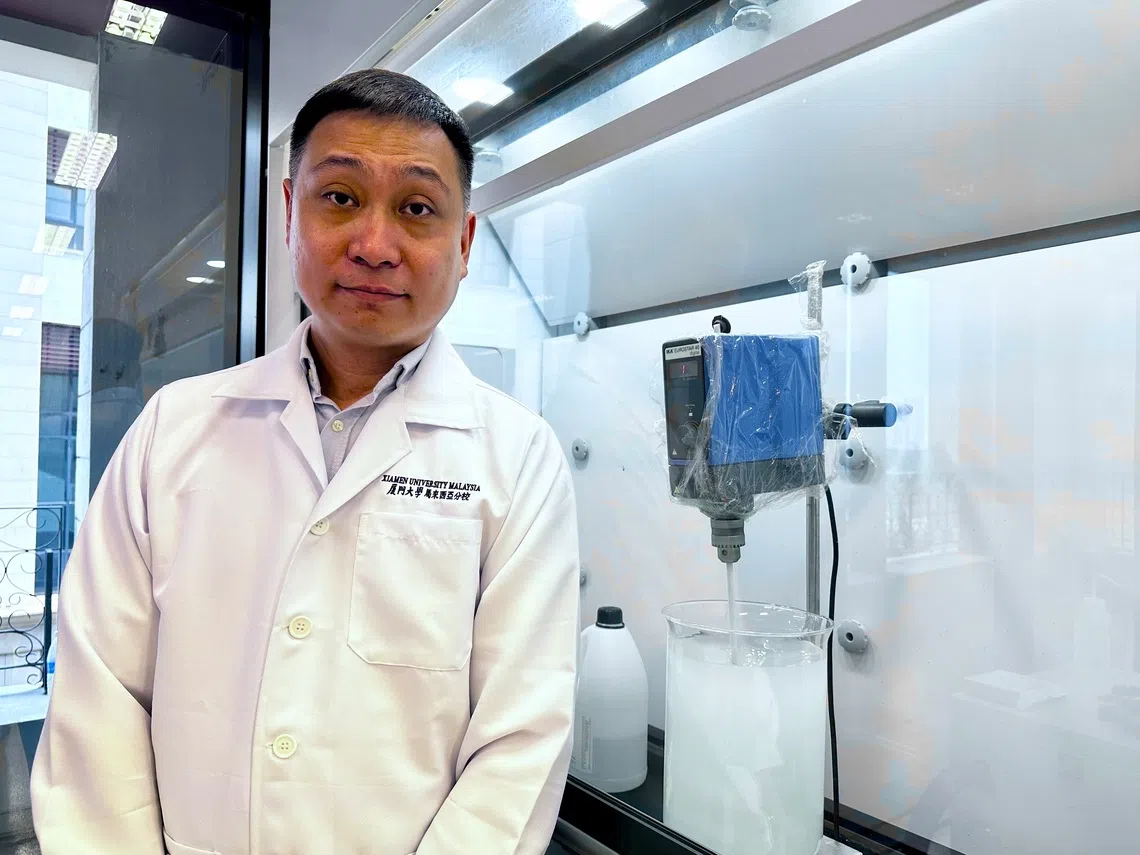
For sustainable material startup Seed Tech’s chief executive Tan Khang Wei, the commercial opportunity begins after the flesh is gone.
Prof Tan, who is also a chemical and environmental engineering lecturer at Xiamen University Malaysia in Selangor, has spent about a decade researching whether durian husks can be converted into high-value nanocellulose fibres.
A durian lover himself, the professor became interested in the fruit’s waste after noticing piles of discarded husks at stalls. He wondered whether they could be turned into something more valuable – especially as he estimates a single seller can generate one to two tonnes of husks a day.
Prof Tan is not alone in seeing value in durian waste. Researchers elsewhere have also explored uses such as biocomposites and eco-friendly packaging.
For instance, a team of scientists from Singapore’s Nanyang Technological University made headlines in 2021 for converting durian husks into antibacterial, biodegradable hydrogel bandages.
But Prof Tan is looking to carve out a niche by refining a less intensive process to extract high-purity nanocellulose from agricultural waste.
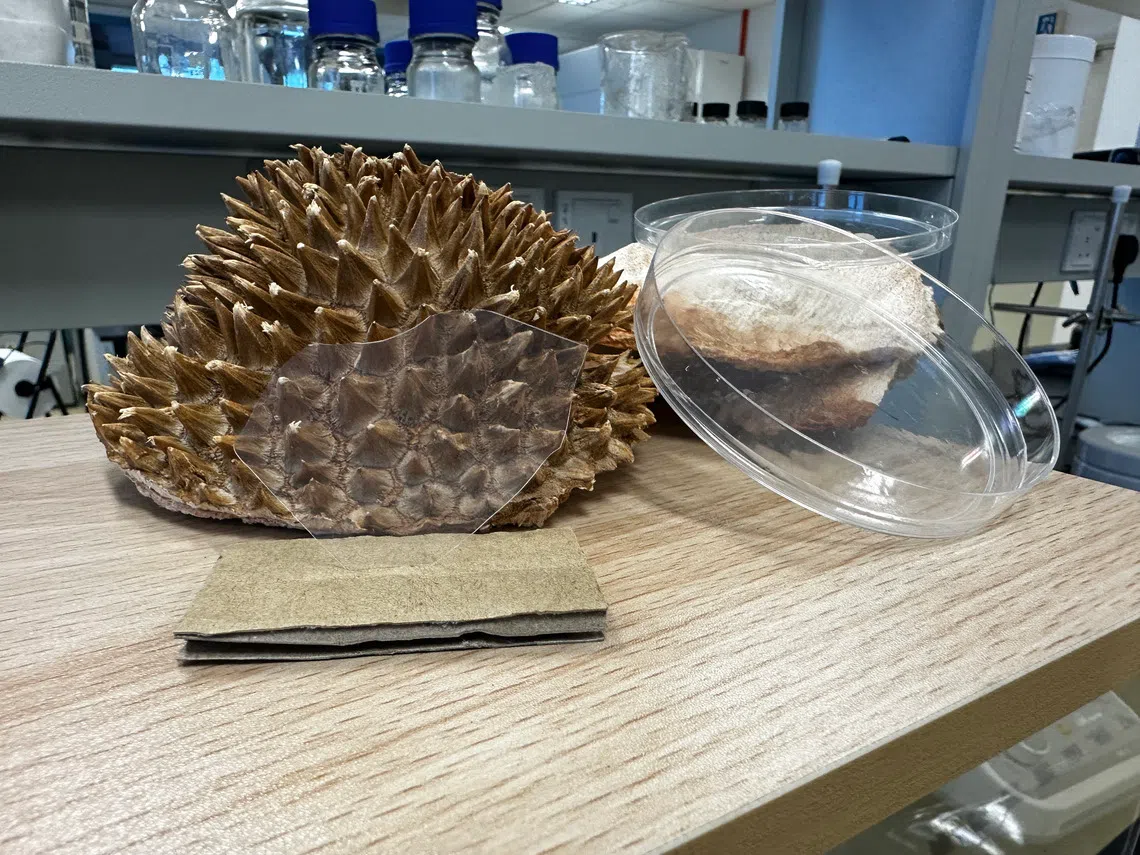
While conventional nanocellulose production relies on timber and concentrated sulphuric acid, Prof Tan’s team is developing an alternative using plant fibres – such as durian husks – and milder chemicals.
Potential applications range from food packaging and skincare to automotive components and other engineering materials, although Prof Tan notes that his durian-derived nanocellulose is not yet a mature commercial product.
Early consumer applications could potentially reach the market within 12 to 24 months, he says, while industrial applications such as automotive components would require longer testing and supply chain approval.
With roughly US$2 million invested to date, the team has advanced from raw nanocellulose extraction to active product integration with corporate partners.
Through Seed Tech, commercialisation agreements are already in place with Xiamen University Malaysia, government agency NanoMalaysia and private industry collaborators. They are aiming for a full commercial launch within a year.
What’s next?
Though Chinese appetite for imported durian continues to expand, the market remains dominated by Thailand, with Vietnam a distant second.
Malaysia flies only about 40 tonnes of fresh durians to China each day, despite annual production of more than 550,000 tonnes. Sunway University’s Prof Yeah says: “Malaysia’s current export capacity is severely constrained by logistics.”
The country has sought approval for overland fresh-durian shipments to China, which could offer an alternative to air freight. But fresh durians are still not permitted to transit through third countries (such as Thailand, Laos or Vietnam), notes Prof Yeah.
Until that changes, Malaysia remains at a disadvantage. He expects the downturn to accelerate business restructuring in the durian industry.
“Falling durian prices and the ensuing balance sheet stresses are causing a structural divergence in Malaysia’s durian sector,” Prof Yeah adds.
Larger and better-capitalised operators may take over the management of struggling orchards or establish partnerships with their owners – akin to the revenue-sharing arrangements that Dooran Dooran already has in place.
Other farms could become more closely integrated with processors, exporters and operators capable of aggregating supply and enforcing quality standards.
Processing will also become increasingly important, Prof Yeah says, noting that frozen pulp, paste and other products can extend commercial lifespan.
In the face of these challenges, industry players remain cautiously optimistic.
Ang said: “In my view, the (glut brought on by the) so-called ‘durian tsunami’ does not mean there is no demand. China remains a very large market. The real question is whether Malaysia is prepared in terms of logistics, standards and sales channels.”
Ultimately, the downturn may favour those that can differentiate themselves over growers that remain exposed to commodity prices.
For Dooran Dooran’s Yong, the price slump is a reminder that the days when rising durian prices could mask inefficiencies are disappearing.
“You need to know how to sell and market your products,” she said. “Simply owning a durian farm doesn’t make you rich.”
To succeed, growers will need to understand costs, improve consistency and quality, and establish tie-ups for processing, branding or marketing their fruit.
As Lim puts it: “The durian boom encouraged people to plant. The durian glut will force people to innovate… The winners of the next 10 years may not necessarily be the people with the most durian trees.”
TRENDING NOW

Grab CEO’s wife Chloe Tong on life with Anthony Tan and finding her purpose

HDB reviewing ‘jumbo’ flat scheme after Telok Blangah unit listed for sale at S$2.18m

He built the Vingroup empire. Now South-east Asia’s richest man is handing some key roles to his sons

Singapore judge raises doubts iron ore trader Radiant World is owed US$1 billion

