

AI is making talent invisible – that is a problem for organisations
The link between a polished piece of work and the effort and judgment behind it is weakening
 Add BT as a preferred source
A FEW weeks ago, a friend sent me a message about a post I had written on LinkedIn. In it, I described an academic who had criticised writing with the assistance of artificial intelligence – but was later accused of relying on it himself.
My friend ignored the professor and went straight for me. “Your post itself shows obvious signs of AI writing,” he said. “Do you see the irony?”
I have been turning that question over ever since, not because he had called me out, but because the exchange gestured at something larger than AI. It pointed to the processes we use to judge one another.
In contemporary times, we have quietly assumed a chain of equivalences: good writing reflects thinking and evaluation. A strong paper means a serious scholar.
Words became a trusted proxy for competence because writing was difficult and not everyone could do it well. It took time, training and the slow accumulation of knowledge.
AI has loosened that link, and once a signifier stops being reliable, the judgments built on it begin to wobble.
Consider how quickly this is playing out at work. A junior analyst can now produce a board-ready deck in half an hour. A fresh graduate can turn out a consulting-grade report overnight. A manager can draft a set of strategic recommendations before breakfast.
The average quality of output has risen sharply, and that is genuinely productive.
But it creates a problem that few organisations have named out loud. If almost anyone can produce polished work, how does a company evaluate skill from output? What actually counts as talent, once its visible markers can be manufactured on demand?
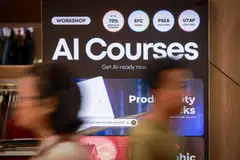


Illusion of effortless output
Most commentary frames the AI problem as one of excess: too much content, information and output.
I think the real problem runs in the opposite direction. It is not abundance that should worry us. It is the disappearance of markers of labour.
Effort has not vanished, but has become invisible. In the past, reading a thoughtful article told us something dependable about the person who wrote it. We could infer the hours behind it, and we recognised work put into it.
Today, we cannot. The link between effort and output has been quietly severed by AI, and with it goes one of the oldest instruments we have for assessing aptitude.
This is not only a problem for writers. It also reaches into hiring, management, education and leadership.
At a moment when most output is produced by people and machines together, one of the hardest tasks facing any organisation will be determining who created value.
Human societies have always rewarded visible effort. AI removes our ability to see it.
The implications are particularly crucial for knowledge economies such as Singapore. Much of the country’s competitive advantage has rested on highly educated professionals who were prized because of their reports, their analyses and the way they communicated.
As AI commoditises those outputs, employers will need new ways of identifying judgment, responsibility and the quality of a decision. The challenge is no longer how to generate information. It is about identifying who knows what to do with it.
We may be entering an era in which intelligence itself is no longer scarce. For centuries, institutions valued the people who could acquire and communicate knowledge clearly, because those capabilities were hard to cultivate.
AI is dismantling that logic faster than most of us expected.
The question is not whether AI should be used. That has already been settled, quietly, in millions of documents written with the help of the technology.
The real issue is how we learn to recognise human skill once polished output costs next to nothing and signifies little.
AI is not making intelligence obsolete. It is making the traditional signals of proficiency unreliable.
The organisations that adapt fastest will not be the ones that use AI most aggressively. They will be those that learn to recognise human judgment after the old markers of expertise have lost their meaning.
The writer is an associate faculty at the Singapore University of Social Sciences and a visiting scholar at the Lee Kuan Yew School of Public Policy, National University of Singapore
The commentary is based on the writer’s own experiences, observations and argument. AI tools were used for language and editing. The writer remains fully accountable for the commentary’s accuracy, originality and final form.
Decoding Asia newsletter: your guide to navigating Asia in a new global order. Sign up here to get Decoding Asia newsletter. Delivered to your inbox. Free.
Share with us your feedback on BT's products and services
TRENDING NOW

Ohmyhome Ltd sells real estate business for token US$1 due to poor business and continued losses

Buyer for England striker Harry Kane’s former mansion must pay £3.4 million after abandoning deal
Malaysian tycoon Vincent Tan’s sell-downs point to pruning rather than an exit plan

The Asian playbook for global brands no longer works

