

DBS, OCBC, UOB’s big sell-off: Was it their Q3 numbers or a broader market de-rating?
Strong year-to-date performance underscores their continued relevance to investors amid the recent volatility

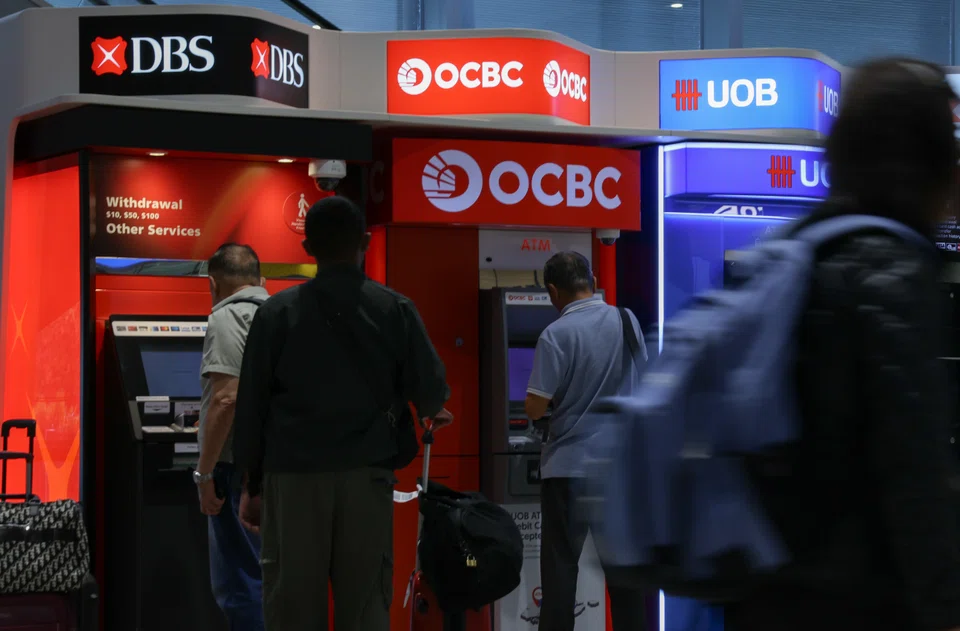
[SINGAPORE] The shares of the three Singapore banks dived last week as they reported mixed Q3 2026 financial numbers. But imagine how ugly things might have been if their shares had not already taken a beating in early October after some analysts flagged the risk of their financial performance falling short of the market’s elevated expectations.
Ironically, OCBC – which led the sell-off in early October – was the only one that managed to beat analysts’ forecasts. Its net profit for Q3 2026 increased 3 per cent to S$2.04 billion.
DBS reported a 5 per cent decline in Q3 2026 net profit to S$2.81 billion. UOB’s net profit for the quarter came in at S$1.25 billion, up 182 per cent against an exceptionally depressed Q3 2025 net profit of just S$443 million.
Meanwhile, concerns about normalising net interest margins (NIMs) at the three banks weighing on their profitability were mitigated.
While DBS reported a nine basis-point contraction in its NIM to 1.87 per cent for Q3 2026, it said this key metric was improving towards the end of the quarter, and should continue doing so into 2027. In any case, its net interest income for the quarter increased 4 per cent to S$3.71 billion, supported by a 10 per cent rise in total assets.
Similarly, OCBC reported a 4 per cent rise in net interest income to S$2.31 billion, with a 13 per cent rise in assets offsetting an 18 basis point contraction in its NIM to 1.66 per cent. The lender said it expects its NIMs to stabilise in the coming quarters, and raised its guidance for net interest income.
UOB’s forward guidance was disappointing, though. The lender reportedly downplayed the impact that rising interest rates will have on its NIMs, given competition for quality assets. It also said its full-year NIM for 2026 will fall short of earlier guidance of 1.75 to 1.8 per cent.
For Q3 2026, UOB’s net interest income rose 1 per cent to S$2.28 billion as its total assets expanded 9 per cent and its NIM slipped 14 basis points to 1.68 per cent.
UOB shares suffered a big sell-off immediately after reporting its Q3 2026 financial numbers, ending the week 10.9 per cent lower. This made it the worst performing constituent of the Straits TImes Index (STI), which fell 3.7 per cent last week.
UOB’s better performing peers were not entirely spared, though. DBS ended last week 4.7 per cent lower, while OCBC was down 5.3 per cent.
Caught in a broader sell-off
Over a slightly longer period of time, however, the sell-off that Singapore’s bank stocks have suffered looks less like the market discriminating against a weak performer and more like a general de-rating of the whole sector.
Prior to last week, the last precipitous dip suffered by the three banks happened on Oct 7, following a bearish call by Citi. Measuring their performance from that point, UOB has still lagged DBS and OCBC, but the gap in their performance was not quite as large.
DBS and OCBC are down 11.3 per cent and 13.9 per cent, respectively, while UOB is down 15.7 per cent.
This column noted in early October that Singapore’s three banks had not pulled back in isolation. Bank stocks in the US and Hong Kong had been weakening too, amid concerns of rising interest rates pushing up their funding costs and eroding the value of their bond holdings.
In fact, surging bond yields were also weighing on the big US technology stocks at the time. Interestingly, the Nasdaq 100 index began rolling off its recent peak on Oct 7, the same day the three Singapore banks tumbled on Citi’s bearish call.
Since then, the Nasdaq 100 has fallen 13.6 per cent. Over the past week alone, it sank 4.9 per cent, with some market watchers linking the sell-off to concerns of tougher artificial intelligence regulation as the US Democratic Party gained control of the country’s legislative body. Earnings misses by Amazon and Alphabet, and disappointing forward guidance by Intel and Qualcomm did not help.
The selling swept across Singapore’s technology stocks too. Over the past month, AEM, Frencken Group and UMS Integration have declined 43.1 per cent, 34.2 per cent and 41.3 per cent, respectively.
My point in all this is the recent share price trajectory of the DBS, OCBC and UOB was probably heavily influenced by global market themes and trends rather than their microfundamentals alone.
So, what should investors do? Is the recent slump in the Singapore banks a buying opportunity? Or, is it the beginning of a more serious de-rating?
Magnets for capital flows
Even after the sell-off they have endured since the beginning of the year, the three Singapore banks are still among the best performing constituents of the STI this year.
OCBC is in first place by a long way, with a gain of 40.3 per cent since the beginning of the year. DBS is in third place, with a gain of 23.7 per cent. UOB is up 5.2 per cent, putting it in eighth place.
The STI is up 11.5 per cent this year, with only eight of its 30 constituents in positive territory.
While this may be partly a reflection of the big gains some of the banks made earlier in the year, it also underscores the continued relevance of the Singapore banks to investors amid the recent volatility. WIth strong performance track records and a combined weighting of more than 50 per cent in the STI and MSCI Singapore Index, they are likely to remain magnets for capital flowing into the Singapore market.
This does not mean that the Singapore banks are attractively priced or that their recent sell-off will not deepen, of course. Investors should keep in mind that the strong long-term returns chalked up by the banks have been flattered by their recently expanded stock valuations, which may not be easily sustained.
Indeed, this column has warned against chasing the bank stocks as they soared over the past year, and suggested rotating towards the laggard within the sector – UOB.
DBS, OCBC and UOB are currently trading at 2.8 times, 2 times and 1.3 times their respective Sep 30 net asset values.
For investors who are not already adequately invested in the Singapore banks, the current pullback may be an opportunity to dip their toes in the water. But they should weigh the familiar advice that “time in the market beats timing the market” against the traditional market wisdom of quickly cutting losses.
TRENDING NOW

China recruited exec at Singapore data centre firm to spy on Nvidia CEO Jensen Huang: US intelligence

Higher rates, weaker spending: Is the Philippines entering stagflation?

Could Japan trigger the next global financial crisis?

Protect people, not prices: How Asean+3 can build resilience to energy shocks

