

Japan Home is retreating and rents are rising. Singapore retail could pay the price
Cheap imports and free shipping are changing retail. The Republic must decide which shops it needs to keep
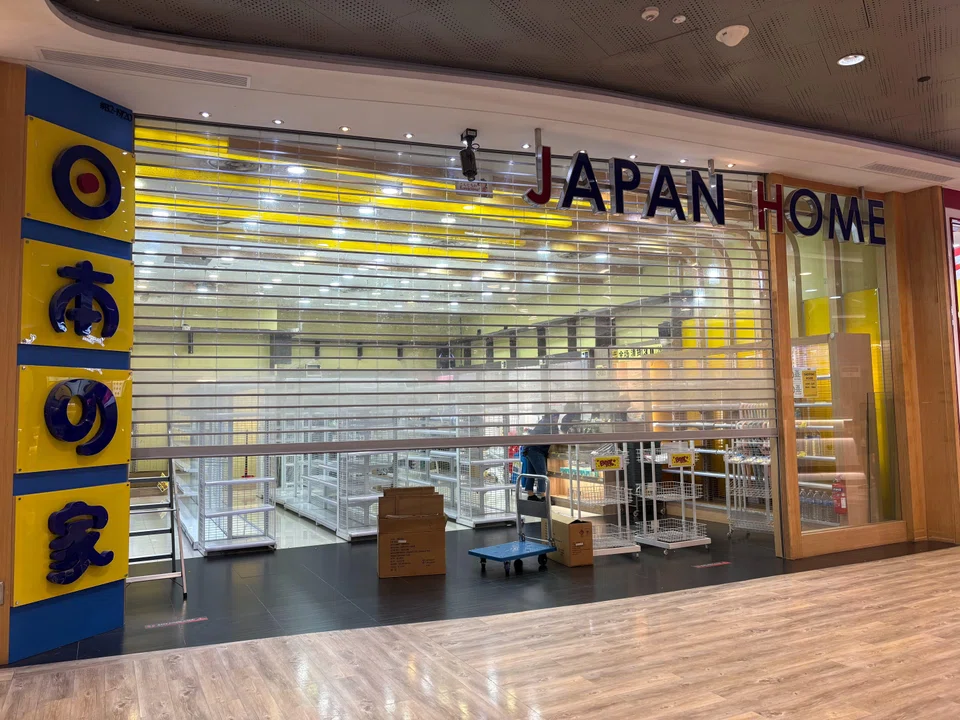
JAPAN Home’s recent retreat from the retail scene should concern more than bargain hunters. The household-goods chain closed several Singapore outlets in June and July, before licensing its remaining stores to Radha Exports, the company behind Value Dollar (Valu$).
Its loss for the financial year ended April 2025 more than doubled to S$2.3 million from a year earlier.
The story captures a larger contradiction. In the second quarter of 2026, Urban Redevelopment Authority’s retail rental index rose 0.6 per cent. Yet occupied retail space fell by a net 37,000 square metres, and the islandwide vacancy rate edged up from 6.3 to 6.5 per cent.
Shops are withdrawing, space is emptying and rents are still rising. Who, then, is carrying the cost of retail’s transformation?
The vanishing shopping trip
For Poh Hwee, one of the writers of this op-ed, that question became personal after he used Pinduoduo for the first time.
The prices seemed absurd: a 10-roll pack of toilet paper for S$0.58, a razor with five replacement cartridges for S$0.18 and a pair of dumbbells for S$0.65. The app promised dispatch within 24 hours and free delivery, even for one item.
Shopee, Lazada and other platforms have pressured physical retailers since before the pandemic. Pinduoduo’s “one item, free shipping” offer adds a revealing twist: It removes the “basket threshold” – the minimum amount a shopper must hit to qualify for a benefit.
Without it, a minor need can become an immediate purchase. The consumer no longer has to wait, reconsider or walk downstairs.
Japan Home cannot beat that system by cutting prices. A physical shop pays Singapore rent and wages and holds stock near customers. A cross-border platform can aggregate demand across China’s manufacturing base and spread logistics costs over millions of transactions.
But if price is the only measure of value, the conclusion is predetermined. The more difficult question is what physical retail provides that an app cannot – and how to make that value commercially viable.
Affection is not a business model
For almost 10 years, Poh Hwee has had his hair cut at a small shop on the third floor of Beauty World Centre. A Malay barber whom he calls “Uncle” has been there throughout. Whenever Poh Hwee sits down, he says one word: “Same.” Uncle knows exactly what he means.
Sometimes Poh Hwee arrives while Uncle is praying, so he waits quietly. For years, Uncle accepted only cash. Poh Hwee suggested PayNow, for Uncle’s convenience as much as his own. Eventually, a QR code appeared at the counter. Even when Poh Hwee does not need a haircut, he still stops at the entrance to say hello.
Pinduoduo knows what he clicked yesterday. Uncle knows what “same” means after nearly a decade. Both know their customer, but not in the same way.
This value extends beyond one friendship. A Frasers Property-Singapore Management University study found that more than six in 10 older adults visit suburban malls at least weekly, driven less by discretionary spending than by routine, familiarity and social connection.
Still, affection cannot pay the rent. If residents praise familiar shops but spend almost everything online, that feeling becomes an obituary rather than a strategy.
Technology should remove friction without removing the relationship: PayNow, WhatsApp ordering, searchable listings, booking and inventory systems.
Merchants could also share a precinct catalogue, collection service, delivery and loyalty programme. The relevant digital unit need not be one shop; it can be the neighbourhood.
The economics of sameness
Landlords also face consequential choices. Metro’s plan to close its last two department stores, at Paragon and Causeway Point, shows that the old anchor-tenant model is fading.
At Plaza Singapura, CapitaLand Integrated Commercial Trust has begun a S$160 million revamp that will run until October 2028 and refresh the mix around experiences, entertainment and dining.
These are not simply stories of closure. They are moments when owners decide what kind of retail comes next.
Real estate investment trusts (Reits) are an important part of this landscape. To qualify for tax transparency, Singapore-listed Reits owning Singapore property must distribute at least 90 per cent of specified taxable income.
The desire for predictable distributions can encourage risk-managed leasing: Familiar chains are safer than untested independents. Repeated across malls, rational decisions can produce a homogeneous city.
Yet it would be wrong to say that Reit managers must award every unit to the highest bidder. A lower-rent bookstore, repair shop or distinctive local business may generate off-peak traffic and lift the value of surrounding units.
Maximising a property’s value is not the same as maximising each lease. The social case for variety can also be a portfolio-level commercial case.
Share the cost of transition
Singapore already supports small and medium-sized enterprise retailers to adopt digital tools.
The refreshed Retail Industry Digital Plan is expected to benefit more than 2,000 such merchants, while government subsidies for heartland enterprises’ visual merchandising and place-making have risen from 50 to 70 per cent.
But these schemes should be judged by profitable sales, repeat customers, faster stock turnover and survival after subsidies end – not how many firms adopted a tool.
Lease policy matters just as much. Publicly controlled neighbourhood centres should weigh function and diversity alongside rent, offering useful lower-margin trades longer leases in return for service commitments.
Indeed, the Housing & Development Board has kept rental rates steady for 90 per cent of its shops over the past five years.
Private mall owners should explain how asset-enhancement projects will treat existing small tenants, including notice, relocation and realistic routes to return.
The current review of the retail leasing code is an opportunity to improve renewal transparency and planning certainty.
The goal is not to freeze every old shop in place. Some formats will disappear and owners will retire.
But if every mall converges on identical safe tenants, physical retail becomes less worth visiting, driving still more demand online. That feedback loop could hollow out neighbourhoods more efficiently than any single platform.
Poh Hwee will probably continue buying some things online. The savings are real. He will also return to Beauty World Centre, sit in the same chair and say the same single word.
While it’s true that shopping for consumer goods is not the same as patronising a personal service, the same principle applies.
Retailers should value relationships with customers (including ensuring value for money), while reducing friction with technology, to have a chance of standing up against e-commerce platforms.
Perhaps the test of Singapore’s retail policy, then, is whether, a decade from now, there will still be a shop where one word is enough.
Tan Chong Huat is chairman of RHTLaw Asia and the Asia Academy of Digital Economics. Tan Poh Hwee is president of the Asia Academy of Digital Economics.
TRENDING NOW
PSD reviewing paper that alleges civil servants disproportionately bought homes near unannounced MRT stations

CapitaLand Investment’s retrenchments: Mind the downsides of a profitable business laying off staff

In a business takeover, how can landlords in Singapore protect themselves?

How Asia’s next generation is rewriting legacy through entrepreneurship

