

Trump-Xi summit buys 100 days of calm that S-E Asia could use
Extended US-China trade truce stabilises relations but Asean remains caught between opposing pressures
IN FEBRUARY 1950, in the dark days of the Cold War, Winston Churchill coined the term “summit”, when advocating for a talk with the Soviet Union at the highest level. The British statesman said it was “not easy to see how matters could be worsened by a parley at the summit”.
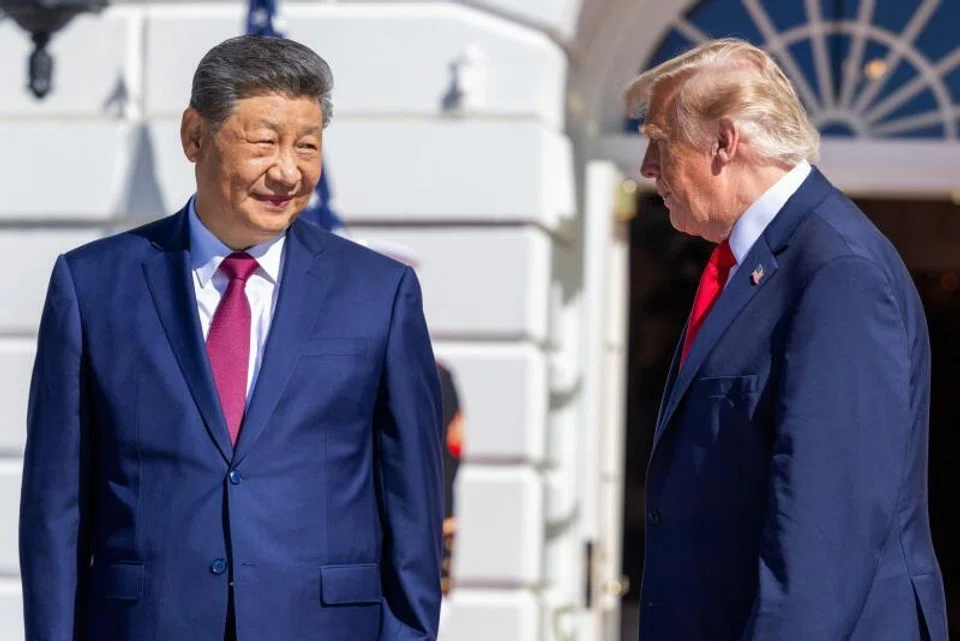
Sometimes, diplomacy asks us to be content with very little. The meeting between US President Donald Trump and Chinese President Xi Jinping in Washington on Thursday (Sep 24) was one of those occasions.
Why there is reason for relief
No grand bargain was struck. No breakthrough on Taiwan or Iran. No settlement of the disputes over rare earths, semiconductor control or the wider trade relationship.
Even on artificial intelligence, there was no agreed mechanism and no shared starting point: Xi insisted AI must remain “under human control”, while Trump said he wanted to “leave it exactly where it is”.
The clearest deliverable was the two-month extension of the Busan Agreement signed in October 2025. Originally set to expire on Nov 10, the trade truce will now end on Jan 10, 2027. That removes a trade cliff that would have fallen just a week after the US midterm elections.
Add two giant pandas for Zoo Atlanta and an invitation for 100,000 young Americans to participate in study exchanges in China over five years, and the list of outcomes is essentially complete.
Yet when a single tariff decision or rare earth licence can ripple through global supply chains, avoiding escalation is itself an achievement. That is the paradox of this summit: there is very little to celebrate, but there is still reason for relief.
What is emerging between Washington and Beijing is neither detente nor decoupling. It is closer to managed interdependence: an acceptance that strategic competition will persist, but that the economic ties between the two countries must be managed, rather than dismantled.
Tellingly, Beijing is supplying much of the vocabulary. During Trump’s visit to Beijing in May 2026, Xi defined the terms of coexistence between the two powers as “constructive strategic stability”.
Washington has traditionally been wary of Beijing-authored frameworks for the relationship. This time, however, the White House itself adopted remarkably similar language, committing to a “constructive relationship of strategic stability”.
The lavish choreography in Washington, from the personal welcome on the tarmac to the military flypast, reinforced the summit’s heavy emphasis on relationship and symbolism.
More importantly, the two sides may be converging in practice, because both have learned that each can hurt the other but neither can easily force the other to capitulate.
Washington holds tariffs, advanced semiconductor technology, financial power and the world’s largest consumer market.
Beijing showed its leverage in 2025, when rare earth export controls disrupted Western automotive, aerospace and defence supply chains, and a halt to Chinese soybean purchases hit American farmers hard.
Meanwhile, by redirecting exports towards other markets, China still posted a record trade surplus of almost US$1.2 trillion in 2025 despite US tariffs.
Why there is still reason to worry
The truce gives each side what it needs without resolving anything fundamental. China avoids renewed tariff escalation, while Trump avoids a trade fight with potential inflationary consequences in the closing stretch before the November midterms.
But on Jan 10, 2027, the suspended threats return. The deadline has moved. The disagreements have not.
Taiwan remains the most dangerous of issues. Xi asked Washington to handle the issue with “prudence” and to oppose Taiwanese independence, a stronger formulation than America’s long-standing position that it does not support it.
Official US policy did not change. Practice, however, is drifting. A US$14 billion arms package has been on hold since May 2026, and Trump has called it “a very good negotiating chip”. Small deferrals have a way of becoming policy.
Even the stabilising mechanisms create complications.
The US-China Board of Trade set up in 2026 is considering reciprocal tariff reductions covering roughly US$30 billion of goods: Chinese consumer and manufacturing inputs entering the US, and American agricultural and energy products entering China.
That may ease friction, but it raises an awkward question for everyone else: whose trade gets displaced when the world’s two largest economies increasingly manage commerce bilaterally?
What it means for Singapore and South-east Asia
The region faces a double bind. As Hunter Marston of the Lowy Institute argued, South-east Asian countries want a steadier US-China relationship, but fear deals struck over their heads.
The Iseas-Yusof Ishak Institute’s 2026 State of Southeast Asia Report captured that unease. US leadership under Trump topped the region’s geopolitical concerns, cited by 51.9 per cent of the respondents.
Additionally, 52 per cent said they would now align with China rather than the US if forced to choose, reversing the past year’s result.
For business, stability helps – but stability is not certainty. A two-month tariff extension says little to a company deciding where to build a factory for the next 20 years.
Before Busan, average US tariffs on Chinese goods approached 60 per cent, against roughly 20 per cent on Vietnamese goods. That gap powered the “China+1” strategy, but it has since narrowed sharply.
After the US Supreme Court struck down the emergency tariffs in February 2026, Washington’s new Section 301 levy applies the same 12.5 per cent rate to China and South-east Asian countries including Singapore, Thailand and Vietnam.
What remains of China’s premium rests on older sectoral duties, which the Board of Trade is now negotiating.
South-east Asian advantage is therefore thinner and more dependent on Washington and Beijing than it looks. The summit’s lack of concrete commitments on Iran adds another layer of uncertainty for a region heavily reliant on Gulf energy exposed to the disruption at the Strait of Hormuz.
Technology sharpens the dilemma. As the US and China build distinct AI ecosystems, firms in Bangkok, Jakarta or Singapore face choices over chips, cloud infrastructure, standards and compliance.
Singapore illustrates both sides of the equation.
In August 2026, its Ministry of Trade and Industry raised the 2026 growth forecast from 2-4 per cent to 4.5-5.5 per cent, after recording 6.1 per cent year-on-year growth in the first half and accelerating AI-related investment.
Yet that upside is concentrated precisely in sectors most exposed to US-China decisions over semiconductors, AI and export controls.
The summit should therefore not be dismissed as empty spectacle. It buys 100 days of calm, and South-east Asian economies could use them.
Diversification is already under way. The Comprehensive and Progressive Agreement for Trans-Pacific Partnership (CPTPP) members are pursuing further expansion, including preparatory discussions with Indonesia, the Philippines and the United Arab Emirates.
In November 2026, Asean is due to sign its Digital Economy Framework Agreement, harmonising cross-border digital payments. European countries are deepening trade ties across the region.
Companies, too, will continue to diversify suppliers and markets, map their exposure to both American and Chinese regulations, and incorporate geopolitical scenarios into long-term investment decisions.
The calm is fragile. A new US law signed on Sep 18, 2026, allows tariffs of up to 100 per cent on major buyers of Russian oil and gas, China among them.
The Washington summit did not settle the rivalry. It would have been wishful thinking to expect it to. Its “clear deliverable”, as Singapore’s former ambassador to the US Chan Heng Chee put it, was “a relationship”.
Churchill, the man who gave diplomacy the language of the summit, is also remembered for insisting that “meeting jaw to jaw is better than war”. On this account, the Washington summit delivered.
The writer is vice dean (executive education) and associate professor in practice at the Lee Kuan Yew School of Public Policy, National University of Singapore
TRENDING NOW

He built the Vingroup empire. Now South-east Asia’s richest man is handing some key roles to his sons

Grab CEO’s wife Chloe Tong on life with Anthony Tan and finding her purpose

What role can Japan play in Asean’s future?

From folding clothes to factory work: Why China is sending humanoid robots to school

