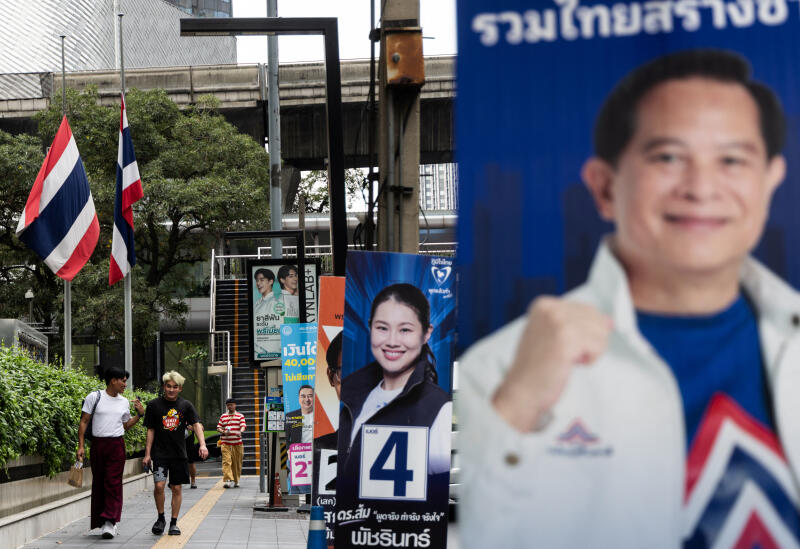
Commuters in Bangkok pass campaign posters ahead of Thailand’s February 8 election. With the country eyeing its fourth leader in three years, can this vote finally break the political cycle and spark an economic revival? PHOTO: REUTERS
Dear BT reader,
Vietnam’s food-safety crackdown has sparked a logistics crisis during peak Lunar New Year demand.
Over 300,000 tonnes of agricultural goods are stranded, with 1,800 containers stalled at Cat Lai port due to abrupt new documentation rules. While intended to fix scandals such as tainted pork and fake coffee, the lack of transition has caused "extreme frustration".
Market observers expect near-term shortages and price volatility, though the move may eventually improve structural integrity in Vietnam’s consumer market. Read more from BT’s Vietnam correspondent Jamille Tran.
Meanwhile, Indonesia is in damage-control mode following an MSCI transparency warning that sparked an US$80 billion stock rout.
To restore investor confidence, capital market authorities are fast-tracking reforms, including tougher disclosure rules and a mandatory 15 per cent minimum free float.
On Feb 2, senior regulators met with MSCI to address concerns over beneficial ownership and the concentrated power of conglomerates. These moves signalled a desperate push to align Indonesia with global transparency standards. BT’s Indonesia correspondent Elisa Valenta has the full story.
To wrap things up, let's look at Kopi Kenangan, Indonesia’s coffee giant that’s currently taking South-east Asia by storm and eyeing moves into Taiwan and the Middle East.
Co-founder and CEO Edward Tirtanata sat down with BT Global’s Lionel Lim to share why “less is more”. He opened up about how simple discipline was the secret sauce that helped them stop the bleeding and finally land their first full year of profit.
That’s all for this week’s highlights. More stories are waiting for you below and we’ll be back in your inbox next Friday.
Trending
Election shockwave rocks Thai markets
All eyes are on Thailand’s February 8 general election, a high-stakes three-way race between progressive, populist, and conservative factions. While the People’s Party currently leads the polls, the lack of a clear majority points toward a messy, drawn-out coalition negotiation process.
For investors, the atmosphere is a mix of "cautious optimism" and long-term dread. While an election rally boosted stocks by over 5 per cent in January, deep-seated structural issues still haunt the outlook, from household debt hovering at a staggering 90 per cent of GDP to 2026 growth forecasts being slashed to as low as 1.5 per cent.
With the country potentially facing its fourth leader in three years, can this vote finally break the cycle of political instability and deliver the structural reforms needed to revive the economy? Read more from BT’s Thailand correspondent Peter Janssen.