Private property fundraising up 29% yoy to US$222.2 billion in 2025 after three-year slump: report
In the Asia-Pacific, some US$21.3 billion of capital was raised in 2025
 Add BT as a preferred source
DeeperDive is a beta AI feature. Refer to full articles for the facts.
[SINGAPORE] Private real estate fundraising turned a corner in 2025 with US$222.2 billion raised, up 29 per cent from the US$172.4 billion in 2024, a report from Private Equity Real Estate (PERE) showed.
This was the first year of growth in capital raised since 2021, which pulled in US$304.5 billion. Since then, private real estate fundraising activity has steadily fallen.
Of the US$222.2 billion raised, North America accounted for around 40 per cent of funds or US$89.2 billion. Multi-region funds made up 31 per cent (US$69.9 billion) of capital, Europe 18 per cent (US$40.6 billion) and the Asia-Pacific, 10 per cent (US$21.3 billion). The remaining capital was spread among the Middle East, Latin America and Africa.
Much of the fundraising activity was fuelled by industry heavyweights Blackstone and Brookfield. Together, the two firms raised US$35 billion – 16 per cent of 2025’s total capital raised – for three of the 10 largest funds closed.
In comparison, the two giants contributed just US$1.3 billion in the whole of 2024, which was the worst fundraising year since 2020.
Singapore was among the markets in which these two global managers were active.
Navigate Asia in
a new global order
Get the insights delivered to your inbox.
In December, Brookfield acquired eight non-core Singapore assets from ESR-Reit for S$338.1 million. In May, the asset manager bought a S$535 million portfolio of industrial and business park properties from Mapletree Industrial Trust.
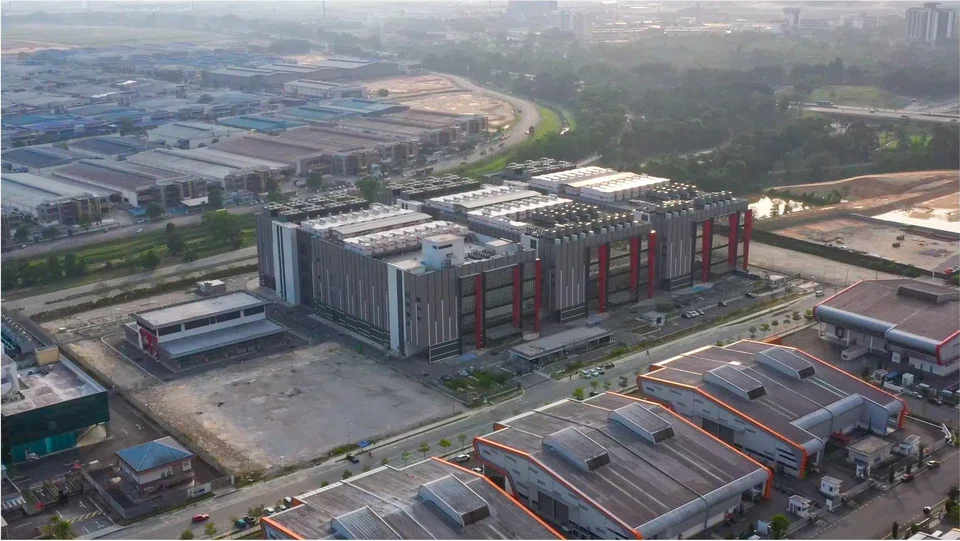
Meanwhile, Blackstone-backed data centre AirTrunk in August secured a S$2.3 billion green loan in Singapore to develop its second hyperscale data centre. The company is reportedly considering a potential Reit listing in Singapore, with an initial public offering that could raise more than US$1 billion.
Another major driver of private real estate fundraising in 2025 was the rise of data centre-focused funds. PERE said the sector has overtaken long-time investor favourites such as residential and industrial real estate to become the most sought-after segment for sector-specific funds.



Data centre funds drew 37 per cent of all capital raised in 2025, a sharp increase from just 2 per cent in 2024. This includes Blue Owl Capital’s US$7 billion digital infrastructure fund and Principal Asset Management’s US$3.6 billion data centre fund.
Most other sectors recorded year-on-year declines. Multi-family and residential funds fell to 32 per cent of capital raised, from 49 per cent in 2024; industrial 16 per cent, from 26 per cent; hospitality 4 per cent, from 9 per cent; office 2 per cent, from 6 per cent; and healthcare 1 per cent, from 5 per cent.
Student housing funds, however, gained attention in 2025, rising to 3 per cent of capital raised, from 1 per cent in 2024. Retail funds also rose to 5 per cent, from 1 per cent.
Longer timelines
Although private real estate fundraising rebounded in 2025, the time required to close a fund rose to an all-time high of 25 months on average – up from around 24 months in 2024 and 15 months in 2020 and 2021.
Even the year’s two largest funds – a US$16 billion Brookfield fund and Blackstone’s US$11 billion fund – took 24 months or more to complete their fundraising efforts, the PERE report found.
Despite the longer timelines, more funds hit their targets.
Based on the report, 52 per cent of funds met or exceeded their fundraising goals in the year, up from 2024’s 40 per cent.
The remaining 48 per cent of funds closed below target in 2025, compared with 61 per cent of funds in the previous year.
Opportunistic funds also made a comeback in 2025, capturing the largest share of capital raised at 33 per cent – up markedly from 18 per cent in 2024. Six of the year’s largest fund closings were opportunistic funds, including the top three – Brookfield’s US$16 billion real estate fund, Blackstone’s US$11 billion fund, and Carlyle Realty’s US$9 billion fund.
Value-add and debt strategies, on the other hand, fell out of favour. Value-add fell from 30 per cent to 22 per cent, and debt slipped from 31 per cent to 24 per cent.
PERE noted an uptick in capital targeting the Middle East and North Africa over the past two years. Fundraising aimed in the region, which was at US$1.4 billion in 2020, climbed to US$3.5 billion in 2024. It dipped to just under US$3 billion in 2025.
This includes the US$500 million target set by CapitaLand Investment and SC Capital Partners, which aims to drive industrial transformation across Gulf Cooperation Council markets in Saudi Arabia, the United Arab Emirates (UAE), Bahrain, Oman, Qatar and Kuwait.
The fund’s first project is an industrial development that will be built in the Ras Al Khaimah Economic Zone, a business hub in the UAE.
Decoding Asia newsletter: your guide to navigating Asia in a new global order. Sign up here to get Decoding Asia newsletter. Delivered to your inbox. Free.
Copyright SPH Media. All rights reserved.