Singapore worker dorm rents could rise 5% in 2026 after a H2 2025 dip, as mandated upgrades roll out
Post-upgrades, rents may be raised to reflect the higher quality and costs of maintaining the facilities
 Add BT as a preferred source
DeeperDive is a beta AI feature. Refer to full articles for the facts.
[SINGAPORE] Worker dormitory rents fell in the second half of 2025 as a supply crunch eased, but rates are set to go up again amid ongoing property upgrades.
Rental rates in commercial dormitories averaged S$485 per bed per month (pb pm) in H2 2025, down 1 per cent from H1, ending a steady run of increases since 2019.
In H1, average dormitory bed rents islandwide stood at S$490 pb pm, up 81 per cent from the pre-pandemic trough of S$270 pb pm in H1 2019, said a market report by Knight Frank and the Dormitory Association of Singapore Ltd (DASL) in February.
The surge plumped up revenues for leading dorm builder and operator Centurion . In the year ended December 2025, its revenue rose 17 per cent to S$295.9 million, on the back of positive rental reversions and strong occupancies in all its assets, and higher contributions from its two Westlite properties.
Excluding fair-value adjustments, its net profit would have risen 26 per cent year on year to S$139.2 million.
Its Singapore assets raked in S$212.3 million in revenue for FY2025, up from S$176.1 million the year before. Occupancy remained high, at 99 per cent.
Navigate Asia in
a new global order
Get the insights delivered to your inbox.
PhillipCapital equity research analyst Yik Ban Chong estimated that the group’s 1,650-bed Westlite Ubi dormitory had 5 to 10 per cent higher rental rates, contributing to the top-line growth in its Singapore workers’ dormitory portfolio.
Rents softened in H2 2025 when pressure on bed supply eased. Occupancy levels were still healthy, but demand moderated as marine, shipyard and process firms became more cautious amid geopolitical tensions.
The average islandwide occupancy dipped 1.2 percentage points from 98.3 per cent in H1 2025 to 97.1 per cent in H2, data from DASL showed.



The east and west regions remained nearly full, at 98.3 per cent and 99 per cent, respectively. Central zone occupancy fell to 94.5 per cent in H2 from 97.2 per cent in H1.
The dip in islandwide rents in H2 reflected flat or falling rates in all three dormitory zones, easing demand pressure and shortening the waitlists for beds.
In the east, the average bed rent was unchanged at S$515 pb pm; in the central region, it fell 1.9 per cent to S$520 pb pm. In the west, rents declined 1.1 per cent half-yearly to S$440 pb pm.
Rents could rise again in 2026, but at a more moderate pace of around 5 per cent, as dormitory operators begin upgrading works under the Dormitory Transition Scheme, the report noted.
Under the scheme, existing dormitories must meet enhanced interim standards by 2030; these include capping the number of residents per room at 12, and en-suite toilets.
By 2040, all dormitories must fall in with the full set of new standards, which mandate at least 4.2 sq m of living space for each resident and at least a metre’s space between beds.
In January, the government announced a grant to defray some retrofitting costs. Operators that complete upgrades by end-2028 will get higher grants than those who do so in 2029 or 2030.
As more operators undertake upgrading works over the next five years, the bed supply is expected to tighten. “Transient supply constraints should prop up occupancies and support rental growth,” said the report.
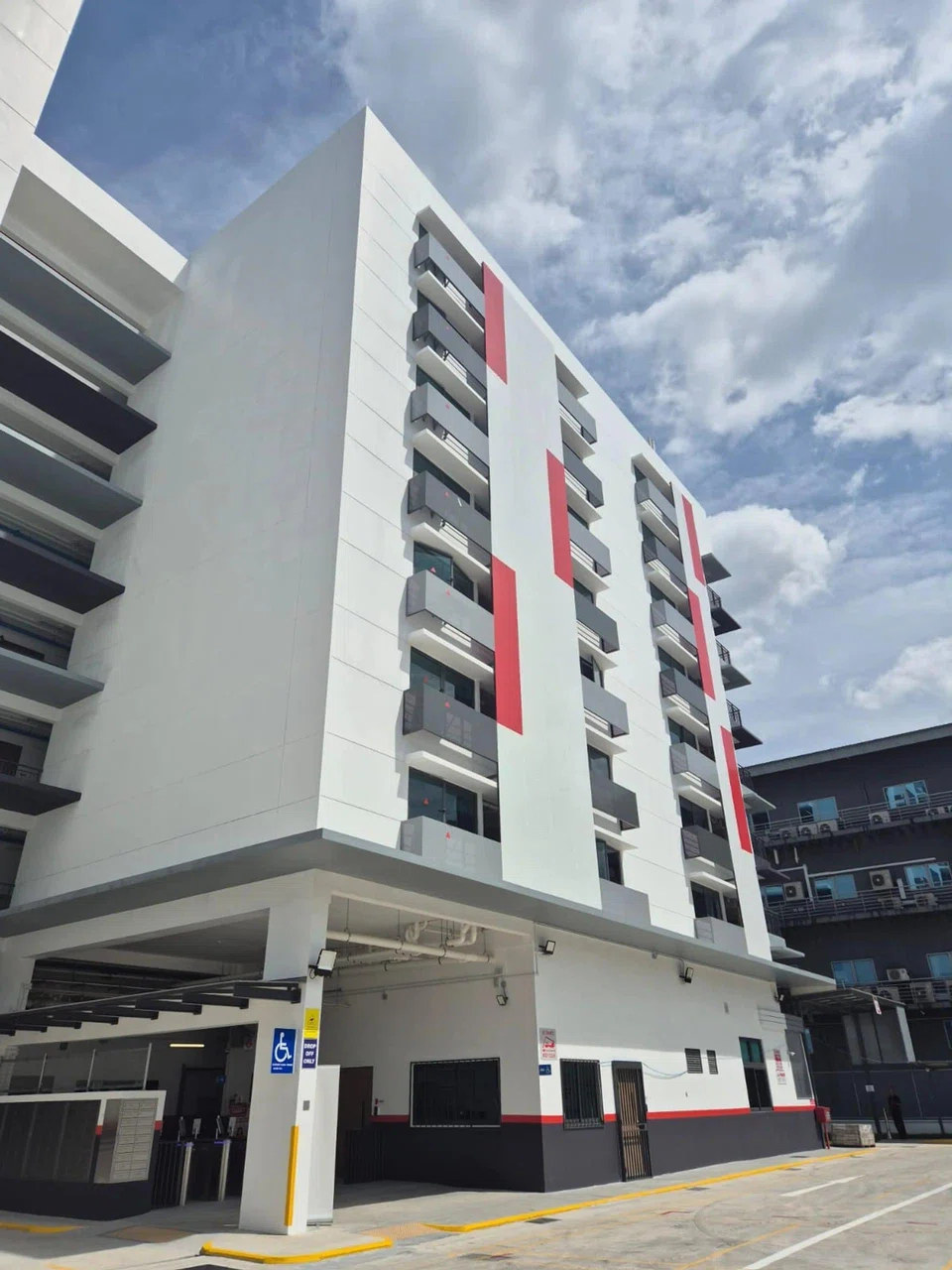
Newly listed The Assembly Place (TAP) is also taking a slice of the market. It has partnered with S11 Granuity Management to operate a dormitory in Seletar North Link under a new brand, Habitat.
S11, which owns the asset, holds a 40 per cent stake in the joint venture; TAP owns the remaining 60 per cent.
The dormitory has 886 beds and offers planned social programmes to engage its residents.
Eugene Lim, TAP’s chief executive officer, said the government’s push for dorm upgrades is “accelerating a structural shift towards quality”.
“Rents of purpose-built dormitories are expected to stay elevated with upward momentum over the medium to long term, as operators have already raised prices to finance these upgrades,” he added.
Post-upgrades, rents may rise to reflect the higher quality and costs of maintaining improved facilities, said Knight Frank and DASL.
Despite global economic uncertainty, Lim said demand for worker accommodation in Singapore is likely to remain supported by domestic construction volume for mega projects like the Tuas Port.
“The question is no longer whether beds are needed, but who can operate them to the standards that residents, regulators and asset owners increasingly expect.”
Decoding Asia newsletter: your guide to navigating Asia in a new global order. Sign up here to get Decoding Asia newsletter. Delivered to your inbox. Free.
Copyright SPH Media. All rights reserved.