

Singapore’s private home market closes 2024 on a high; will late-year burst fizzle out?
Sentiment looks to be improving, but this momentum may not sustain into the new year, say analysts

SINGAPORE’S private residential market seemed to spring back to life during the fourth quarter, in a year when new home sales earlier collapsed to record lows and buyers stayed on the sidelines with market-cooling measures in place.
It was also an unprecedented year for state land sales, with three sites not awarded and one tender closing with no bids as developers shied away from risky projects.
Sentiment appears to be improving after new home sales jumped in November, although analysts are not betting that the recent surge will be sustained, and prices are not expected to climb much higher next year.
But the slate of well-located, “buzzy” housing sites to be put up for tender in next year’s government land sales (GLS) programme should lead developers to step up land acquisition, market watchers reckoned, albeit with cautious bidding.
The demand for new private homes revived in October with the launch of City Developments Ltd’s Norwood Grand. The medium-sized project in Woodlands sold 84 per cent of its 348 units over the launch weekend.
Alan Cheong, Savills Singapore executive director of research and consultancy, said this ignited chatter among market watchers that subsequent launches – such as Chuan Park by Kingsford Group and Sim Lian Group’s Emerald of Katong – would perform well.
“However, when these were finally launched, their numbers surprised even the optimist – both agents and developers were pleasantly surprised, and for outsiders, they were shockers, resulting in some opining that more cooling measures are to come.”
The 846-unit Emerald of Katong clocked a take-up rate of nearly 99 per cent over its launch weekend in mid-November, at an average of S$2,621 per square foot (psf). Some 76 per cent of Chuan Park’s 916 units were also sold over the launch weekend at S$2,579 psf that same month.
Collectively, developers sold a total of 3,295 condominiums and private apartments in October and November – surpassing that of the preceding nine months, when just 3,049 units were sold.
The final quarter of 2024 is now poised to achieve one of the highest quarterly sales volumes in over a decade, said Wong Xian Yang, Cushman & Wakefield research head for Singapore and South-east Asia.
PropNex chief executive Ismail Gafoor noted that this is worlds apart from the first half of this year, which saw tepid new home sales with just 1,889 homes sold – the lowest half-yearly figure on record since 1996.
Few major projects were marketed in 2024, with buyers and developers treading with caution. “There were buyers who were ready to enter the market, but decided to hold out for a more opportune time, which came towards the later part of the year with the US rate cuts, improving economic outlook and the deluge of new launches in November.”
Huttons Asia senior director of data analytics Lee Sze Teck puts the 2024 total at 22 new launches, excluding two executive condominiums (ECs), totalling around 6,800 new units this year.
Those figures are slightly lower than the 26 projects, excluding one EC, totalling 7,551 homes launched in 2023, Lee said.
Unsold stock of new homes “remains manageable”, said Gafoor from PropNex, at 19,940 units (excluding ECs) as at the end of the third quarter. “If we take a conservative annual sales at 6,000 units, the 19,940 units can be cleared in just over three years. We do not see the upcoming supply as excessive.”
In the EC market, prices rose quite significantly in the past year, said Tricia Song, CBRE’s research head for Singapore and South-east Asia, hitting a high of over S$1,600 psf. Limited supply and growing demand have pushed sales and prices upwards.
The median price of a new EC is now S$1.51 million, up more than 40 per cent from 2020’s S$1.07 million, she added. “This is while still being subject to a household income ceiling of S$16,000 and mortgage servicing ratio of 30 per cent. ECs are becoming more unaffordable especially for first-timers, given the limited loan they can obtain.”
Notably, the government will offer three new EC sites in the first half of 2025, generating 980 units. In comparison, just one EC site was on the H2 2024 confirmed list, yielding some 560 homes.
Cushman’s Wong said that in the broader market, underlying demand appears steady, with the secondary market (comprising subsales and resales) showing stable volumes and poised to grow year on year in 2024.
Over the first three quarters of this year, the secondary market recorded 11,468 transactions – around 91 per cent of 2023’s whole-year volume.
An unprecedented year
As homebuyers stayed on the fence for much of 2024, developers switched to risk-off mode, turning in lower-than-expected bids for land or backing off completely.
The result was the unprecedented non-awarding of three sites at Marina Gardens Crescent, Jurong Lake District and Media Circle. Bids for these sites were rejected by the authorities for being “too low”, while another land parcel along Upper Thomson Road garnered no bids.
CBRE’s Song said that participation in state tenders was muted with measured bidding, save for EC sites. She cited “plum sites” at Orchard Boulevard, Zion Road and Holland Drive, which drew bid prices that were below expectations.
Higher construction and financing costs, coupled with uncertain buying demand – particularly in the city centre due to the 60 per cent Additional Buyer’s Stamp Duty rate for foreigners – led developers to act with caution, she added.
Nicholas Mak, chief research officer at Mogul.sg, noted that the cost of building a “good-quality condominium” has risen some 30 per cent to S$377 psf in the first half of this year, from S$288 psf of gross floor area in the first half of 2021.
Construction costs for luxury condominiums similarly grew 30 per cent to S$499 psf, from S$386 psf over the same period, he added.
Developers stepped back from risky sites – such as the two plots reserved for an untested new “long-stay” serviced apartment category labelled SA2 in Media Circle and Upper Thomson.
Ramped-up supply of GLS sites diluted bids across the board, said Marcus Chu, CEO of ERA Singapore. “On several occasions, we have also observed the government aligning the tender closing dates of some popular sites and that has further diluted the bids from developers for these sites.”
What is ahead?
The burst of buying in the last few months brought on speculation about further market-cooling measures in the coming year.
At the same time, more million-dollar Housing and Development Board (HDB) flats than ever have been sold.
Between January and November, there were 940 resale HDB transactions that crossed the million-dollar mark, noted Gafoor. This is double the 470 transactions recorded in the whole of 2023.
He also said that with the 940 transactions in the year to November accounting for just 3.7 per cent of total HDB resale transactions, any knock-on effect on the private housing market would be minimal.
HDB resale prices grew 2.7 per cent in Q3, in contrast to the 0.7 per cent dip in overall private home prices. Cumulatively, the HDB resale price index was up 6.9 per cent in the first three quarters of this year, far outpacing the overall private home market’s 1.6 per cent.
But most believe cooling measures seem unlikely in 2025, especially with a general election around the corner.
Total new home sales (excluding ECs) are expected to come in between 6,500 and 7,000 – relatively similar to 2022’s 7,099 units and 2023’s 6,421 units, and way below the annual average of 9,288 units from 2019 to 2023, said CBRE’s Song.
Lee from Huttons Asia noted that stress tests by the Monetary Authority of Singapore also indicated that most households can service their debts even if interest rates rise to 5.5 per cent and incomes drop by 10 per cent.
ERA’s Chu observed that price growth has already moderated this year, to just 1.6 per cent in the first nine months of the year.
Mixed expectations for the coming year
Wong predicts overall private home prices will grow by 3 to 4 per cent year on year in 2025, similar to the 2 to 3 per cent forecast for 2024.
Wider buyer affordability remains constrained by current cooling measures and loan curbs, he added. The key risks include disruptive dynamics from global economics or a deterioration in the employment outlook.
Mogul.sg’s Mak pointed to the US, where president-elect Donald Trump had “promised to raise more trade barriers for friends and foes alike”.
“This could create economic headwinds for an open economy such as Singapore, which would adversely affect private housing demand,” he added.
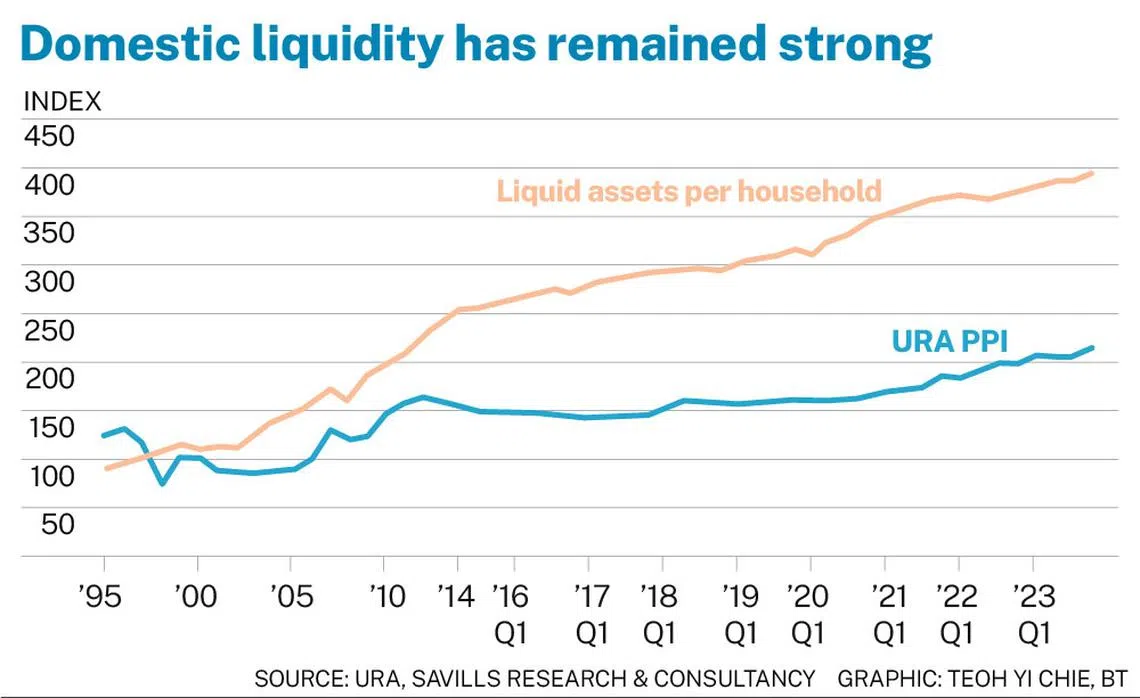
Still, there is a “largesse of savings from baby boomers, new citizens, (permanent residents) and early cohorts of Generation X that can be vicariously redeployed into private housing through their children’s names”, said Savills’ Cheong.
Singapore’s economy has a large pool of baby boomers that benefited financially from the double-digit economic growth in the earlier decades, as well as many wealthy and talented individuals attracted to its shores, he added.
“The indexed trajectory of liquid assets per households has been outperforming the URA private property price index for decades.”
TRENDING NOW

He built the Vingroup empire. Now South-east Asia’s richest man is handing some key roles to his sons

Seatrium allocates S$200 million for new share buyback programme

32 companies, 6 individuals bag accolades at Singapore Corporate Awards 2026

Stocks to watch: Mapletree Logistics Trust, Seatrium, Keppel DC Reit, Food Empire

