Nearly half of employers using AI in HR deploy it for recruitment: SNEF survey
More than eight in 10 artificial intelligence-supported processes still need human oversight

[SINGAPORE] Nearly half of employers using artificial intelligence in their human resource functions are deploying the technology for recruitment and selection, a new survey by the Singapore National Employers Federation (SNEF) has found.
But even as employers increasingly turn to AI for HR tasks, human judgment remains central to decision-making, with 85 per cent of AI-supported use cases still requiring human involvement.
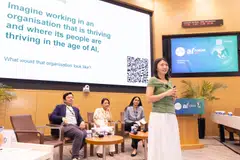
The findings were released at the SNEF Employers’ Summit 2026 on Friday (Oct 30), alongside a new initiative to help companies adopt AI responsibly and strengthen HR capabilities.
SNEF president Kuah Boon Wee said that the survey findings would help the federation develop practical support and solutions for employers.
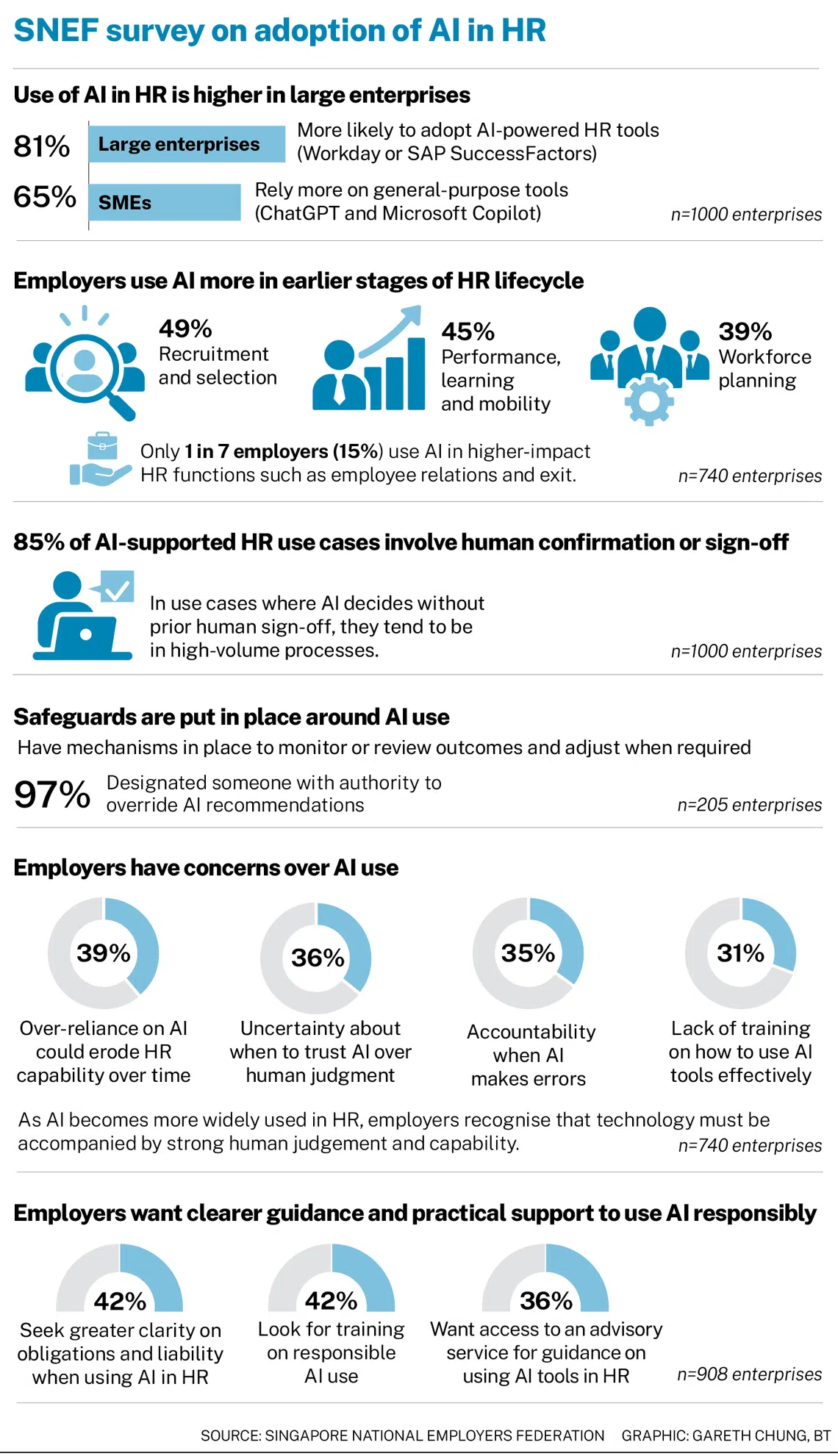
Some 42 per cent of employers wanted clearer guidance on their obligations and liabilities when using AI in HR, while an equal proportion sought training on responsible AI use.
“SNEF does not claim to have every answer on AI. I don’t think anybody does,” said Kuah. “But we can provide advisory services and bring the right partners to you.”
The survey, conducted between June and July this year, polled 1,000 employers, including small and medium-sized enterprises (SMEs) with 200 or fewer employees and large enterprises with more than 200 employees.
SNEF’s outgoing CEO Hao Shuo said ahead of the forum that the survey was prompted by the federation’s interest in how employers are transforming their workforce and adopting new capabilities. He said generative AI could help HR professionals work more efficiently by reducing administrative tasks, freeing them up for “higher value-added work” such as strategic workforce planning and employee engagement, where “the human touch is also important”.
Poon Hong Yuen, former deputy secretary at the Ministry of Digital Development and Information, will join SNEF as CEO-designate on Nov 1 before formally taking over from Hao on Dec 1.
SEE ALSO


Where AI is used by HR
While AI adoption in HR is “becoming increasingly common across Singapore workplaces”, the survey found that large enterprises were more likely to use the technology, with 81 per cent deploying AI in at least one HR function, compared with 65 per cent of SMEs.
The types of tools used also differed. Large enterprises were more likely to adopt AI-powered HR platforms such as Workday and SAP SuccessFactors, while SMEs tended to rely on general-purpose tools such as ChatGPT and Microsoft Copilot.
AI use was also concentrated in the earlier stages of the HR lifecycle, with the most common applications being in:
- recruitment and selection (49 per cent), such as screening and shortlisting candidates;
- performance, learning and mobility (45 per cent), which includes managing employee performance and informing internal mobility decisions; and
- workforce planning (39 per cent), such as forecasting workforce demand and identifying skills gaps.
Only 15 per cent deployed AI for higher-impact functions, such as analysing the reasons behind employee relations issues and staff departures.
Of the nearly 3,000 reported instances of AI use in HR, 15 per cent involved AI making decisions without prior human sign-off.
Nearly three-quarters (73 per cent) of these cases involved routine or high-volume administrative processes, such as resume screening and skills assessments, where AI could improve efficiency.
However, nearly all employers (97 per cent) using AI without prior human review had designated someone with the authority to intervene and change or reverse decisions.
In the remaining 85 per cent of AI-supported HR use cases, human involvement was still required.
In 14 per cent of the nearly 3,000 use cases, the technology was used only to provide information, while another 36 per cent involved AI recommending options for a person to decide on.
For 35 per cent of the use cases, AI made decisions that still required a person to either approve, reject or override them.
Despite the widespread adoption of AI, the top concerns among employers using the technology were that over-reliance could erode HR capabilities (39 per cent), uncertainty over when to trust AI over professional judgment (36 per cent), and accountability for AI errors (35 per cent).
Mental fatigue from managing AI outputs was the least cited concern, at 20 per cent.
Safeguards against bias in AI hiring
Addressing concerns that AI-powered recruitment tools could disadvantage jobseekers, particularly older workers who may be less familiar with the technology, Hao said both employers and applicants had a role to play in ensuring fair hiring outcomes.
Jobseekers should learn to use AI to improve their resumes and help them “stand out among the crowd”, while employers must ensure that AI tools used to screen applications do not introduce bias, he said.
“For employers, I think they remain quite aware that they are liable for any kind of offence made, especially with the Workplace Fairness Act coming up,” said Hao.
The survey found that 84 per cent of employers using AI were highly familiar with at least one relevant legal or governance framework, including the Workplace Fairness Act.
“But at the end of day, I think employers, as we can see from the survey, still trust human judgment,” he said.
He added that HR professionals would remain the “ultimate decision maker” in the hiring process.
New support for employers adopting AI
To address the challenges identified in the survey, SNEF has introduced an AI-HR pre-scoped solution to help employers adopt AI while strengthening their HR capabilities and redesigning jobs.
The initiative combines four areas of support: human capital advisory, AI tools for HR processes, workforce transformation consultancy and workforce skills analytics.
These include AI-powered chatbots to handle routine employee queries and tools to identify workforce skills gaps and support succession planning.
Under the Workforce Development Grant (Job Redesign+), SNEF will assess employers’ needs and match them with specialist consultants to implement suitable solutions.
Companies can receive funding of up to 70 per cent of qualifying costs for SMEs and 50 per cent for non-SMEs, capped at S$150,000 per project.
Five consultants have been appointed to support the initiative: BDO, Elitez, EON, PwC and Skybots.
Hao said the success of the initiative should not be measured by how many HR tasks are performed by AI, but by whether HR professionals can take on a more strategic role within their organisations.
“If HR professionals are really becoming the strategic partners of the business leaders in thinking through the long-term business strategy, looking at workforce transformation, if they have a seat in the boardroom, I think that will be the success factor,” he said.
Decoding Asia newsletter: your guide to navigating Asia in a new global order. Sign up here to get Decoding Asia newsletter. Delivered to your inbox. Free.
Copyright SPH Media. All rights reserved.