

Singapore strengthens transboundary haze law with expanded investigative powers, stiffer penalties
The maximum fine has been raised to S$20 million, from S$2 million previously

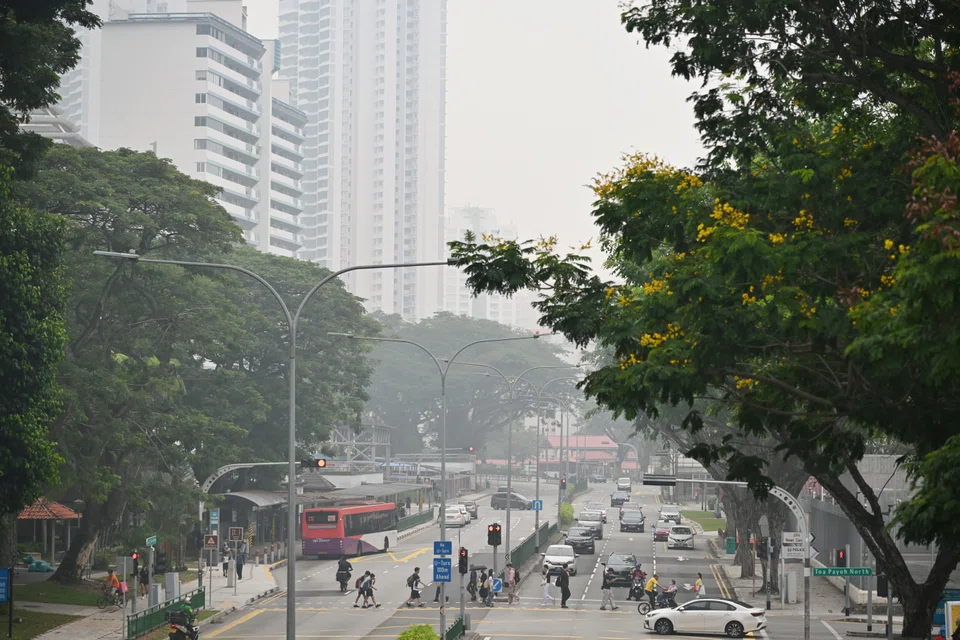
[SINGAPORE] Singapore’s transboundary haze law has been given a boost, granting the government greater powers to gather relevant information from companies suspected of being responsible for haze, investigate their commercial links and impose restrictions on them.
Entities found guilty of offences under the amended law will also face stiffer penalties, with the maximum fine rising 10 times to S$20 million.
These are among the amendments to the Transboundary Haze Pollution Act (THPA), which Parliament passed on Wednesday (Nov 4) after a six-hour debate in which 24 Members of Parliament from both sides of the aisle spoke.
The Bill was fast-tracked after receiving a Certificate of Urgency, which allowed the changes proposed to be passed in a single sitting.
Speaking at the end of the debate, Minister for Sustainability and the Environment Grace Fu said the changes to the THPA – which was first enacted in 2014 – are being made urgently as investigations into the 2026 haze episode are under way, and the expanded legal powers will give government agencies the tools to make progress.
In September and October, Singapore faced its worst air quality since 2015, with the 24-hour Pollutant Standards Index (PSI) reading crossing 200 – within the “very unhealthy” range – at one point.

Despite bilateral and regional efforts between Singapore and its South-east Asian neighbours over the past decade, the latest recurrence highlighted the complexities and persistent challenges of addressing transboundary haze, said Fu.
“It reinforced the need to strengthen our domestic legal framework alongside these cooperative efforts,” she added.
“This set of changes to the THPA is significant. It gives us the power to impose economic and financial costs on errant entities, in addition to legal penalties,” Fu told the House.
SEE ALSO





“This is not a decision to take lightly. We are dealing with complex corporate structures and arrangements. And our laws must give us sufficient flexibility and reach to investigate and act effectively.”
New enforcement tools
To give legislative backing to a specialist panel tasked with investigating firms linked to the transboundary haze, the amended law empowers the director-general of environmental protection to require entities with suspected links to haze pollution in Singapore to appoint expert private-sector assessors.
The director-general will specify the assessors and terms of the assessment in the direction to an entity. The entity receiving a direction must then engage the assessors at their own expense.
The assessors will submit evaluation reports directly to the National Environment Agency (NEA) to help establish the relevant facts.
Fu explained at the start of the debate that a direction by the director-general to appoint an assessor is meant to establish the relevant facts, and does not necessarily mean that the entity has committed or is suspected of having committed an offence.
She pointed out that the changes will not remove all the challenges of tracing overseas activities. They do, however, give the government another avenue to obtain information, understand complex business relationships and hold responsible entities accountable.
In addition, the minister for sustainability and the environment now has the power to designate errant entities or individuals, and impose orders restricting business dealings with them.
This may include the supply or purchase of goods and services, as well as provision of loans and other financial support.
Those found to still have business dealings with designated entities or individuals could be fined a maximum of S$1 million for each contravention, and an additional fine of up to S$100,000 for each day the breach continues.
Fu said the objective of this new lever is to create real commercial consequences for irresponsible conduct and incentivise entities to comply with the THPA.
“It also enables us to act preventively without having to wait for a criminal conviction to discourage business arrangements that may sustain irresponsible burning,” she added.
As the government would not be able to identify and designate all errant entities, the amended law includes a new tool allowing the government to put entities on notice, directing them not to deal with parties involved in activities that cause or contribute to haze pollution.
Fu said this complements the government’s designation powers by placing greater responsibility on larger entities to ensure their supply chains are free of parties linked to such activities.
Entities put on notice will be required to take appropriate steps to ensure that their supply chains and business arrangements are clean; failure to comply without reasonable excuse will be an offence.
“The objective is not to impose an impossible guarantee that no risk will ever arise,” Fu said, “but to ensure that companies do not turn a blind eye to irresponsible forestry and agriculture practices.”
While the changes expand the government’s reach beyond errant companies to their supply chains, related corporates and financiers, Fu said the new enforcement powers will be exercised in a measured and targeted manner.
“In summary, our measures are targeted at entities responsible for causing or contributing to the haze, while avoiding onerous obligations for businesses operating legitimately and responsibly,” she added. “We will implement these changes carefully and proportionately.”
Enhancing existing powers
In addition to new enforcement tools, five existing powers under the THPA have also been enhanced.
First, documents can be served electronically, including through the news media or on NEA’s website, instead of just in person.
While this will help address practical difficulties in serving notices and initiating formal processes involving foreign entities, Fu said that it does not guarantee overseas entities will cooperate all the time. “But they will remove procedural obstacles that have constrained our ability to proceed with investigations and legal processes,” she explained.
Second, the director-general and authorised officers will have the power to arrest.
Third, THPA offences can be heard in court even if the accused person is absent. These amendments will help ensure that entities cannot frustrate enforcement simply by being difficult to contact or by remaining outside Singapore.
Fourth, the scope of what is considered an offence under the THPA has also been expanded to include “the risk of haze”. This means that an entity may be held liable when its activities contributing to forest fires overseas pose a risk of haze pollution in Singapore, even if the haze has not reached the city-state.
While this change gives the government the option of taking preventive action before the haze reaches Singapore, Fu said that it does not change the territorial nexus the government used in scoping the original THPA.
“We do not intend to direct our powers at every fire in the region. We must focus our resources where there is a credible risk of haze affecting Singapore. It would not be realistic or prudent to investigate every fire across the region,” she added.
Fifth, entities need to provide more than one statutory defence out of the three afforded to entities under the THPA.
Entities will no longer be able to rely on a single defence. For instance, they will have to show not only that a fire was caused by another person acting without their knowledge, but also that they have taken reasonable measures to prevent and fight the fire.
“This recalibrated defence sends a strong signal of our expectations (of what is responsible behaviour),” said Fu. “Entities are expected to take sufficient care to avoid burning on their land. It will no longer be sufficient to simply claim that another person caused the fire.”
Penalties
To achieve a stronger deterrent effect, penalties under the Act will be increased.
Entities found to have caused or contributed to fires that pose a risk of haze in Singapore will be fined S$1 million per day until they resolve the situation, up from the current S$100,000.
The maximum aggregate fine will be increased from S$2 million to S$20 million.
The original penalties were set at a level comparable to existing penalties for domestic pollution offences. However, Fu said that transboundary haze needs to be deterred by stronger penalties, to underscore the gravity of such offences given the serious harm it causes.
Nonetheless, the penalties that guilty entities would have to pay will ultimately be decided by the courts, and the government does not expect the maximum fine to be imposed in every case, she added.
The court will also be able to assess if any profit gained or loss avoided by the entity committing the offence could be imposed as an additional penalty. This is to enable the court to remove any benefits the entity obtained from their offences.
A civil penalty framework with a maximum penalty of S$10 million has also been introduced, opening another route to take errant entities to task. However, civil court proceedings cannot be used in tandem with criminal prosecution in any single case, to ensure that entities are not doubly punished.
Decoding Asia newsletter: your guide to navigating Asia in a new global order. Sign up here to get Decoding Asia newsletter. Delivered to your inbox. Free.
Copyright SPH Media. All rights reserved.
TRENDING NOW
How Vietjet’s US$250 million global asset freeze complicates its 600-aircraft financing plans

Work Permit holders increase by 10,900, but S Pass, EP holders decline by 900 each in Q2: Jasmin Lau

US midterms: What investors can expect after Democrats shatter Republican strongholds

The AI frenzy gets a reality check

