

US tariff affects S$9.5 billion of Singapore’s domestic exports: Gan Kim Yong
He says none of 60 trading partners fully exempt; any move to secure a lower tariff rate would carry wider compliance, trade implications
 Add BT as a preferred source
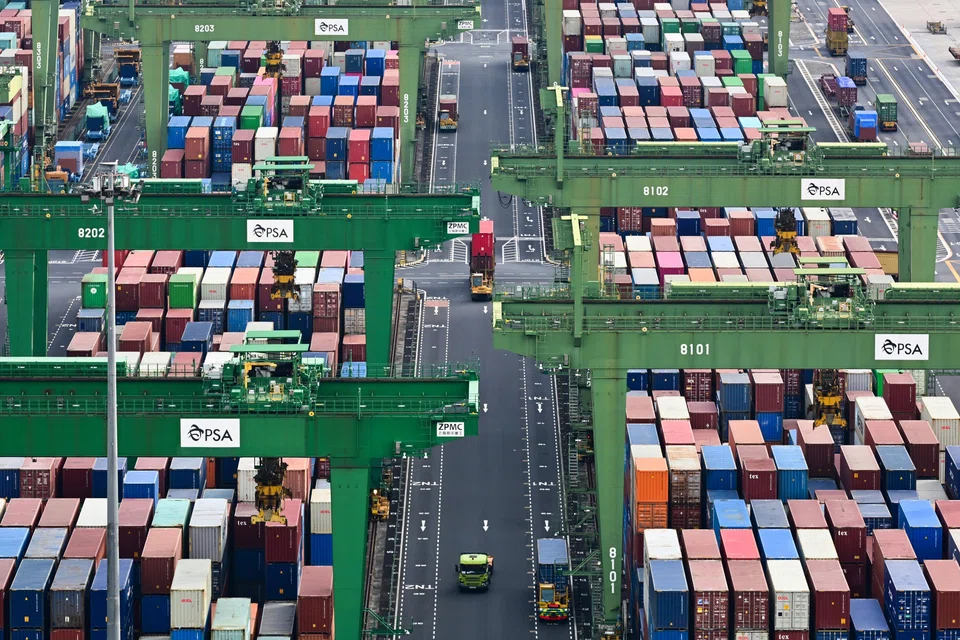
[SINGAPORE] Some S$9.5 billion worth of Singapore’s domestic exports to the US annually are affected by Washington’s new 12.5 per cent tariff, Deputy Prime Minister Gan Kim Yong said on Wednesday (Aug 5), adding that none of the 60 economies covered received a full exemption.
This represents around one-third of the Republic’s domestic exports to the US. Affected goods include optical instruments and chemical products, while energy products, certain electronics and aerospace products are excluded.
Pharmaceuticals and semiconductors, which are subject to separate US Section 232 tariffs or investigations, are also exempted.
Compared with the earlier 10 per cent tariff, the new measure raises the overall effective tariff rate on Singapore’s exports to the US by an estimated 0.7 percentage point.
DPM Gan, who is also minister for trade and industry (trade), provided the figures in a written response to a parliamentary question from Yio Chu Kang MP Yip Hon Weng on the tariff’s impact and measures to support affected exporters.
The latest tariff took effect on Jul 24, replacing the earlier levy. It followed an investigation into the alleged failure of 60 economies to prevent forced labour in their supply chains, to the detriment of American workers.
Goods from around 10 trading partners deemed to have adopted forced-labour restrictions are subject to a lower tariff of 10 per cent. These include Mexico, the UK, Canada and India.
DPM Gan, who chairs the Singapore Economic Resilience Taskforce, said Singapore was assessed at the 12.5 per cent rate because it does not prohibit imports of goods produced with forced labour, nor has it committed to introducing such a prohibition through an Agreement of Reciprocal Trade (ART) with the US.
“Importantly, none of the 60 economies, including those that already have such prohibitions in force, received a full exemption from the tariff,” he said.
DPM Gan added that Singapore had engaged the United States Trade Representative (USTR) at both the political and official levels throughout the investigation, including during his visit to Washington in April.
Singapore had also submitted written comments and participated in bilateral government consultations, said DPM Gan.
He added that Singapore had “made clear that there is no evidence” that it is involved in the trade of goods associated with forced labour, based on data from the US Department of Labour and Customs and Border Protection.
“We emphasised that our policies do not burden US commerce, as reflected in the longstanding and substantial trade surplus the US continues to enjoy with Singapore,” DPM Gan said.
“We also explained that Singapore does not condone forced labour and maintains a comprehensive enforcement framework against such practices.”
He did not disclose how the US responded to Singapore’s representations.
Careful consideration needed
On whether Singapore could negotiate a lower tariff with the US, DPM Gan said the Republic would continue engaging the USTR constructively, but must “consider carefully what steps, if any, Singapore should take in response”.
Singapore is a major trading hub, with its goods and services trade amounting to around S$2.5 trillion annually, including S$1.4 trillion in goods. Against this backdrop, any import prohibition would have significant implications, he said.
“Businesses could face substantial compliance costs arising from supply-chain due diligence, documentation and investigations, particularly where production takes place outside Singapore and beyond our jurisdiction,” he said.
Such a measure could also affect Singapore’s broader trade relationships with other partners.
DPM Gan added that Singapore must carefully consider what an ART with the US would entail.
“Based on the agreements that the US has concluded with other economies, such arrangements may involve commitments beyond an import prohibition, including export controls or restrictions relating to third countries,” he said.
These broader implications must be assessed carefully before Singapore decides on any course of action, he added.
For now, Singapore’s immediate priority is to “help businesses and workers adjust”, he said.
This includes continued industry consultations through the Singapore Economic Resilience Taskforce and targeted support where necessary, drawing on existing grants, financing schemes and employment programmes.
Decoding Asia newsletter: your guide to navigating Asia in a new global order. Sign up here to get Decoding Asia newsletter. Delivered to your inbox. Free.
Copyright SPH Media. All rights reserved.
TRENDING NOW
1 in 5 fresh graduates from autonomous universities still seeking employment: MOM
Can Seatrium build on its robust H1 earnings? UOBKH and DBS analysts have divided views

UOB CEO’s youngest child Grant Wee turns burnout into a wellness business
UOB to sell asset management arm to Allianz Global Investors for S$555 million, sharpen wealth advisory focus

