
Most countries avoided ‘protectionist virus’ this year, but US could be ‘epicentre of downside risks’ in 2026: DBS
The bank’s chief economist says to watch for more ‘DeepSeek moments’ from China and high levels of FDI in Asean next year
 Add BT as a preferred source
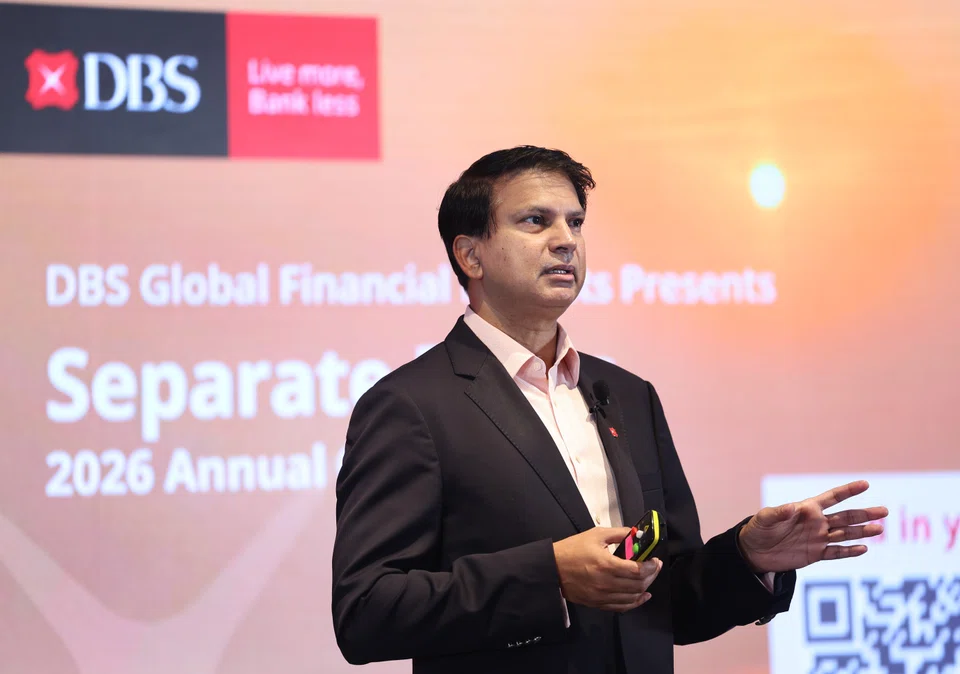
[SINGAPORE] Fears of economic instability following US President Donald Trump’s “Liberation Day” tariffs turned out to be unfounded this year, with countries outside the US steering clear of the “protectionist virus” that had percolated in the world’s largest economy, said DBS chief economist Taimur Baig.
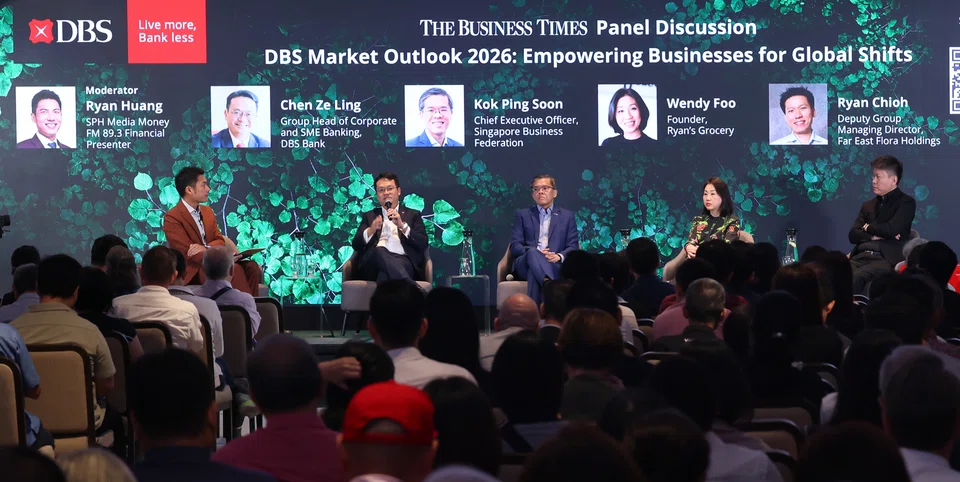
Yet, there are “substantial worries” going into 2026, he said at the bank’s Market Outlook 2026: Empowering Businesses for Global Shifts event on Dec 4.
Still, he noted that even though “things had seemed so dire” in April, 2025 has turned out to be a much better year than expected. Baig, who is also a managing director at DBS, summarised the year with two acronyms.
The first is “Taco”, which stands for “Trump always chickens out” – a term coined by the Financial Times to describe the frequent about-turns in the president’s trade policies.
“This has made us somewhat immune (to) the outbursts and volatility coming out of the White House, so we are stress-tested,” Baig said, adding that the market has been repeatedly stress-tested since the Covid-19 pandemic that began in 2020.
“Because shocks have become sort of (permanently) present, there’s a lot of scenario analysis being done… which then makes it not that shocking to deal with these sorts of advanced adverse developments,” he said.
Navigate Asia in
a new global order
Get the insights delivered to your inbox.
“Shocks are basically a manifestation of a tail-risk scenario.”
Two sets of rules
The second acronym is “Totus”: Trade outside the US. But as the country started tightening its restrictions on other issues including immigration, Baig said the “T” also stands for technology, talent, travel and tourism.
Totus is about playing to two different sets of rules – the first when dealing with the US, and the second when dealing with the rest of the world.
“This is not a divorce from the US,” he emphasised. “We will continue doing business with the US, but we will not abide by America’s insistence on creating protectionist barriers around us.”
“People outside the US remain very much committed to more frictionless trade, more frictionless flows of goods, services, capital. That, to me, is a hallmark of business strategies for the remainder of this decade and maybe also the 2030s.”
Taimur Baig, DBS chief economist
He said the US is too large and consequential for many businesses and investors, who would have to get along with their “demands”.
“But that doesn’t mean we replicate that behaviour,” he added. “To me, that’s the most optimistic takeaway from 2025 – we’ve not been infected by the protectionist virus.”
This was one of his biggest fears back in April, which has fortunately been proven “entirely wrong”. In “a very welcome development” this year, many countries – in Europe, Asean, India, North Asia, Middle East and China – came together to set up or reinforce free trade agreements.
“It’s a very big world out there,” he said, noting that 96 per cent of the world’s population, 89 per cent of international trade and 75 per cent of global gross domestic product reside outside the US.
“People outside the US remain very much committed to more frictionless trade, more frictionless flows of goods, services, capital. That, to me, is a hallmark of business strategies for the remainder of this decade and maybe also the 2030s.”
“Epicentre” of downside risks in 2026
Despite this optimism, however, Baig said there are several downside risks in 2026 – with the US as their “epicentre”.
The first is US financial markets, given talk of a possible artificial intelligence (AI) bubble and AI-related overvaluation. There is also a lack of transparency over how AI companies are funded, which involves a lot of private credit and private debt.
“Even a small correction could have reverberations all over the world, from asset managers in Asia to insurance companies in Europe to private equity companies in the Americas,” he said.
The second is volatility surrounding trade deals, especially with the zero-sum narrative embedded in the US perspective.
Monetary policy credibility is the third, with that of the US Federal Reserve being attacked on a regular basis by American politicians.
“Fed credibility is an anchor of global financial markets,” said Baig. “If that were to erode… the market will start worrying about where the US is going with respect to targeting inflation, with respect to managing banks and regulations and so on.”
A critical issue is the administration’s “default” light-touch regulation, which Baig said is “not wise” when it comes to managing and monitoring regional banks, the cryptocurrency ecosystem and stablecoins – all of which require careful watch.
“They will let the players play and ‘let’s see what happens’ – and things break when you let all the players just play,” he said.
This casts financial repression and fiscal dominance as the fourth risk, which the US is heading towards. This is when central banks act in a way that prioritises government debt.
With the US “sitting on a mountain of debt”, Baig said government officials do not want to pay high interest for it. “For that, they want to lean on the Fed to cut interest rates, or they might want to lean on financial institutions to hold more US debt, or they may even institute interest rate caps, they may force the Fed to take back QE (quantitative easing).”
This could cause market worries over the greenback or US corporate credit stress.
Bright spots
On the bright side, Baig said the surge in foreign direct investment is expected to spill into 2026, after Singapore, Vietnam and Malaysia look set to hit an all-time high in this “golden age of investment in South-east Asia”.
He expects India to draw closer to Asean, now that it is rethinking its “strategic mistake” of not joining the Regional Comprehensive Economic Partnership.
There may also be more “DeepSeek moments” from China, he added, citing an Australian think tank finding that the Chinese are leading the world in critical technologies.
He also noted that the trade war narrative had been about China stealing technology from the West, flooding the West with large quantities of cheap goods and stealing US jobs.
“That is yesterday’s narrative,” he said.
“The narrative for 2026 and beyond is China becoming sources of consequential technology that you and I sitting in South-east Asia, or perhaps even our friends in the US, want to license, want to consume, want to pay a lot for.”
Brought to you by:

Decoding Asia newsletter: your guide to navigating Asia in a new global order. Sign up here to get Decoding Asia newsletter. Delivered to your inbox. Free.
Copyright SPH Media. All rights reserved.

