

New Online Safety Commission opens its doors to help victims tackle harmful content
It will have legal authority to force platforms and group administrators to remove harmful content quickly
 Add BT as a preferred source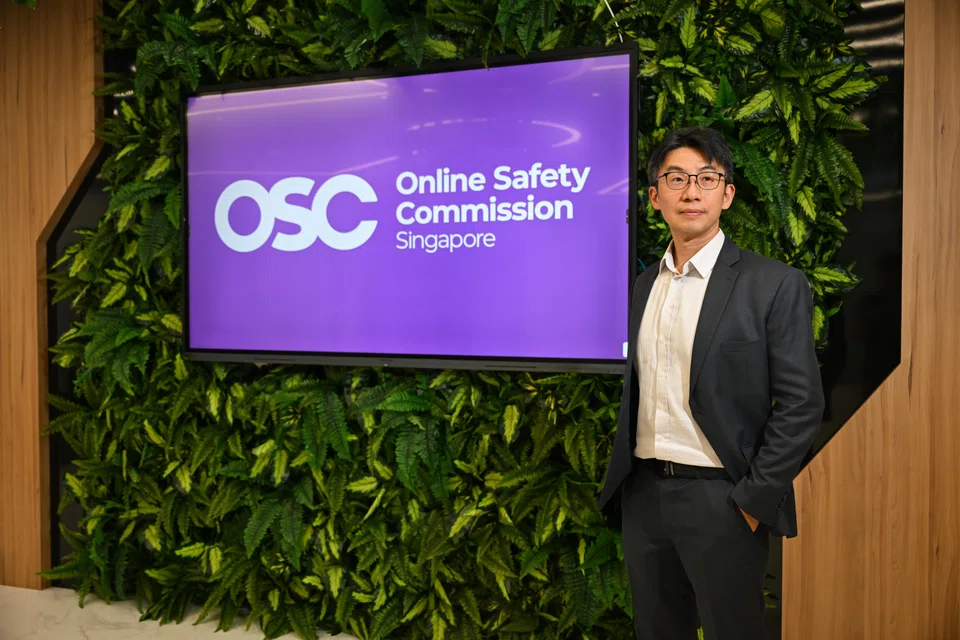
[SINGAPORE] A one-stop agency to help victims of online harms secure swift content takedowns and restrict offender accounts will open its doors on Jun 29, after it was mooted in 2024.
The Online Safety Commission (OSC) was set up to address victims’ frustrations with slow platform responses, which previously took four days or more, by granting it the legal authority to force platforms and group administrators to remove harmful content quickly.
The establishment of OSC follows the passage of the Online Safety (Relief and Accountability) Act or OSRAA in Parliament in November 2025.
The 40-strong organisation will start by tackling five of the most prevalent and serious online harms: intimate image abuse, image-based child abuse, doxxing, online harassment and online stalking. Eight other types of online harms will be dealt with at a later stage.
Minister for Digital Development and Information Josephine Teo said Singapore is one of a few countries in the world to have a law and an agency dedicated to helping victims of online harm.
“We hope OSRAA and OSC will help strengthen norms for positive and responsible online behaviour, so that all Singaporeans can participate safely and confidently in our digital society,” said Teo.
Minister for Law Edwin Tong said online harms have real-world consequences. “By giving victims better avenues to seek relief and accountability, we can build a safer online space for Singaporeans,” he added.
Minister of State for Digital Development and Information Rahayu Mahzam added that none of the work would have been possible without the contributions of survivors who bravely shared their experiences and community partners who worked alongside the government.
Singapore’s Commissioner of Online Safety, Francis Ng, said OSC’s work is guided by a belief that victims deserve not just relief, but also hope that the harm they have suffered can be stopped and their sense of dignity and safety restored.


“The OSC aspires to not only get harmful content removed swiftly, but to be a trusted commission worthy of public confidence – one that will meet victims where they are in their hurt and anxiety, and one that has their well-being as a foremost consideration,” said Ng.
How to report online harms
Victims can make reports directly on OSC’s website at www.osc.gov.sg.
Reports can also be made on a victim’s behalf. Parents and guardians must show proof of relationship, while other representatives need a signed authorisation form and the victim’s identification document.
Those facing intimate image abuse, image-based child abuse and doxxing can submit reports immediately, while victims of online harassment or stalking must first report the content to the platform and wait 24 hours before escalating the case to OSC.
In cases involving multiple types of online harm, victims need only submit a single report covering all the harms involved.
Victims will need to provide their identity information, a description of what happened and who was involved, including usernames or account details and supporting documents like screenshots.
A confirmation e-mail with a case reference number will be sent after a report is made.
OSC will assess the case and, if online harm has occurred, can issue directions to the perpetrator, the administrator of an online group or page, or the platform. These directions can be to remove the content or restrict the perpetrator’s account.
Selected platforms, including Facebook, HardwareZone Forums, Instagram, TikTok, X and YouTube, can also be directed to disable access to identical copies of the offending material.
While OSC is not required to act within a set timeframe, Ng said it will “do everything in its power to deal with (cases) as quickly as possible”.
However, directions issued by OSC will specify timelines that recipients must comply with.
Victims will be kept updated on the progress of their cases and any directions issued.
The police and selected social service agencies have also been briefed to refer victims to OSC when appropriate.
Those who need further guidance on making a report or require counselling can turn to Fei Yue Community Services, the Samaritans of Singapore, SG Her Empowerment, Singapore Children’s Society and TOUCH Community Services.
If victims or parties involved in a case are not satisfied with an OSC decision, they can ask the agency to reconsider it within 14 days. After the decision has been reconsidered, they can appeal to the Online Safety Appeal Panel within 14 days of the reconsidered decision for a fee of $200.
Commencing legal action
While OSC helps get harmful online content taken down, victims who have suffered losses as a result of it can separately seek compensation through the courts under the new legislation.
This may include financial losses such as lost income, as well as costs incurred for medical or psychological treatment.
Even if harmful content has been taken down, perpetrators and administrators who have created group chats or pages for the key purpose of committing online harms are liable for damages.
Victims can approach a lawyer to begin civil proceedings against them.
Platforms and administrators of group chats or pages not created for online harms are liable only if they fail to act after being notified by victims.
Victims must serve an online harms notice informing the administrator or platform of their intention to take legal action. The notice can be generated at https://onlinesafety.mlaw.gov.sg, which will be online only on Jun 29.
They need to provide information such as their personal details, the nature of the incident, where it took place and supporting evidence. Victims should also state what action they require the administrator or platform to take, such as removing content or restricting a perpetrator’s account.
The notice can be sent to the administrator’s e-mail address or social media account. Some tech platforms will have designated contact points listed on the Ministry of Law’s website.
The administrator or platform will have to respond reasonably within a reasonable time after a victim sends the notice. What is considered a reasonable time depends on factors such as the complexity of taking down content and the amount of harmful content involved.
Larger platforms with wider reach – Facebook, Google Maps reviews, HardwareZone Forums, Instagram, Reddit, Telegram, TikTok, Threads, WhatsApp, X and YouTube – must respond to online harm notices within six hours for intimate image abuse or child abuse material with private parts exposed.
The limit is 24 hours for other types of intimate image abuse or child abuse material, and 48 hours for all other harms.
The court will award at least S$5,000 for each image or recording involved in an intimate image abuse or child abuse material case. It can also award damages for loss of future earnings. Online platforms’ liability is capped at S$500,000 per case.
Victims can also take action against anonymous perpetrators by applying to OSC for help in identifying the person responsible. They can use the identity information only for limited purposes, such as commencing civil proceedings.
Applications must be made within 12 months of when the online harm began or when the victim first became aware of it.
Platforms respond
A spokesperson for Google, which operates platforms such as YouTube and Google Maps, said the company shares the government’s vision of tackling online harms.
“We continue to engage with them closely to demonstrate the robust measures we have in place to keep our online spaces safe,” said the spokesperson in response to ST’s queries, adding that this includes content policies and close collaboration with community groups.
Tech giant Meta will also continue to work constructively with the local government to operationalise the Online Safety (Relief and Accountability) Act, said a spokesperson for the company, adding that Meta is committed to online safety in Singapore.
Among the company’s recent work are new detection tools that can proactively identify potentially harmful interactions between adults and minors on Instagram Direct and Messenger, without a user report.
TikTok also said in response to ST’s queries that it does not allow content targeting individuals with the intent to bully, harass, humiliate, discriminate against them or promote hate speech.
It added that public figures attract greater attention and that some content may serve the public interest, which is why TikTok allows more critical commentary about public figures than private individuals.
However, harmful content such as doxxing, sexual harassment, violent threats, hate speech and sexual exploitation will still be removed, said TikTok.
HardwareZone Forums has a content policy in place to guide members and set boundaries for discussions, said HardwareZone.com’s editor-in-chief, Vijay Anand.
This includes a system under which members are given infraction points for activities such as cyberbullying, posting sexual content and doxxing, with bans imposed once they reach a certain threshold.
“As one of Singapore’s key online discussion platforms, HardwareZone Forums supports all efforts to ensure online discourse remains safe and constructive, enabling robust and healthy discussions on issues that matter to Singaporeans,” said Vijay.
“We will continue to uphold these standards (set out in the Act) and act in accordance with the Online Safety Commission’s directions and the circumstances.” THE STRAITS TIMES
Decoding Asia newsletter: your guide to navigating Asia in a new global order. Sign up here to get Decoding Asia newsletter. Delivered to your inbox. Free.
Share with us your feedback on BT's products and services
TRENDING NOW

EU and Asean at 50: time for bold action

Asean must retain more value as its digital economy races towards US$2 trillion: Indonesian minister

Palm oil stocks set to surge as Indonesia said to be scaling back export overhaul: analysts

Malaysian tycoon Vincent Tan’s sell-downs point to pruning rather than an exit plan

