

Singapore unveils green shipping, AI governance initiatives with China after PM Wong meets Premier Li Qiang
The initiatives follow Friday’s announcement of plans to upgrade the bilateral trade pact
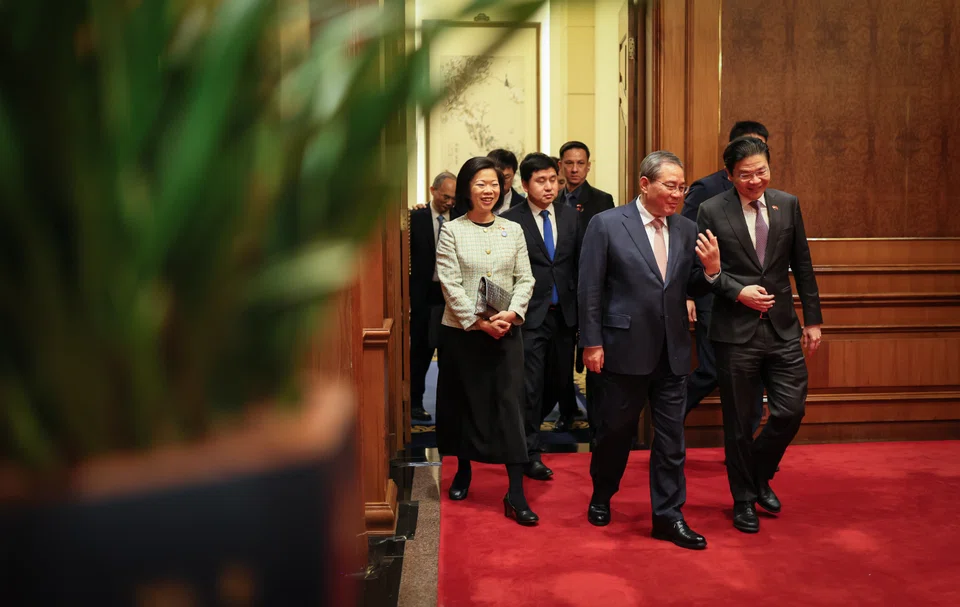
[BEIJING] Singapore announced a series of initiatives with China ranging from green shipping to artificial intelligence (AI) governance, as Prime Minister Lawrence Wong wrapped up his visit to the country on Saturday (Nov 21).
The initiatives follow an earlier announcement on Friday that the two countries would begin work on an upgrade to the China-Singapore Free Trade Agreement, known as CSFTA 4.0.
It also comes after PM Wong met Chinese Premier Li Qiang at the Diaoyutai State Guesthouse, a former imperial garden and modern diplomatic estate, in Beijing.
PM Wong held separate talks with Chinese President Xi Jinping and Beijing party secretary Yin Li, who is a member of the Communist Party of China’s Political Bureau, a day earlier.
This is PM Wong’s second time meeting Li in Beijing since his introductory visit last year at the Premier’s invitation.
Since then, PM Wong noted that Singapore and China has had a “good, constructive discussion” on how to take the cooperation between both countries forward.

“Both China and Singapore have continued to build on our All-Round High-Quality, Future-oriented Partnership,” he said.
PM Wong also referenced the upcoming 22nd Joint Council for Bilateral Cooperation with China, which will be held in the Republic on Sunday and Monday.
At the event’s conclusion, he said it is expected to yield more than 20 deliverables spanning areas like trade digitalisation and financial integration. It will also include research and innovation in the healthcare and education industries.
SEE ALSO
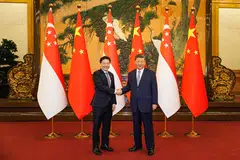
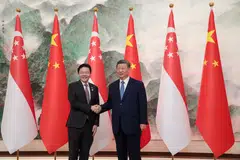
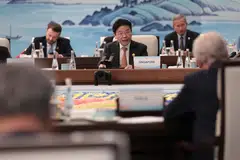
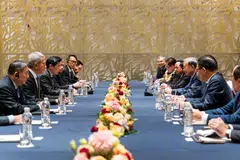
“That reflects the depth and breadth of our cooperation,” said PM Wong.
Premier Li said in Mandarin that by joining hands to foster open development, both China and Singapore can “contribute greater positive energy toward stability and prosperity, both within this region and globally”.
“As a long-standing, friendly neighbour, China is prepared to strengthen strategic communication with Singapore,” said Li.
This includes expanding the partnership toward both countries to produce more tangible outcomes, “all while continuing to enhance the friendship between our two peoples”.
The media were allowed to be in attendance only for the first few minutes of the leaders’ meeting.
According to a read out of the meeting from Singapore’s Ministry of Foreign Affairs, the leaders discussed the opportunities and challenges brought by AI, including the need for international coordination on AI safety and governance.
They also discussed the potential of cooperating on the practical use of AI in areas like healthcare and manufacturing, that can increase productivity and bring benefits to both countries.
PM Wong also introduced Second Minister for Foreign Affairs and Home Affairs Sim Ann; Minister of State for Manpower and Energy, Trade and Industry Foo Cexiang; and Member of Parliament Hamid Razak.
The meeting with Li capped a series of talks for PM Wong with Chinese leaders after he arrived in Shenzhen on Wednesday to attend the Asia-Pacific Economic Cooperation (Apec) Economic Leaders’ Meeting.
On Friday, PM Wong met Chinese President Xi Jinping and spoke of deepening ties between Singapore and China and saw the launch of the China-Singapore Free Trade Agreement 4.0 upgrade. He also met Beijing party secretary Yin Li, a member of the Communist Party of China’s Political Bureau.
In a social media post after meeting Yin, PM Wong described Beijing as a major research and innovation hub and said “there is much that Singapore and Beijing can do together”.
He said they discussed plans to deepen integration across the Beijing-Tianjin-Hebei region. These developments, he added, offer “exciting opportunities” for cooperation in areas ranging from technology and innovation to sustainable development and education.
New areas of cooperation
In a statement on Saturday, Singapore’s Ministry of Foreign Affairs said [insert how MFA links the initiatives to PM Wong’s visit].
Singapore’s Ministry of Transport (MOT) said the two countries signed a memorandum of understanding (MOU) to facilitate the movement of goods and people, improve transport safety and support the rollout of green and digital shipping corridors between Singapore and China.
The agreement also covers intelligent transport systems and AI.
A committee co-chaired by the transport ministers of the two countries will oversee its implementation and meet every two years, alternating between Singapore and China.
MOT said the MOU builds on the Singapore–PRC All-Round High-Quality Future-Oriented Partnership established in 2023.
Separately, Singapore’s Ministry of Sustainability and the Environment (MSE) said it also signed an MOU related to cooperating on green industry development with China’s National Development and Reform Commission ahead of PM Wong’s visit.
The agreement sets up a framework for policy exchanges, research and industry partnerships in areas including energy efficiency, green upgrading of infrastructure development, and biodiversity conservation, among others.
MSE said it will lead implementation and involve relevant ministries and agencies across the Singapore Government.
The Republic’s Infocomm Media Development Authority (IMDA) and the China Academy of Information and Communications Technology have also mapped Singapore’s AI Verify Testing Framework, which helps organisations validate the technology’s performance, against a Chinese industry standard for managing AI system risks.
IMDA said the comparison shows how safeguards and checks under one framework correspond to those under the other. This could help businesses using both frameworks avoid duplicating some checks.
The two countries are also due to sign an MOU on educational technology and the use of AI in schools on the sidelines of the Joint Council for Bilateral Cooperation later this month, Singapore’s Ministry of Education (MOE) said.
The National University of Singapore’s AI Centre for Educational Technologies and East China Normal University’s Shanghai Institute of AI for Education will lead the collaboration.
MOE said it will cover testing tools, sharing AI-enabled teaching practices and developing ways to assess vocational and human skills, along with short exchanges and joint workshops.
The teams behind the Singapore Student Learning Space and the Smart Education of China platform will share how they develop and run their platforms and explore sharing AI literacy resources.
The two countries will also use existing exchanges to strengthen educators’ AI and digital skills, and build on partnerships between their primary and secondary schools, said MOE.
Decoding Asia newsletter: your guide to navigating Asia in a new global order. Sign up here to get Decoding Asia newsletter. Delivered to your inbox. Free.
Copyright SPH Media. All rights reserved.
TRENDING NOW
What shattered Crystal Jade? How the culinary empire shrank from 120 to just 9 outlets
Could Jensen Huang work for Elon Musk? It would be ‘a titanic ego death match’, says biographer
As Indonesia picks new vice-president to succeed Gibran, investors see risks and opportunities

Bitcoin falls to more than two-year low as global markets sink

